
Agentic AI in Data Migration: 10 Enterprise Use Cases, Real Examples, and How to Deploy It Safely


Agentic AI in data migration is the use of autonomous, governed AI agents to perform discovery, schema mapping, code translation, data extraction, validation, and reconciliation across the migration lifecycle — while humans approve cutover decisions and resolve exceptions.
Instead of engineers spending months reading undocumented legacy code and manually reconciling records, AI agents do the investigative and repetitive work inside defined authority boundaries, with every action logged, checked against business rules, and routed for human approval where it matters.
That combination — agent speed plus enterprise governance — is why agentic AI is rapidly becoming the default approach for enterprise data migration. In this guide, we break down 10 practical use cases with real (anonymised) enterprise examples, explain the architecture that makes agentic migration safe, and show how to adopt it without betting your cutover on an ungoverned black box.
What Is Agentic AI in Data Migration?
Agentic AI refers to AI systems that can interpret an objective, plan a sequence of steps, select tools, gather evidence, and adapt as conditions change — rather than executing a fixed script.
Applied to data migration, that means agents can read a legacy schema, infer what an undocumented stored procedure actually does, propose a field mapping with a confidence score, translate SQL between dialects, extract structured data from messy documents, and reconcile source and target datasets after the move.
The critical word is governed. An agent that can write to your ERP is not a productivity tool; it is an operational risk unless its authority is bounded. Production-grade agentic migration keeps agents inside explicit envelopes: what data they may read, what actions they may take, what value thresholds require approval, and what evidence must exist before anything is committed.
Agentic AI vs Traditional Migration Automation
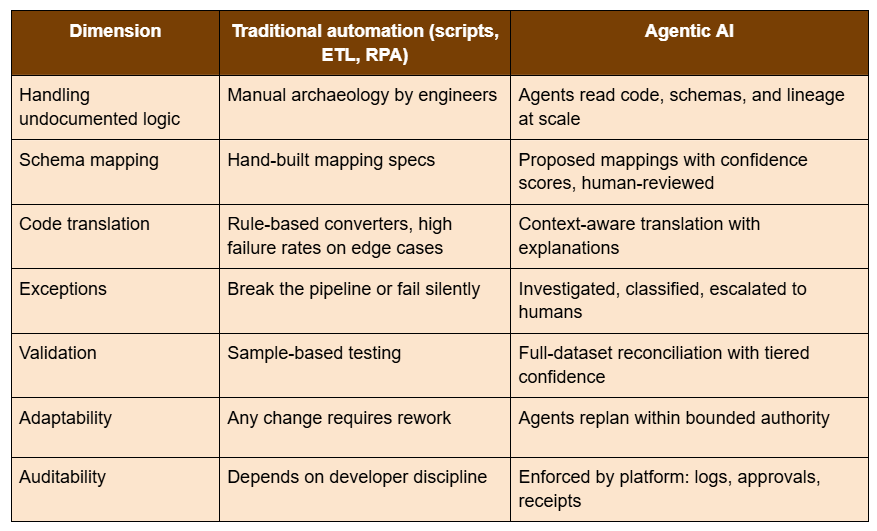
Traditional migration tooling — hand-written scripts, ETL platforms, rule-based converters, RPA — is deterministic and transparent, but brittle. It handles exactly what you specified and fails (sometimes silently) on everything you didn't. Agentic AI inverts the trade-off: it handles ambiguity and variation well, but its reasoning must be checked. The two are complements, not substitutes.
Where Agents Fit in the Migration Lifecycle
A realistic division of labour across the lifecycle looks like this:
- Discovery and assessment — agents excel. Reading legacy codebases, mapping dependencies, documenting business logic.
- Schema mapping and design — agents propose, humans approve. Confidence-scored mappings with review queues.
- Code and pipeline translation — agents translate, humans spot-check and own the output.
- Extraction and transformation — agents execute inside deterministic workflow control.
- Validation and reconciliation — agents compare full datasets and classify discrepancies.
- Cutover — humans decide. Always.
- Post-migration operations — agents monitor, detect drift, and keep systems in sync during coexistence.
The teams getting real production wins are not pursuing "fully autonomous migration." They are shifting humans from doers to reviewers in the phases where agents perform well, while keeping human authority over irreversible decisions.
Why Traditional Data Migration Fails
Most enterprise migrations run late and over budget for the same handful of reasons:
- Undocumented legacy logic. The business rules live in ten-year-old stored procedures, spreadsheet macros, and the heads of people who left. Understanding what the old system does consumes months before any data moves.
- Brittle pipelines. Hand-built ETL collapses on the first schema surprise, and every fix introduces new regression risk.
- Manual reconciliation. Validation by sampling means errors surface in production, after cutover, when they are most expensive.
- The parallel-platform trap. Because proving parity takes so long, old and new systems run side by side for months or years — doubling infrastructure cost, split-brain data, and team fatigue.
- Compliance exposure. Regulated data moving between environments without complete lineage and audit evidence is a finding waiting to happen.
Every one of these is fundamentally a knowledge work bottleneck — reading, interpreting, mapping, checking, chasing. That is precisely the class of work agentic AI is built to absorb.
10 Agentic AI Use Cases in Data Migration (With Enterprise Examples)
1. Legacy System Discovery and Dependency Mapping
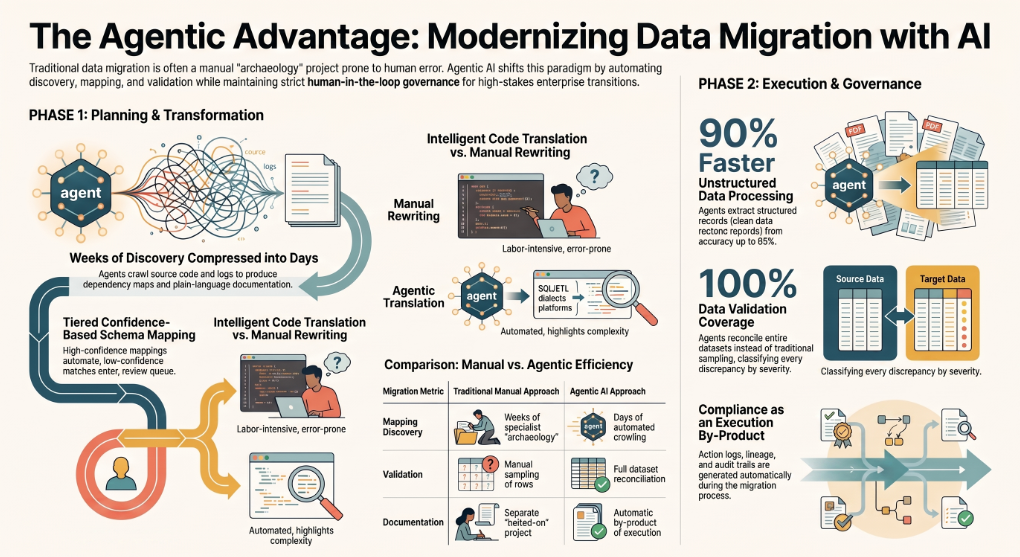
Before anything can move, someone has to understand what exists: which tables feed which reports, which jobs depend on which upstream systems, which fields are actually used. Agents can crawl source code, schemas, job schedulers, and query logs to produce a dependency map and plain-language documentation of business logic — compressing weeks of specialist archaeology into days, with humans reviewing the output rather than producing it from scratch.
2. Schema Mapping and Reconciliation
Field-to-field mapping between source and target is where migrations quietly go wrong. Agentic systems propose mappings using column names, data profiles, sample values, and documentation — and, critically, attach a confidence score to each mapping. High-confidence mappings proceed; medium-confidence mappings go to spot-check; low-confidence mappings enter a mandatory human review queue and are never loaded automatically. That tiered structure is what separates governed agentic migration from hopeful automation.
3. ETL and SQL Code Translation
Moving between data platforms means translating dialects, rewriting pipelines, and preserving performance optimisations. Agents translate ETL and SQL workloads with awareness of the target platform's syntax and behaviour, annotate anything they could not translate confidently, and generate tests alongside the translated code. Engineers shift from writing every line to reviewing flagged sections — typically the highest-leverage change in the entire programme.
4. Document-to-System Data Migration
Not all migration is database-to-database. A large share of enterprise data lives in documents — tenders, contracts, invoices, quality certificates — that must land as structured records in operational systems.
Real example: an Australian remedial-construction and waterproofing specialist deployed a multi-agent document workbench that ingests complex, frequently revised tender documents, extracts structured data using vision-capable models, detects revisions between versions, and synchronises the results directly into its core field-service platform with full audit logs and record locking. The system was engineered for up to ~90% faster tender document processing, with a ~95% extraction accuracy target on standard formats — and every write into the core system is logged and reviewable.
This pattern — agents converting unstructured evidence into governed system-of-record entries — is one of the most immediately valuable and most underestimated migration use cases.
5. Legacy Application Replacement and Transactional Migration
Sometimes the migration driver is an end-of-life system: licensing costs are climbing, support is ending, and the workflows it carries must move somewhere. Agentic AI can absorb the workflow itself rather than just the data.
Real example: a Middle East consumer-appliances distributor needed to move off an end-of-life enterprise document workflow product that sat between order intake and its ERP. Rather than re-implementing the legacy middleware, agentic automation now interprets incoming order triggers, validates them against business rules, creates sales orders directly in SAP, routes exceptions through governed approvals, and produces reconciliation reports — replacing the legacy dependency while improving auditability of every order created.
This is migration in its truest sense: not just moving records, but retiring a system safely because agents plus rules now perform its job under tighter control.
6. Master Data Cleansing and Deduplication
Migration is the one moment an enterprise is forced to look at all its data at once — which makes it the best moment to fix it. Agents profile source data, detect duplicates and conflicting golden records, standardise formats, flag anomalies, and propose survivorship decisions for human approval. Cleansing in-flight avoids the classic failure of faithfully migrating ten years of bad data into a brand-new platform.
7. Automated Validation and Post-Cutover Reconciliation
Traditional validation samples a few thousand rows and hopes. Agentic validation reconciles entire datasets — row counts, checksums, business-level totals, referential integrity, report-output parity — and classifies every discrepancy by likely cause and severity. Humans review a prioritised exception list instead of playing spot-the-difference across dashboards for six months. This is where migration risk genuinely shifts from "can we cut over?" to "the evidence says we can."
8. Cross-Entity Data and Analytics Consolidation
After acquisitions or years of multi-system sprawl, the "migration" many enterprises actually need is consolidation: one consistent set of definitions, KPIs, and reporting across entities that each measure things differently.
Real example: a global logistics and supply-chain enterprise operating across multiple regions consolidated analytics across its multi-entity operations — standardising KPI definitions, unifying reporting, and adding governed data-quality checks — producing a single operational view for leadership and materially faster issue identification across the group.
Agents accelerate this by mapping semantic differences between entities ("revenue" rarely means the same thing twice), proposing a canonical model, and continuously checking conformance as data flows in.
9. Compliance, Lineage, and Audit-Trail Preservation
In banking, healthcare, insurance, and the public sector, the migration itself is a regulated event. Every record movement needs lineage; every transformation needs justification; every access needs authorisation. A governed agentic platform generates this evidence as a by-product of execution — action logs, approval records, policy evaluations, and receipts — rather than as a documentation project bolted on afterwards. Agents also pre-screen data for sensitive fields so masking and residency policies are enforced before movement, not discovered after.
10. Phased Coexistence and Continuous Synchronisation
Big-bang cutovers are rare; staged migrations are the norm, which means old and new systems must stay consistent for months. Agents monitor both sides during coexistence, detect divergence, investigate causes, apply bounded corrections, and escalate anything outside their authority. This directly attacks the parallel-platform trap: instead of parity being proven slowly and manually, it is continuously evidenced — which shortens the parallel-run window and its cost.
The Architecture: How a Governed Agentic Migration Actually Works
The design principle that makes agentic migration production-safe is simple to state:
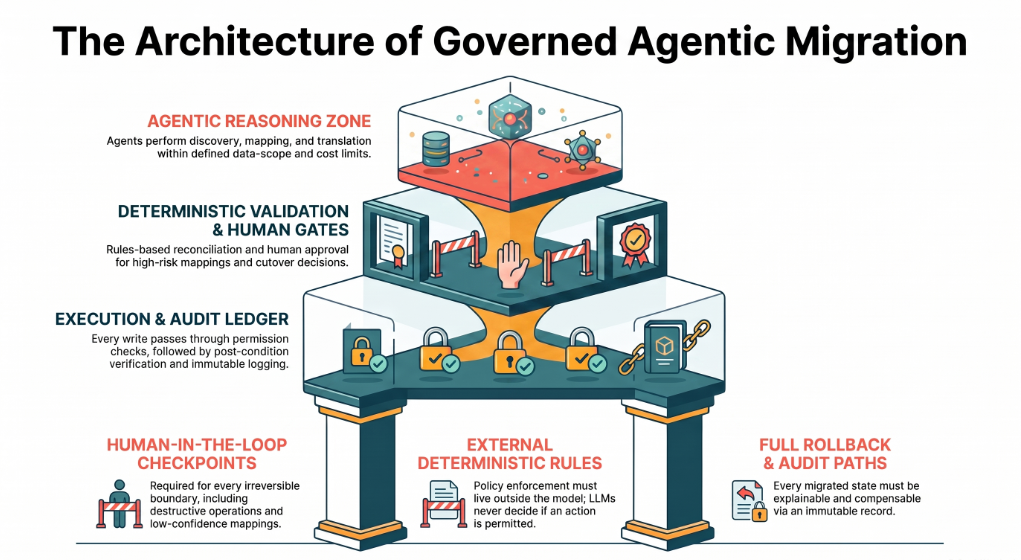
Deterministic macro, agentic micro.
A durable workflow engine owns the macro structure of the migration — stages, state, deadlines, approvals, retries, rollback, and compensation. AI agents operate only inside bounded micro zones within that structure, where interpretation and reasoning add value: reading a schema, proposing a mapping, investigating a mismatch. Agents cannot widen their own authority, skip a required approval, or change the surrounding process.
A governed migration flow looks like this:
Intake (systems, schemas, documents) → Agentic zone (discovery, mapping, translation — inside data-scope, cost, and action limits) → Deterministic validation (rules, reconciliation checks) → Human approval gates (mappings above risk thresholds, all cutover decisions) → Governed execution (every write passes through permission checks, business rules, and idempotency controls) → Verification (post-condition checks confirm the target state) → Audit ledger (immutable record of who or what did what, under whose authority, with what evidence).
Three controls matter most:
- Human-in-the-loop checkpoints at every irreversible boundary — destructive operations, cutover, low-confidence mappings, regulated approvals.
- Deterministic business rules enforcing policy outside the model — an LLM should never be the mechanism that decides whether an action is permitted.
- Complete audit trails and rollback paths, so any migrated state can be explained and, where necessary, compensated.
Get this architecture right and agent capability becomes an accelerant instead of a liability.
Why assistents.ai for Agentic Data Migration
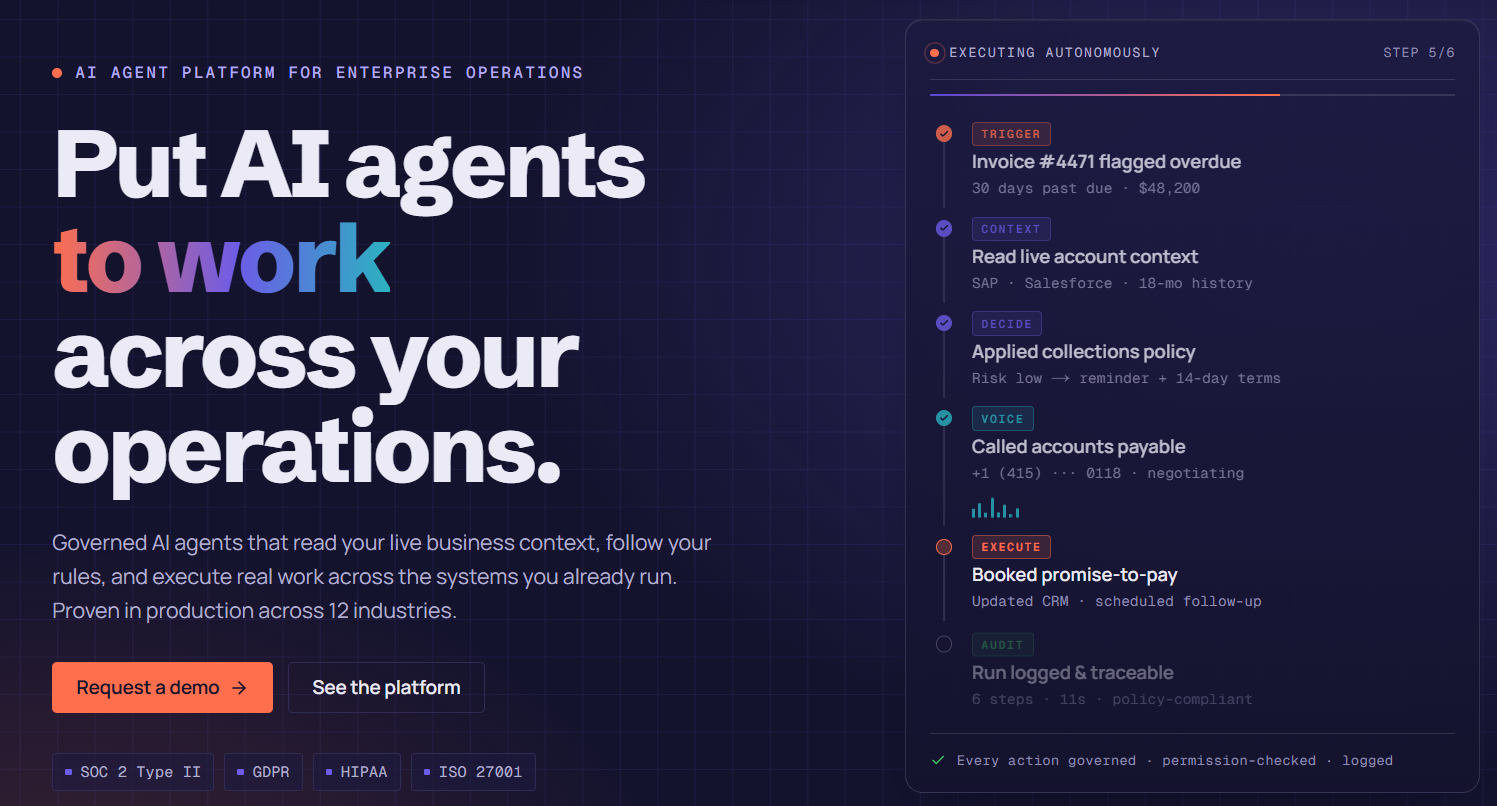
assistents.ai, built by Ampcome, is a governed enterprise agentic AI platform — a context, governance, decisioning, and action layer that sits above your existing ERP, CRM, data, and document systems. It was designed for exactly the class of problem data migration represents: high-stakes, multi-system work that needs agent intelligence and enterprise control at the same time.
Governed Agent Execution by Design
Every agent on assistents.ai operates under enterprise-grade agent governance: role-based permissions, deterministic business rules, human-in-the-loop approval gates, and complete audit trails on every action. For migration, that means an agent can propose a schema mapping or prepare a transactional write, but the platform — not the model — decides what requires approval, what is blocked, and what gets logged. Autonomy is a bounded contract, not a toggle.
Agent-Driven Data Analysis and Validation
Migration lives or dies on reconciliation. The platform's AI data analysis capability gives agents and humans governed, permission-aware access to source and target data — so validation queries, variance investigations, and post-cutover reconciliation run against certified definitions with full provenance, and business users can interrogate migration status in natural language instead of queueing behind a BI team.
Works Above Your Existing Stack
assistents.ai connects to ERP, CRM, data warehouses, document repositories, and communication channels through a broad integration layer plus generic REST connectivity. Your systems of record stay authoritative; the platform orchestrates the work across them. There is no rip-and-replace prerequisite to start — which is precisely what a migration programme needs.
Deployment Control for Regulated Migrations
For migrations involving sensitive or regulated data, assistents.ai supports private cloud, customer VPC, and on-premises deployment with model flexibility — so data residency and security requirements are met by architecture, not by exception.
The combination — document intelligence, multi-agent orchestration, deterministic rules, workflow control, human approvals, auditability, and deployment choice — is why enterprises use assistents.ai to run migration as governed work, not as a science experiment.
How to Adopt Agentic AI for Data Migration: A 5-Step Framework
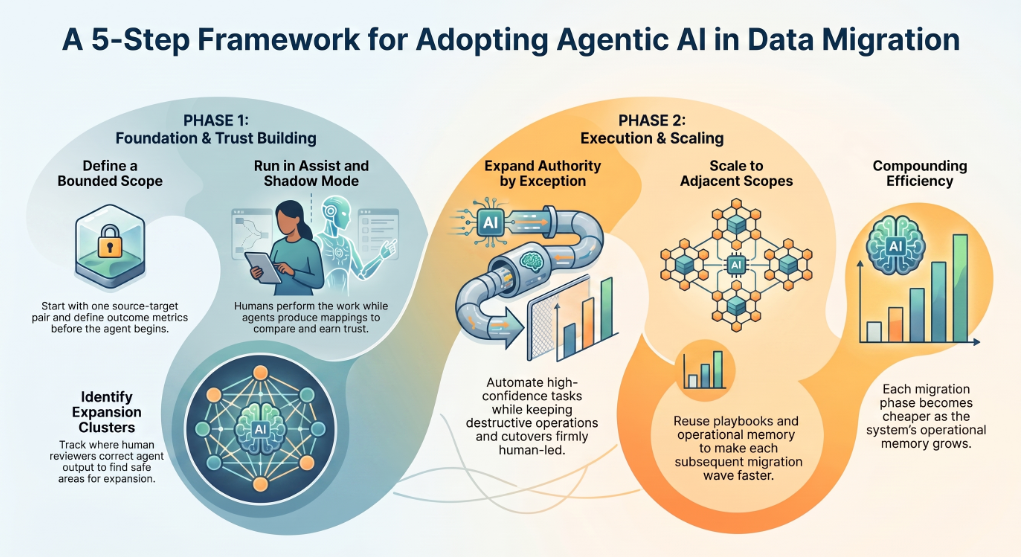
- Land on one bounded scope. One source–target pair, one document type, or one entity's data. Define the outcome metric before the agent touches anything (hours saved in discovery, mapping accuracy, reconciliation coverage).
- Run agents in assist and shadow mode first. Agents produce mappings, translations, and validation reports; humans still perform the work. Compare outputs. Trust is earned on evidence, not demos.
- Measure quality, rework, and exceptions. Track how often human reviewers correct agent output and where exceptions cluster. This tells you exactly where authority can safely expand.
- Expand authority by exception, not by switch. Move high-confidence, low-risk task types to agent execution with human review of exceptions only. Keep value thresholds, destructive operations, and cutover firmly human.
- Scale to adjacent scopes. Reuse the mappings, rules, playbooks, and evidence from the first scope on the next entity, system, or phase. Each migration wave should be cheaper and faster than the last because the operational memory compounds.
Risks and Limitations: What Agents Should Not Own
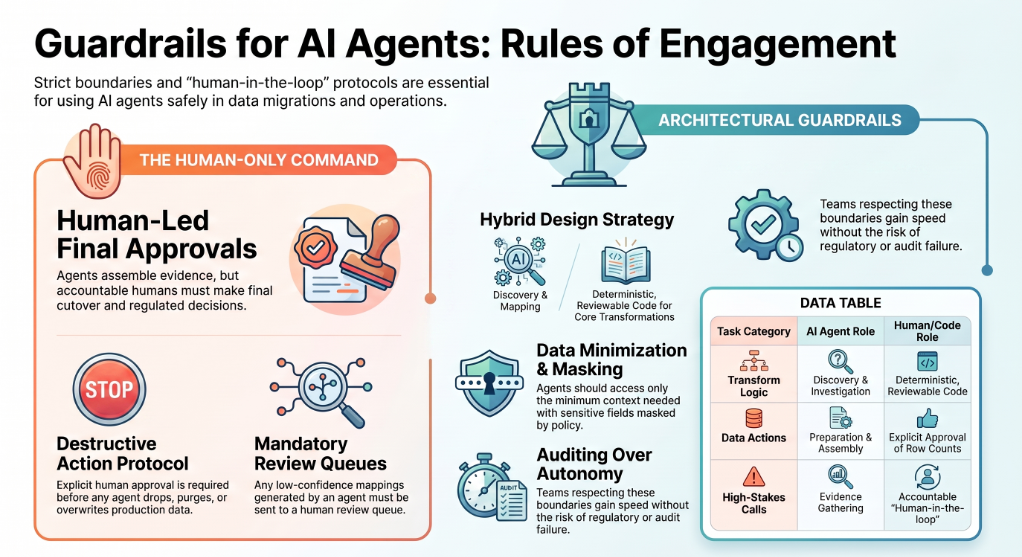
Honest boundaries are part of doing this well:
- Cutover decisions stay human. Always. An agent can assemble the evidence; a named accountable person makes the call.
- Destructive operations require explicit approval. No agent should drop, purge, or overwrite production data without a human confirming the plan and the row counts.
- Low-confidence mappings never auto-load. They go to a review queue, full stop.
- Regulated approvals remain with authorised humans. Agents prepare; accountable roles decide.
- Agent reasoning must be checked, not trusted. Hybrid designs win: agents for discovery, mapping, and exception investigation; explicit, reviewable, deterministic code for core transformation logic.
- Data minimisation applies to agents too. Agents should receive the minimum context needed for the task — not broad warehouse access — with sensitive fields masked by policy.
Teams that respect these boundaries get the speed without inheriting a new class of risk. Teams that don't usually meet the auditors before they meet their deadlines.
Ready to run your next migration as governed agentic work? Explore agent governance and AI data analysis on assistents.ai, or talk to the Ampcome team about a bounded first scope.
FAQs
What is agentic AI in data migration?
Agentic AI in data migration is the use of autonomous AI agents to perform discovery, schema mapping, code translation, extraction, validation, and reconciliation across the migration lifecycle, operating under governance controls — permissions, business rules, approvals, and audit trails — while humans approve cutover decisions and resolve exceptions.
How is agentic AI different from traditional ETL automation?
Traditional ETL executes predefined logic and breaks on anything unanticipated. Agentic AI interprets objectives, handles ambiguity, investigates exceptions, and adapts its plan — but its outputs are probabilistic, so production use requires deterministic guardrails, confidence scoring, and human review at defined checkpoints.
Can AI agents fully automate data migration?
No — and they shouldn't. The proven pattern is agent-assisted migration: agents own discovery, mapping, translation, and validation, while humans own cutover decisions, destructive operations, and regulated approvals. Mature programmes expand agent authority gradually as evidence accumulates.
What are the risks of using AI agents for data migration?
The main risks are incorrect mappings loaded without review, ungoverned writes to production systems, sensitive data exposure to models, and audit gaps. All four are addressed architecturally: confidence-tiered review queues, an approval-gated action path, data minimisation and masking, and platform-enforced audit logging.
How do you validate data migrated by AI agents?
Through full-dataset reconciliation rather than sampling: row counts, checksums, business-total parity, referential integrity, and report-output comparison — with agents classifying discrepancies by severity and humans reviewing a prioritised exception list before sign-off.
Is agentic AI safe for regulated data such as healthcare or financial records?
It can be, if the platform enforces permission-aware data access, field masking, complete lineage, human approval gates, and supports private cloud or on-premises deployment so data never leaves controlled environments. The governance layer — not the model — is what makes it safe.
How much faster is AI-driven data migration?
Published results vary by phase and scope. Industry reporting through 2025–2026 clusters around 30–60% cost reduction and 2–4x acceleration in discovery and translation phases, with smaller gains at cutover. Individual implementations (such as the document-migration example above) have been engineered for up to ~90% faster processing on specific workflows — treat all such figures as scope-specific targets, not universal guarantees.
What should I look for in an agentic AI platform for data migration?
Five things: governed action execution (approvals, rules, audit on every write), human-in-the-loop controls at irreversible boundaries, broad connectivity to your existing systems, permission-aware data analysis for validation, and deployment flexibility (VPC/on-premises) for regulated data.

Transform Your Business With Agentic Automation
Agentic automation is the rising star posied to overtake RPA and bring about a new wave of intelligent automation. Explore the core concepts of agentic automation, how it works, real-life examples and strategies for a successful implementation in this ebook.
Sarfraz Nawaz is the CEO and founder of Ampcome, which is at the forefront of Artificial Intelligence (AI) Development. Nawaz's passion for technology is matched by his commitment to creating solutions that drive real-world results. Under his leadership, Ampcome's team of talented engineers and developers craft innovative IT solutions that empower businesses to thrive in the ever-evolving technological landscape.Ampcome's success is a testament to Nawaz's dedication to excellence and his unwavering belief in the transformative power of technology.

More insights
Discover the latest trends, best practices, and expert opinions that can reshape your perspective


.jpg)


Contact us

