
Agentic AI for Chip Design: How AI Agents Are Rewiring the Semiconductor Workflow in 2026


Agentic AI for chip design means AI agents that plan and carry out multi-step engineering work: writing RTL, running verification, triaging failures and escalating to engineers when they need a decision. In 2026 every major EDA vendor ships or previews these agents. Most coverage stops at the design tools. This guide also covers the work around the design flow, where many semiconductor companies lose the most time, and shows where Assistents.ai, the agentic AI platform by Ampcome, fits in.
Key takeaways
- What it is: AI agents that pursue a goal across many steps. They call EDA tools, check results against deterministic engines and hand off to engineers at defined checkpoints.
- Where it already works: front-end design, verification and debug. Vendors report up to 40x faster RTL validation and 25–40% shorter debug cycles in early evaluations.
- What's still early: back-end implementation, signoff and independent benchmarks. Most agentic EDA products are in early access, and most numbers are vendor-reported.
- The overlooked opportunity: specs, program reporting, compute operations, fab data, supply chain and order-to-cash. These run on documents and business systems, not EDA tools.
- How to start: pick one high-friction process, connect its systems, validate on real cases with human review, measure, then expand. A focused pilot can show results within 90 days.
Agentic AI for chip design agent loop: goal, plan, act with tools, verify, human checkpoint, learn
What is agentic AI for chip design?
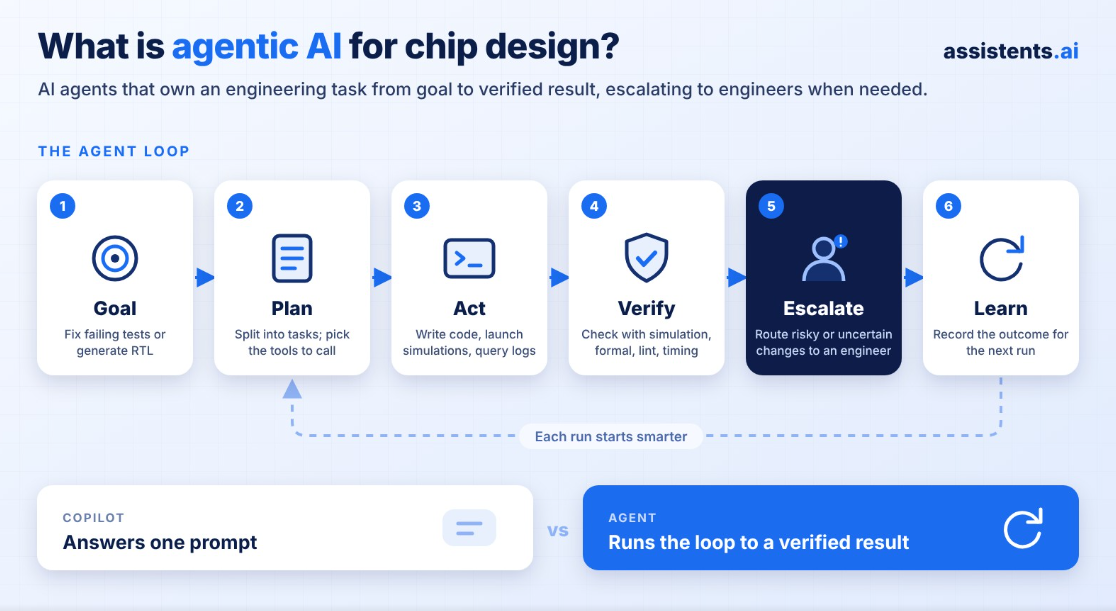
Agentic AI for chip design is the use of AI agents that own an engineering task from goal to verified result. An agent breaks the goal into steps, calls tools such as simulators and formal engines, checks the output, fixes what failed and escalates to a human when policy or uncertainty requires it. A copilot answers one prompt; an agent runs the loop.
A typical agent loop looks like this:
- Goal: "Close the failing tests in tonight's regression" or "Generate RTL and a testbench from this spec."
- Plan: Split the goal into tasks and decide which tools to call.
- Act: Run the tools: write code, launch simulations, query logs.
- Verify: Check results with deterministic engines (simulation, formal, lint, timing), not just the model's own judgment.
- Escalate: Route uncertain or high-risk changes to an engineer for review.
- Learn: Record the outcome so the next run starts smarter.
If you're new to the concept, start with our primer on what agentic AI is and how it transforms workflows.
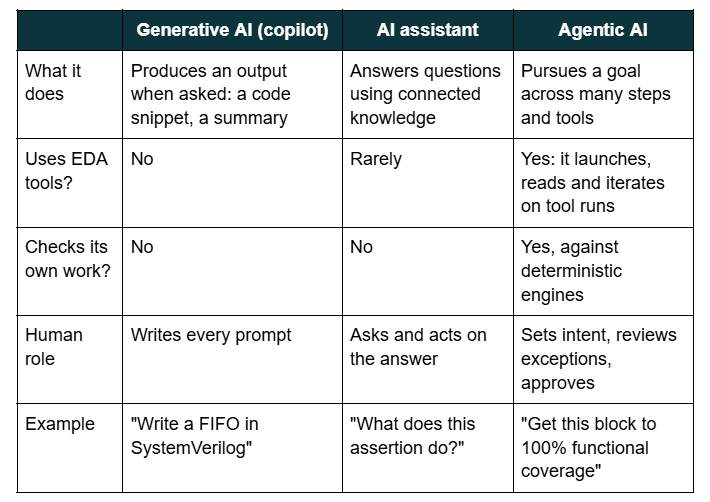
Generative AI vs agentic AI in EDA
Why chip design needs agents now
Chip design has outgrown manual iteration. A single verification regression can involve millions of simulations and thousands of failures to triage, as AMD Corporate Fellow Alex Starr notes. Schedules keep shrinking, and experienced engineers are scarce.
AI is already mainstream in the flow. According to EE Times, citing Technalysis Research, over 50% of advanced silicon designs at 28 nm and below are now realized with AI assistance. The shift in 2026 is from AI that suggests to agents that act. They coordinate tools, run loops overnight and bring engineers only the decisions that need them.
Three pressures make this urgent:
- Volume: More IP blocks, more corners and more tests than teams can triage by hand.
- Speed: Time-to-tapeout decides market windows, especially for AI accelerators.
- Silos: Design, verification, implementation, operations and business teams work in separate tools, and handoffs between them cause delays.
The 5 levels of autonomous chip design
The industry borrows its maturity model from self-driving cars. The five-level framework described in EE Times is a useful way to plan adoption:
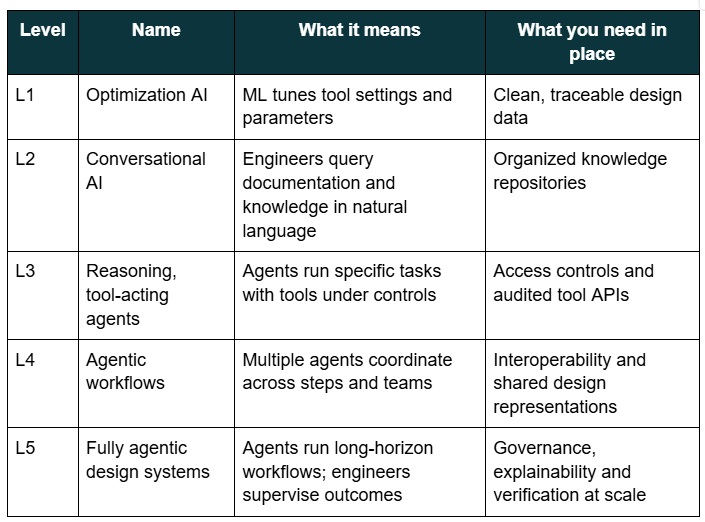
One caution: each vendor defines its own ladder. As Tom's Hardware points out, one vendor's "Level 5" is not directly comparable to another's. Compare what the agent actually does, on which tasks, with what evidence.
Agentic AI use cases across the semiconductor business
Agentic AI in the semiconductor industry spans two layers. The design layer is where EDA-native agents work. The business layer is where specs, data, approvals and enterprise systems decide whether a chip ships on time. Most guides cover only the first. Here are both.
1. Spec-to-RTL and design generation
Problem: Turning a specification into RTL takes months of expert effort. What agents do: Read the spec, generate RTL and testbenches, run lint and simulation, and iterate until checks pass. Evidence: Synopsys reports its spec-to-RTL agents deliver 2x to 5x speedups against a four-to-six-month team effort (Tom's Hardware). IEEE Spectrum reported that Verkor's Design Conductor produced a RISC-V core from a 219-word spec in 12 hours. It reached 1.48 GHz and a CoreMark score of 3,261, though it was verified only in simulation. Metric to track: Time from frozen spec to lint-clean, simulation-passing RTL.
2. Verification, regression triage and debug
Problem: Verification consumes most of the design effort, and failures pile up faster than engineers can sort them. What agents do: Cluster failures by root cause, prioritize them, propose fixes, generate assertions and UVM environments, and rerun. Evidence: Cadence says its ChipStack AI Super Agent delivers over 40x faster RTL validation, cutting a typical five-week verification loop to less than a day in leading-edge deployments (Cadence press release). Synopsys reports 25–40% shorter debug cycles in early evaluations (Synopsys). Metric to track: Failures triaged per day, time to root cause, coverage closure date.
3. Implementation, timing and PPA closure
Problem: Tuning synthesis and place-and-route for power, performance and area takes many long tool runs. What agents do: Explore settings, launch runs, compare quality of results and recommend the next experiment. Honest view: Gains here are harder to prove. Back-end runs take days, and trade-offs are complex, so most published results so far are front-end. Metric to track: Iterations to timing closure, compute hours per closed block.
4. Specs, datasheets and design documents
Problem: Requirements live in PDFs, spreadsheets and email threads. Every customer revision or engineering change order (ECO) has to be compared, extracted and re-entered by hand. What agents do: Document AI reads layouts and tables, extracts parameters, compares versions, highlights changes and routes exceptions for human review before updating systems of record. Metric to track: Hours per document review, extraction accuracy, missed-change incidents.
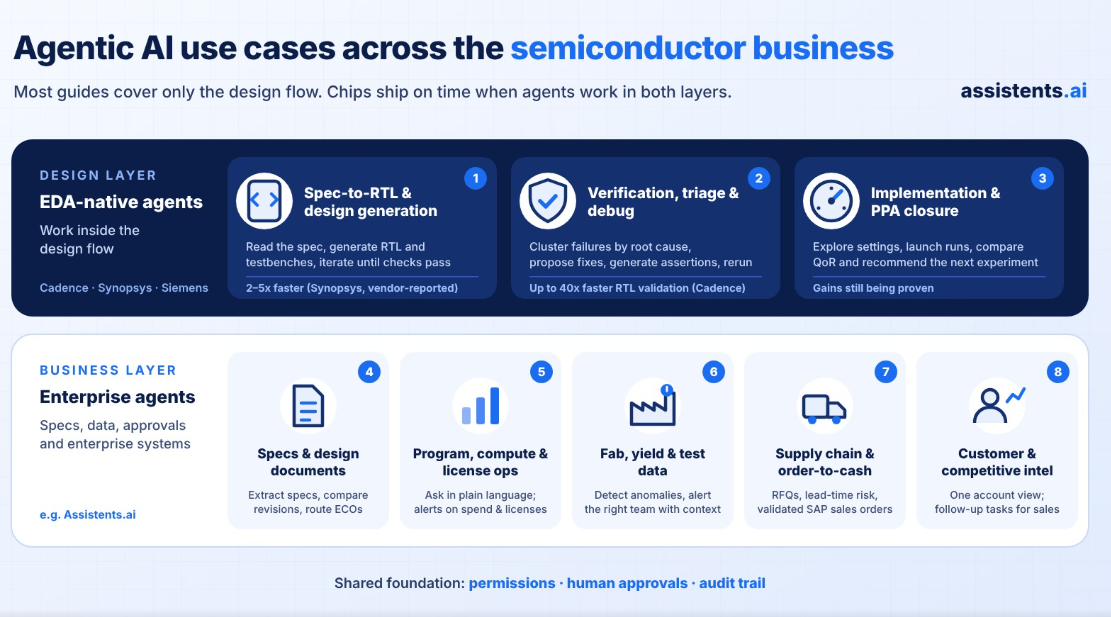
5. Program, compute and license operations
Problem: Program managers chase status across trackers, regression dashboards and compute queues, then rebuild the same reports every week. What agents do: Agentic BI answers questions in natural language ("Which blocks are behind on coverage this week?"). It sends scheduled insight packs and fires alerts when thresholds are crossed, such as compute spend, license saturation or regression pass rates. Metric to track: Time spent on status reporting, time from issue to alert.
6. Fab, yield and test data analysis
Problem: Equipment sensors, test results and yield data arrive faster than engineers can watch them. What agents do: Monitor data streams continuously, detect anomalies, forecast issues and route alerts with context to the right team. This is the core of agentic AI for semiconductor manufacturing. Metric to track: Time to detect an excursion, false-alarm rate, unplanned downtime.
7. Supply chain, procurement and order-to-cash
Problem: Component sourcing, supplier follow-ups and customer purchase orders run through inboxes and manual ERP entry. What agents do: Automate RFQs and supplier matching, track lead-time risk, read incoming purchase orders, validate them against customer and product data, and create sales orders in SAP or your ERP, with exceptions sent for approval. Metric to track: Order-to-confirm cycle time, data-entry errors, supplier response time.
8. Customer, sales and competitive intelligence
Problem: Design-win signals and competitor moves are spread across CRM, ERP, web and email. What agents do: Combine signals into one account view, flag rising buying activity and create follow-up tasks for sales. Metric to track: Response time on opportunities, account coverage per rep.
For agentic AI examples outside semiconductors, see our top 20 agentic AI use cases with real-life examples.
Agentic AI chip design tools in 2026: the landscape
The market splits into three groups: EDA-native agents, AI-first startups and enterprise agent platforms. Most EDA-native products are still in early access or evaluation, so ask every vendor for production references.
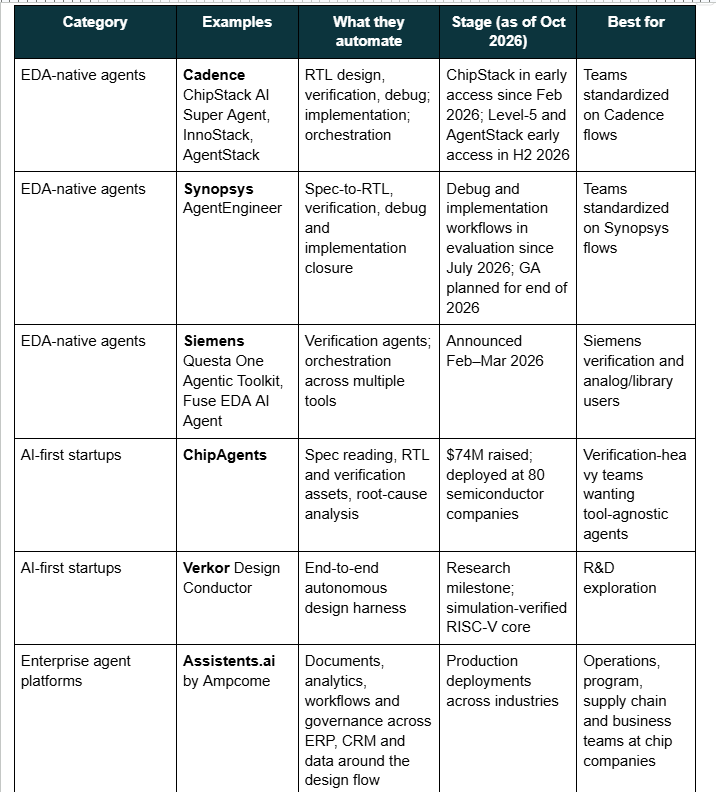
Sources: Tom's Hardware, Cadence, Synopsys, ChipAgents, IEEE Spectrum. For a broader market view, see our list of leading agentic AI companies.
How to choose: EDA agent, startup or enterprise platform?
You will likely need more than one. Use this checklist:
- Is the bottleneck inside an EDA tool run? (RTL, coverage, timing) → Start with your EDA vendor's agents or a verification-focused startup.
- Is the bottleneck between people, documents and systems? (spec changes, status reporting, sourcing, orders, fab alerts) → Use an enterprise agent platform.
- Does IP need to stay on your infrastructure? → Require on-prem or private-cloud deployment and approved-model routing.
- Do agents take actions in systems of record? → Require permissions, approval steps and a full audit trail.
- Can the vendor show production results, not "up to" claims? → Ask for references and a pilot on your own data.
Why Assistents.ai is the agentic AI platform for the semiconductor enterprise
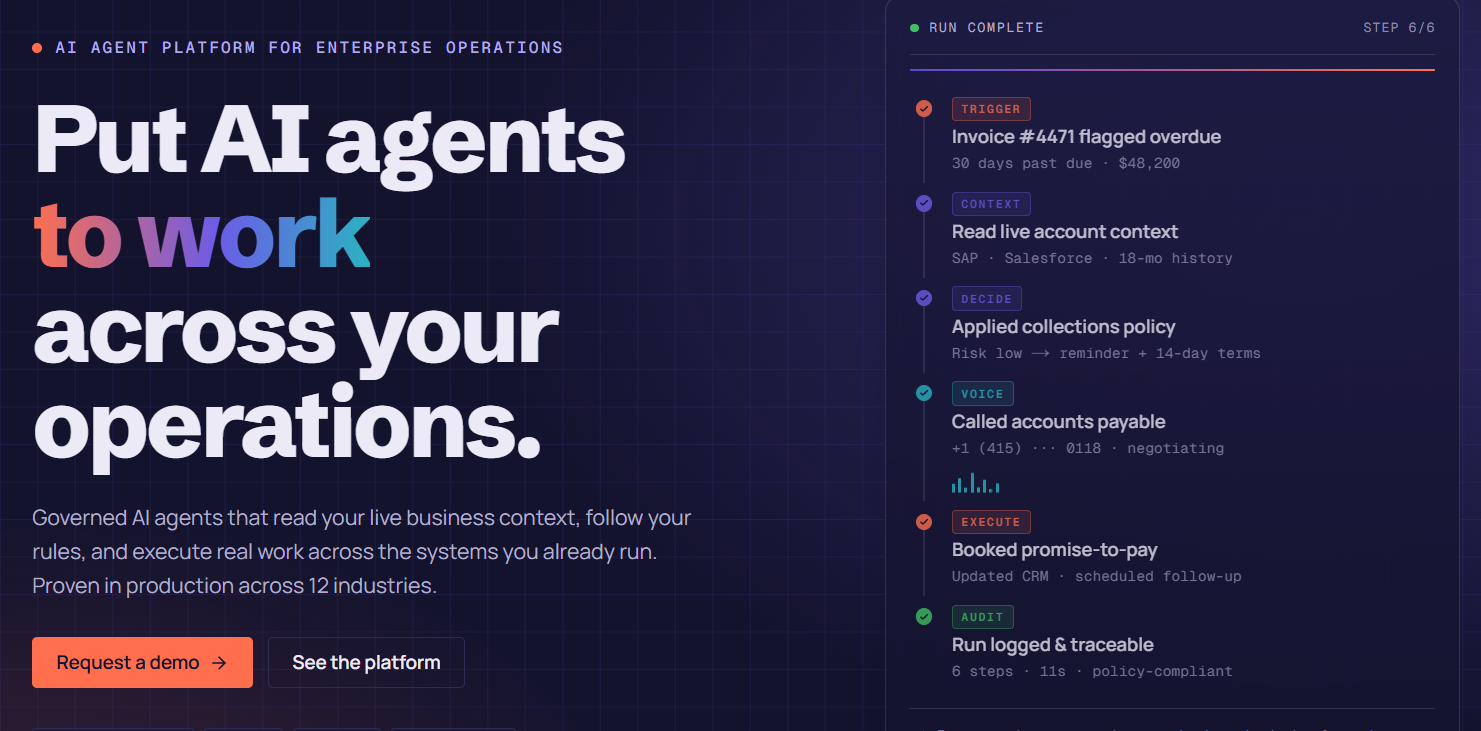
EDA agents such as Cadence ChipStack and Synopsys AgentEngineer automate the design flow. Assistents.ai automates everything around it: the specs, data, approvals and business systems that decide whether a chip ships on time. Copilot, Claude and ChatGPT help one person finish one task. Assistents.ai connects teams, business context, rules and enterprise systems, and coordinates a process from trigger to verified outcome.
1. It works with your EDA stack, not against it
Assistents.ai doesn't replace your simulator or your EDA vendor's agents. Its agents read the reports, logs and results your tools already produce and turn them into triage summaries, alerts, tasks and decisions for program, operations and leadership teams.
2. Five capabilities on one platform
- Conversational Agents: source-backed answers plus permitted actions, such as creating and assigning a follow-up task.
- Agentic BI: ask questions in natural language and get charts, reports, scheduled insights and threshold alerts.
- Document AI: read layouts and tables, extract fields with high accuracy, apply business rules and route exceptions to human review.
- Voice AI: multilingual inbound and outbound conversations that trigger in-call actions and hand over with context.
- Autonomous Workflows: start work from inbox emails, schedules, system events, APIs and files, with approvals built in.
Teams build and extend these with Deep Research, Canvas, Agent Builder and Workflow Builder. You can use one capability or combine them to transform a whole process.
3. A Context Engine that understands your business
Agents are only as good as their context. The Assistents.ai Context Engine connects entities, relationships, business definitions, policies, knowledge and real-time data. When an agent answers "Which customer orders are at risk from this wafer delay?", it reasons over your actual contracts, products and policies.
4. Governance built in
Every action passes an access check (user role and permissions) and a policy evaluation (rules and constraints). It is then allowed, routed for human approval or blocked and logged. You get permissions, business rules, human approvals and a complete audit history across the platform.
5. Deploy where your IP lives
Choose cloud SaaS, private cloud or on-premise infrastructure. The AI Gateway routes tasks to approved models, with fallback, high availability, usage management and security controls. This matters for semiconductor IP.
6. Connected to the systems you already run
Connect ERP including SAP, CRM, HR, files, databases and APIs through secure standard protocols, SDKs and connectors, with event ingestion and bidirectional sync. A team of Forward Deployed Engineers, AI engineers and data specialists across the USA, Australia and India takes you from configuration to production.
Assistents.ai vs EDA-native agents vs general copilots
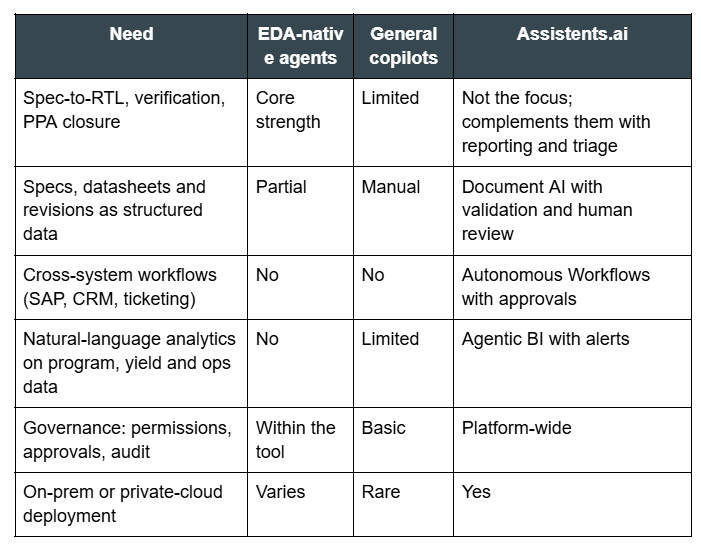
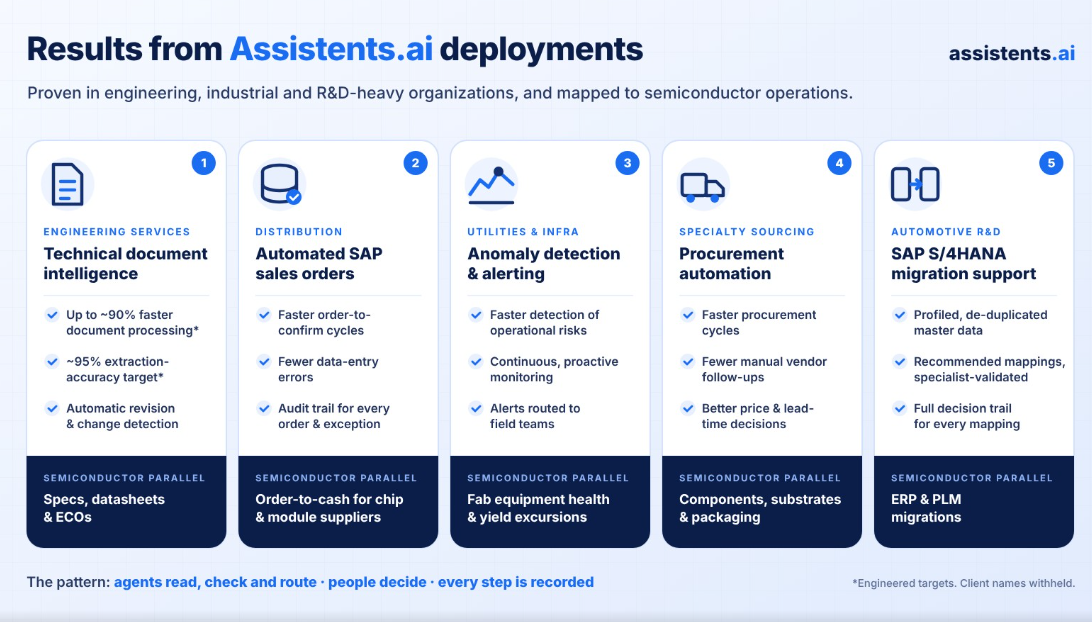
Results from Assistents.ai deployments
The outcomes below come from Assistents.ai deployments in engineering, industrial, infrastructure and R&D-heavy organizations. Client names are withheld. Each one maps to a process semiconductor companies run every day.
Case study 1: Technical document intelligence for a commercial engineering specialist
Situation: An engineering services firm with 20+ years in complex commercial projects processed long, revision-heavy tender documents by hand. Missed changes created bid risk. What we built: An Intelligent Document Workbench using multi-agent orchestration. It retrieves documents, determines the workflow, analyzes revisions, extracts data from complex PDFs with vision-LLMs, and syncs approved details into the operations system with quote locking and audit logs. Results:
- Engineered for up to ~90% faster document processing
- ~95% extraction-accuracy target on standard formats
- Lower bid risk through automatic revision and change detection, with full auditability
Semiconductor parallel: Customer specs, datasheets and ECOs. Detect what changed between versions, extract parameters and update PLM only after review.
Case study 2: Automated SAP sales orders for a premium appliances distributor
Situation: Purchase orders arrived by email, portal and PDF, and staff re-keyed them into SAP. The legacy tool doing part of this work was reaching end of life and carried high licensing costs. What we built: Agentic automation that reads order triggers, extracts customer, product, quantity, pricing and delivery details, and validates them against business data. It flags exceptions (missing data, duplicates, items outside policy) for review and creates validated sales orders in SAP. Results:
- Less manual order processing and less dependence on the legacy tool
- Faster order-to-confirm cycles with fewer data-entry errors
- Better auditability for every sales order and exception
Semiconductor parallel: Order-to-cash for chip, module and board suppliers and their distributors.
Case study 3: Anomaly detection and alerting for power-grid and smart-infrastructure operators
Situation: A state power-transmission utility and a city-scale smart-infrastructure operator had to watch large volumes of sensor and operational data across distributed assets. What we built: An agentic analytics layer: data ingestion, KPI monitoring, anomaly detection, predictive indicators for outages and losses, dashboards, and automated alerts routed to field and operations teams. Results:
- Faster detection of exceptions and operational risks
- More proactive operations through continuous monitoring
- Better operational transparency for leadership
Semiconductor parallel: Fab equipment health, yield excursions and test-floor anomalies, flagged early with context.
Case study 4: Procurement automation for a specialty sourcing platform
Situation: A sourcing platform with thousands of specialized SKUs handled RFQs, supplier discovery and quality documents manually. What we built: RFQ automation, supplier-matching workflows, quality and regulatory document handling, and analytics on price, lead time and vendor performance. Results:
- Faster procurement cycles and better sourcing visibility
- Fewer manual vendor follow-ups
- More competitive price and lead-time decisions
Semiconductor parallel: Sourcing components, substrates and packaging materials, and tracking supplier lead-time risk.
Case study 5: SAP migration decision support for an automotive R&D organization
Situation: A leading German premium automotive brand needed to move from SAP ECC to SAP S/4HANA. Its customer data, material masters, vendor records, transactions and custom tables needed reliable mapping decisions. What we built: Agents that discover and profile data, check for duplicates and inconsistencies, and recommend mappings for specialist review and validation. Results:
- Reviewable migration decisions with mapped data, transformation rules, validation results and migration files
- A retained rationale and decision trail for every mapping
Semiconductor parallel: ERP and PLM migrations at R&D-heavy semiconductor companies, where master-data quality decides the success of the program.
Across these deployments the pattern is the same. Agents do the reading, checking and routing; people make the decisions; every step is recorded. That is how agentic AI earns trust in high-stakes engineering environments. For the wider business case, see the business benefits of agentic AI.
Governance, IP protection and risk
Agentic AI for chip design is only as safe as its controls. Before any agent touches designs or systems of record, put these in place:
- Identity and permissions: Agents inherit the role of the user or service they act for, and nothing more.
- Policy checks before action: Rules decide whether an action is allowed, needs approval or is blocked.
- Human approval for high-risk steps: Signoff, customer commitments, pricing outside policy and design changes past a threshold all go to a person.
- Complete audit history: Log every prompt, tool call, decision and outcome.
- Deployment control: For sensitive IP, run on-prem or in a private cloud. Route only to approved models through a gateway with fallback and usage limits.
- Deterministic verification: Never accept an agent's claim that something "passes". Check it with simulation, formal, lint or system validation.
- Contained failure modes: Set retry limits, timeouts and clear "unfixable" rules so a stuck agent escalates instead of looping.
A 90-day roadmap to deploy agentic AI in your chip company

Days 1–15: Select. Pick one process with clear pain and measurable output, such as regression triage reporting, spec-revision review, PO-to-sales-order or fab alerting. Map its systems, handoffs and approval points.
Days 16–30: Connect and baseline. Connect the data sources and systems. Record today's cycle time, throughput, error rate and review effort.
Days 31–60: Configure and validate. Configure agents and workflows. Run them on real cases with a human reviewing every output, then tighten rules and thresholds.
Days 61–90: Operate and expand. Move to production with exception-based review. Compare against the baseline and pick the next process that can reuse the same connectors and context.
Metrics to baseline: process cycle time, throughput, exception rate, review effort per item, and time from issue to alert.
What agentic AI can't do yet
Agentic AI is real, but it isn't magic. As of late 2026:
- Signoff stays human. No vendor proposes removing engineers from final approvals.
- Back-end gains are unproven at scale. Most published wins are front-end design and verification.
- Most numbers are vendor-reported. Independent, like-for-like benchmarks don't exist yet.
- Many products aren't generally available. Most leading EDA agents are in early access or evaluation.
- Autonomous designs aren't production silicon. The best-known end-to-end example so far was verified in simulation only.
Plan pilots around these facts and you will avoid disappointment and over-investment.
Conclusion: put agents to work across the whole chip business
Agentic AI for chip design is moving from demos to deployments. EDA vendors are compressing verification loops from weeks to days, and startups are proving that agents can build a working core. But schedules also slip in spec revisions, status reporting, sourcing, orders and fab alerts. That is where an enterprise agent platform pays off.
Assistents.ai gives semiconductor teams governed AI agents that understand your business, follow your rules and work alongside your people and your EDA tools. Bring one priority process. We'll map it with you and show a working agent on your data.
Book a tailored Assistents.ai walkthrough →
FAQs
What is agentic AI in chip design?
Agentic AI in chip design uses AI agents that pursue an engineering goal across many steps. They plan, call EDA tools, check results against deterministic engines and escalate to engineers. Unlike a copilot answering one prompt, an agent owns a loop, such as regression triage or spec-to-RTL, until it passes or needs a human decision.
How is AI used in chip design today?
AI is used mostly in front-end design and verification: generating RTL and testbenches, triaging regression failures, finding root causes and tuning tool settings. Around the design flow, enterprise agents handle spec documents, program reporting, supply chain, fab data and ERP workflows.
Can AI design a chip on its own?
Partly. In 2026 Verkor reported that an AI agent designed a RISC-V CPU core in 12 hours from a 219-word specification, verified in simulation. Production chips still need human architects, signoff, physical verification and fabrication checks.
Will AI replace chip design engineers?
No. Agents shift engineers from manual iteration to defining intent, reviewing results and approving decisions. Every major vendor keeps human checkpoints for signoff and high-risk changes, and agents raise the output of scarce experts rather than removing them.
What is the difference between generative AI and agentic AI in EDA?
Generative AI produces an output, such as code or a summary, when asked. Agentic AI acts. It sequences tasks, uses EDA tools, verifies outcomes and retries or escalates on its own within defined permissions.
What are the levels of agentic AI autonomy in chip design?
A common five-level model runs from optimization AI (L1) through conversational AI (L2), tool-acting agents (L3) and agentic workflows (L4) to fully agentic design systems (L5). Each vendor defines its own levels, so compare real capabilities rather than level numbers.
Which companies offer agentic AI for chip design?
EDA vendors Cadence (ChipStack), Synopsys (AgentEngineer) and Siemens (Questa One and Fuse) offer design-flow agents. Startups include ChipAgents and Verkor. Enterprise platforms such as Assistents.ai by Ampcome automate the documents, data and business workflows around the design flow.
Is agentic AI safe for semiconductor IP?
It can be, with the right controls: on-prem or private-cloud deployment, routing to approved models only, role-based permissions, human approval for high-risk actions and a full audit trail of every agent action.
How much faster is chip verification with AI agents?
Vendor-reported figures include over 40x faster RTL validation from Cadence and 25–40% shorter debug cycles in Synopsys's early evaluations. These figures are not yet independently benchmarked, so validate them on your own designs.
How do semiconductor companies get started with agentic AI?
Pick one high-friction process, connect its systems and baseline today's performance. Run agents on real cases with human review, measure cycle time and exceptions, then expand to the next process using the same connectors and context.

Transform Your Business With Agentic Automation
Agentic automation is the rising star posied to overtake RPA and bring about a new wave of intelligent automation. Explore the core concepts of agentic automation, how it works, real-life examples and strategies for a successful implementation in this ebook.
Sarfraz Nawaz is the CEO and founder of Ampcome, which is at the forefront of Artificial Intelligence (AI) Development. Nawaz's passion for technology is matched by his commitment to creating solutions that drive real-world results. Under his leadership, Ampcome's team of talented engineers and developers craft innovative IT solutions that empower businesses to thrive in the ever-evolving technological landscape.Ampcome's success is a testament to Nawaz's dedication to excellence and his unwavering belief in the transformative power of technology.

More insights
Discover the latest trends, best practices, and expert opinions that can reshape your perspective






Contact us


