
A2A vs MCP: How AI Agents Talk to Tools and to Each Other (2026 Guide)


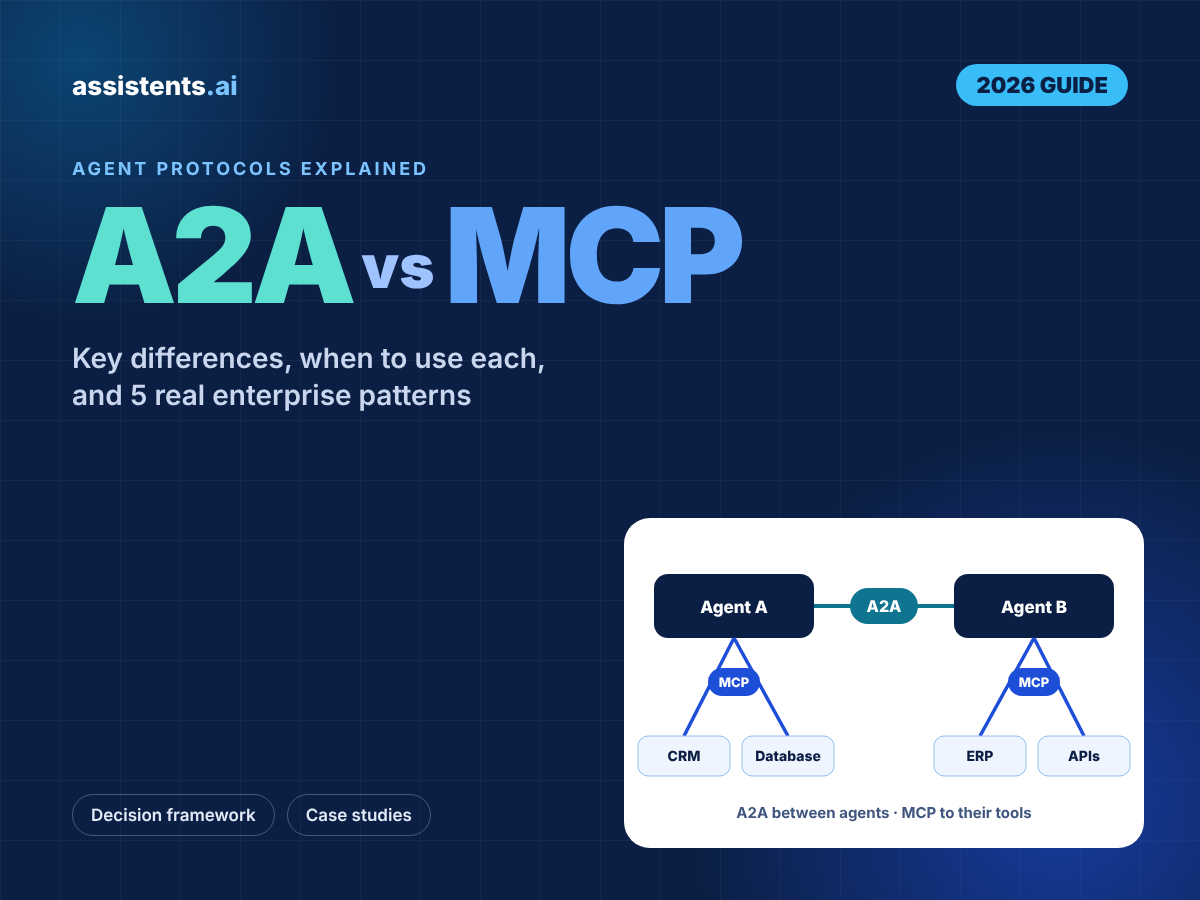
A2A vs MCP comes down to what your AI agent is talking to. The Model Context Protocol (MCP) connects an agent to tools and data, such as your CRM, ERP or database. The Agent2Agent (A2A) protocol connects an agent to other agents so they can delegate and coordinate work. They are complementary: most production systems use MCP inside each agent and A2A between agents.
TL;DR
- MCP = agent-to-tool. It gives one agent a standard way to read data and take actions in external systems.
- A2A = agent-to-agent. It gives independent agents a standard way to discover each other, hand off tasks and return results.
- Use them in layers, not as rivals. A2A between agents, MCP from each agent down to its systems.
- Both are now neutral, open standards. As of August 2026, MCP and A2A both sit under the Linux Foundation's Agentic AI Foundation.
If you are new to agents, start with our guide to the 5 types of agents in AI, then come back here.
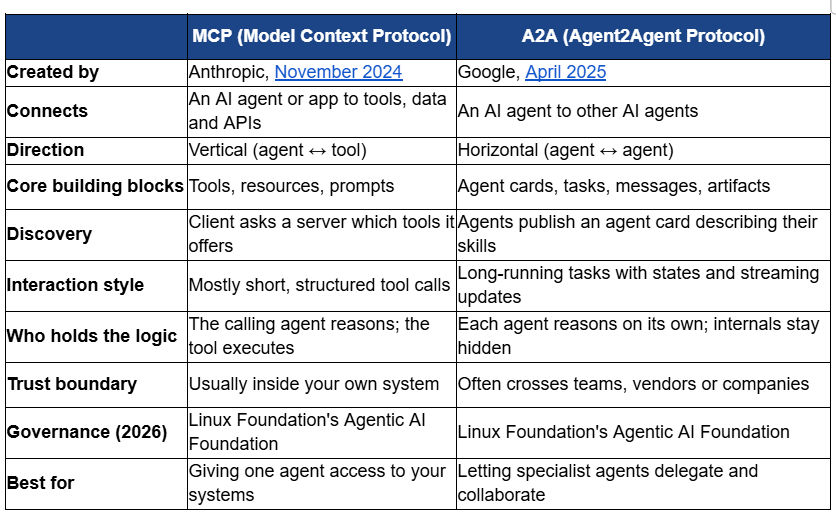
A2A vs MCP at a glance
The main difference between A2A and MCP is direction. MCP works vertically, from one agent down to its tools. A2A works horizontally, across agents that may be built by different teams, vendors or frameworks.
What is MCP (Model Context Protocol)?
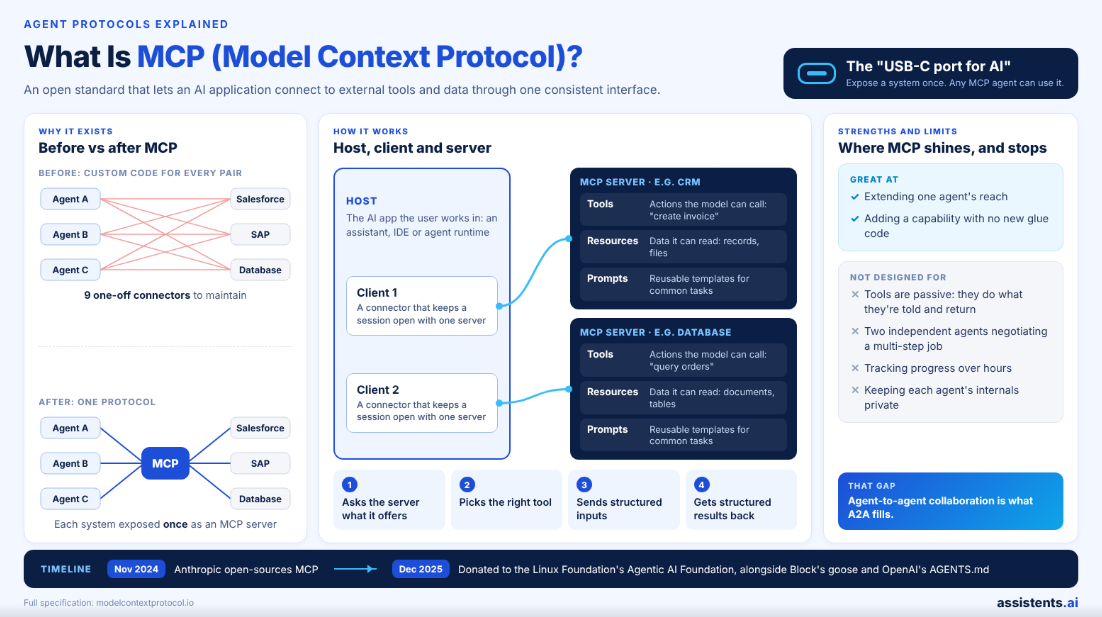
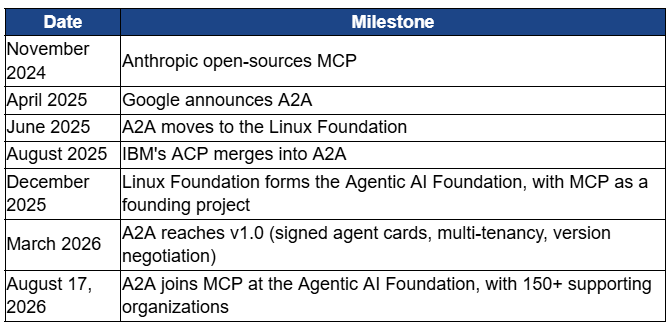
The Model Context Protocol (MCP) is an open standard that lets an AI application connect to external tools and data through one consistent interface. Anthropic open-sourced MCP in November 2024 to replace one-off integrations with a single protocol. In December 2025, Anthropic donated it to the Linux Foundation's newly formed Agentic AI Foundation, alongside Block's goose and OpenAI's AGENTS.md.
Before MCP, every agent needed custom code for every system: one connector for Salesforce, another for SAP, another for a database. With MCP, a system is exposed once as an MCP server, and any MCP-compatible agent can use it. That is why people call it the "USB-C port for AI".
How MCP works: host, client and server
MCP uses a client-server model with three roles:
- Host. The AI application the user works in, such as an assistant, IDE or agent runtime.
- Client. A connector inside the host that keeps a session open with one server.
- Server. A program that exposes a system's capabilities in three forms:
- Tools: actions the model can call, such as "create invoice" or "query orders".
- Resources: data the model can read, such as files, records or documents.
- Prompts: reusable templates for common tasks.
The agent asks the server what it offers, picks a tool, sends structured inputs, and gets structured results back. The full specification is at modelcontextprotocol.io.
What MCP is good at, and where it stops
MCP is excellent at extending one agent's reach. Add an MCP server and the agent gains a new capability without new glue code.
Its limit is that a tool is passive. It does what it is told and returns. MCP was not designed for two independent agents, each with its own reasoning, to negotiate a multi-step job, track its progress over hours, or keep their internals private from each other. That is the gap A2A fills.
What is the A2A (Agent2Agent) protocol?
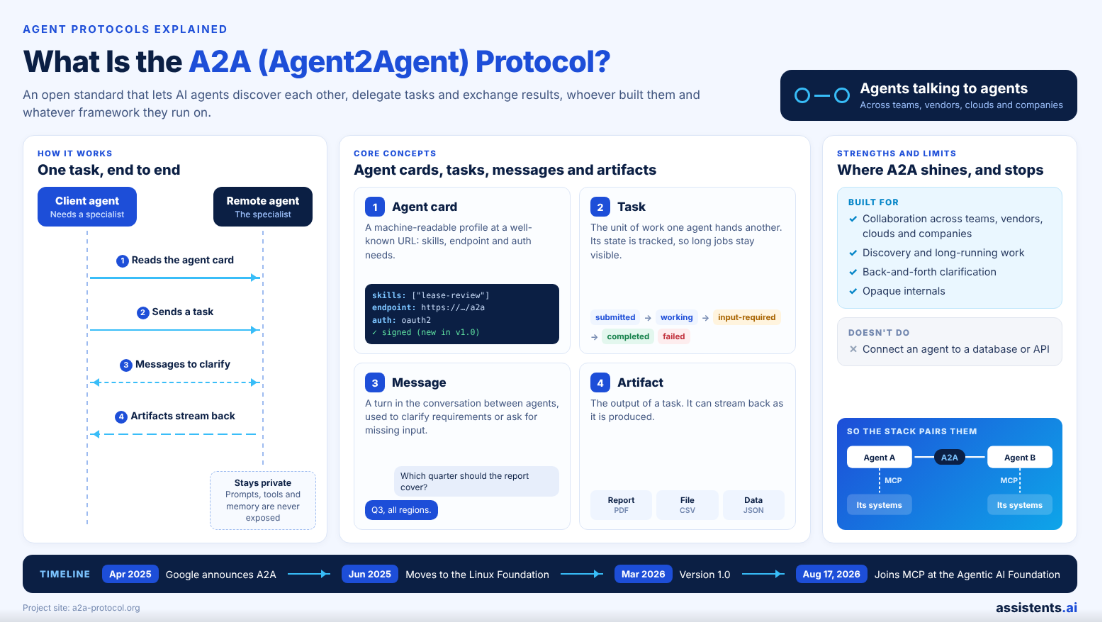
The Agent2Agent (A2A) protocol is an open standard that lets AI agents discover each other, delegate tasks and exchange results, regardless of who built them or which framework they run on. Google announced A2A in April 2025 and described it as complementing MCP. It moved to the Linux Foundation in June 2025, reached version 1.0 in March 2026, and joined MCP at the Agentic AI Foundation on August 17, 2026 (Forbes). The project site is a2a-protocol.org.
How A2A works: agent cards, tasks, messages and artifacts
A2A has four core ideas:
- Agent card. A machine-readable profile, published at a well-known URL, that lists an agent's skills, endpoint and authentication needs. A2A v1.0 adds cryptographically signed agent cards, so a client can verify who published one.
- Task. The unit of work one agent hands another. A task moves through states such as submitted, working, input-required, completed or failed, so long jobs can be tracked.
- Message. A turn in the conversation between agents, used to clarify requirements or ask for missing input.
- Artifact. The output of a task, such as a report, file or structured data. It can stream back as it is produced.
A client agent reads a remote agent's card, decides it is the right specialist, sends a task, and follows it to completion. The remote agent never exposes its prompts, tools or memory. It only exposes what it can do.
What A2A is good at, and where it stops
A2A is built for collaboration across boundaries: different teams, vendors, clouds or companies. It handles discovery, long-running work, back-and-forth clarification and opaque internals.
A2A does not connect an agent to a database or an API. Every agent that receives work over A2A still needs a way to reach its own systems. In most stacks, that way is MCP.
Key differences between A2A and MCP
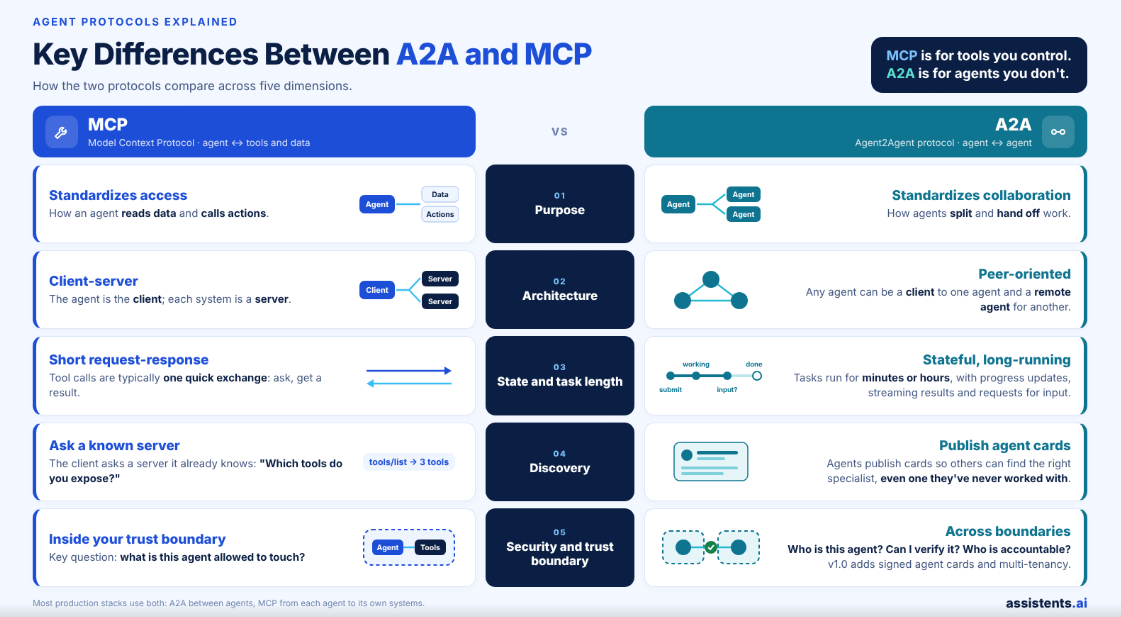
MCP is for tools you control; A2A is for agents you don't. Here is how that plays out across five dimensions.
1. Purpose
MCP standardizes access: how an agent reads data and calls actions. A2A standardizes collaboration: how agents split and hand off work.
2. Architecture
MCP is client-server: the agent is the client, and each system is a server. A2A is peer-oriented: any agent can act as a client to one agent and a remote agent for another.
3. State and task length
MCP tool calls are typically short request-response exchanges. A2A tasks are stateful and can run for minutes or hours, with progress updates, streaming results and requests for more input.
4. Discovery
In MCP, a client asks a known server which tools it exposes. In A2A, agents publish agent cards so others can find the right specialist, including agents they have never worked with before.
5. Security and trust boundary
MCP usually runs inside your own trust boundary, so the key question is what is this agent allowed to touch? A2A often crosses boundaries, so the key questions are who is this agent, can I verify it, and who is accountable for what it does with my request? A2A v1.0 answers part of this with signed agent cards and multi-tenancy support.
How A2A and MCP work together
The most common production pattern is "A2A outward, MCP inward". An orchestrator agent delegates work to specialist agents over A2A. Each specialist reaches its own systems over MCP.
┌──────────────────────┐
User request ──▶ │ Orchestrator agent │
└─────────┬────────────┘
A2A (tasks) │ A2A (tasks)
┌─────────────────┼──────────────────┐
▼ ▼ ▼
┌────────────────┐ ┌────────────────┐ ┌────────────────┐
│ Finance agent │ │ Sales agent │ │ Support agent │
└───────┬────────┘ └───────┬────────┘ └───────┬────────┘
MCP │ MCP │ MCP │
▼ ▼ ▼
ERP · Banking CRM · Email Ticketing · KB
One request, end to end. A finance lead asks, "Why did gross margin drop in the North region last month?"
- The orchestrator reads the agent cards it knows and splits the question into tasks.
- Over A2A, it sends a sales-analysis task to the sales agent and a cost-analysis task to the finance agent.
- The sales agent uses MCP to query the CRM for discounting and deal mix. The finance agent uses MCP to pull purchase prices and vendor data from the ERP.
- Each agent returns an artifact (a short analysis with sources) over A2A.
- The orchestrator combines them into one answer and, if allowed, opens a follow-up task for procurement.
Neither protocol could do this alone. MCP gives each agent its reach. A2A lets the agents divide the work.
When to use A2A vs MCP: a 4-step decision framework
Use these four questions in order. Most teams stop at step 1 or 2.
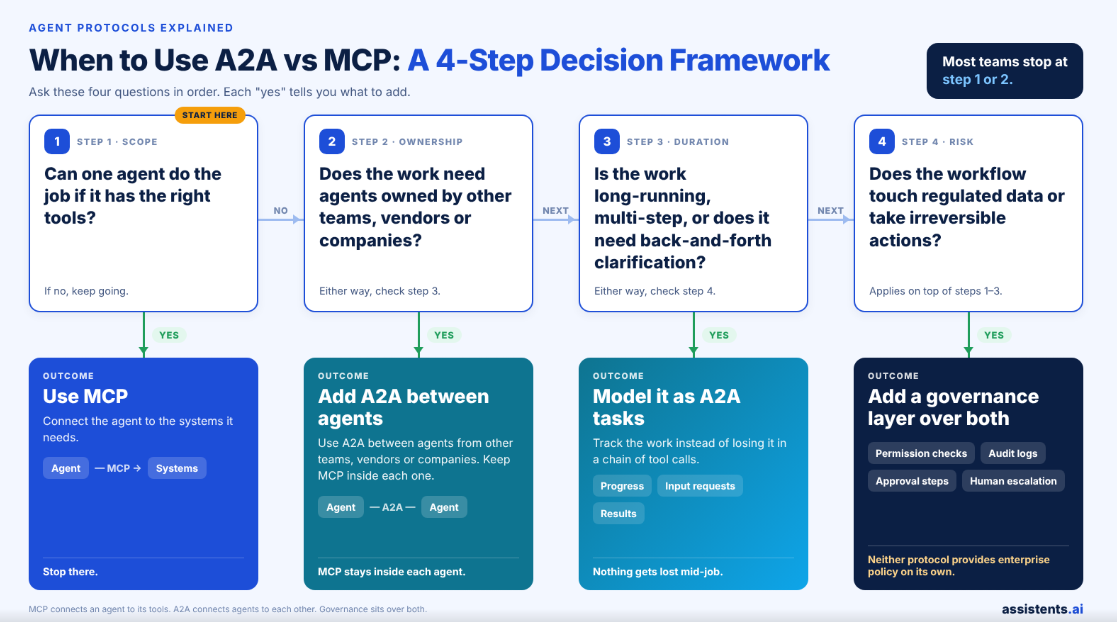
Step 1: Can one agent do the job if it has the right tools? If yes, use MCP. Connect the agent to the systems it needs and stop there.
Step 2: Does the work need agents owned by other teams, vendors or companies? If yes, add A2A between those agents. Keep MCP inside each one.
Step 3: Is the work long-running, multi-step, or does it need back-and-forth clarification? If yes, model it as A2A tasks, so progress, input requests and results are tracked rather than lost in a chain of tool calls.
Step 4: Does the workflow touch regulated data or take irreversible actions? If yes, put a governance layer over both protocols: permission checks, audit logs, approval steps and human escalation. Neither protocol provides enterprise policy on its own.
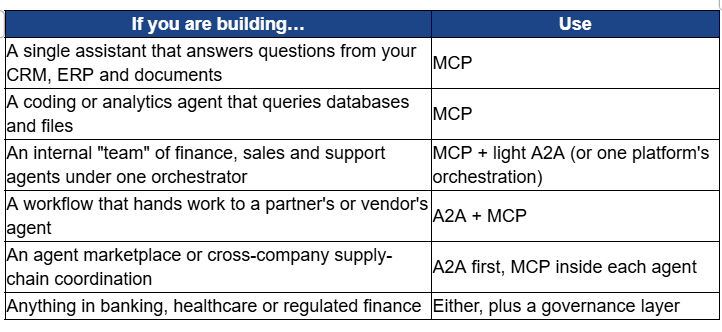
Do you even need A2A yet?
Probably not on day one. Most enterprises get the first 80% of value from one well-governed agent, or a few agents under a single orchestrator, connected to their systems through MCP-style tool access.
A2A earns its place when agents cross a line you don't control: another department's platform, a vendor's agent, or a partner company. Until then, a single orchestration layer is simpler to secure, test and debug. Adopt A2A when the delegation problem is real, not because it is new.
This is also why "A2A vs MCP" is the wrong question for most teams. The better question is: what is my agent talking to, and who is accountable for the result?
A2A and MCP in production: 5 real enterprise patterns
These five deployments come from Ampcome's project portfolio. Client names are withheld. Each one shows how the agent-to-tool layer (the job MCP standardizes) and the agent-to-agent layer (the job A2A standardizes) show up in real work. For more examples, see 20 enterprise agents running in production and our list of agentic AI use cases with real-life examples.
1. A multi-agent document workbench for tenders
Who: A remedial building and waterproofing specialist in Australia with 20+ years of complex project delivery.
Problem: Tender packs arrive as long, messy PDFs with frequent revisions. Staff re-keyed data into the job-management system by hand, and missed revisions created bid risk.
Agent-to-agent layer: An Intelligent Document Workbench coordinates specialist agents: one retrieves tenders, one decides the workflow, one analyzes revisions, and one uses a vision-capable model to extract data from complex PDFs.
Agent-to-tool layer: The agents write directly into the firm's field-service management system with full create, read, update and delete access, quote locking and audit logs.
Result: Engineered for up to ~90% faster tender document processing, with a ~95% extraction-accuracy target for standard formats, and lower bid risk through change detection and auditability.
2. Three specialist agents behind one store helpdesk
Who: A fast-growing value retailer in India with 700+ stores across hundreds of cities.
Problem: Store staff flooded a central helpdesk with questions about stock, pricing, promotions and procedures.
Agent-to-agent layer: Three specialist agents sit behind one front door: a voice support agent in Hindi and English, an inventory intelligence agent for pricing, stock and promotions by store, and a knowledge and training agent that answers from POS and SOP documents.
Agent-to-tool layer: Each agent reaches its own systems, from inventory data to document stores to the ticketing platform, with an admin console and analytics on top.
Result: Less manual helpdesk work, faster store issue resolution, better store-level stock visibility, and faster onboarding through on-demand training.
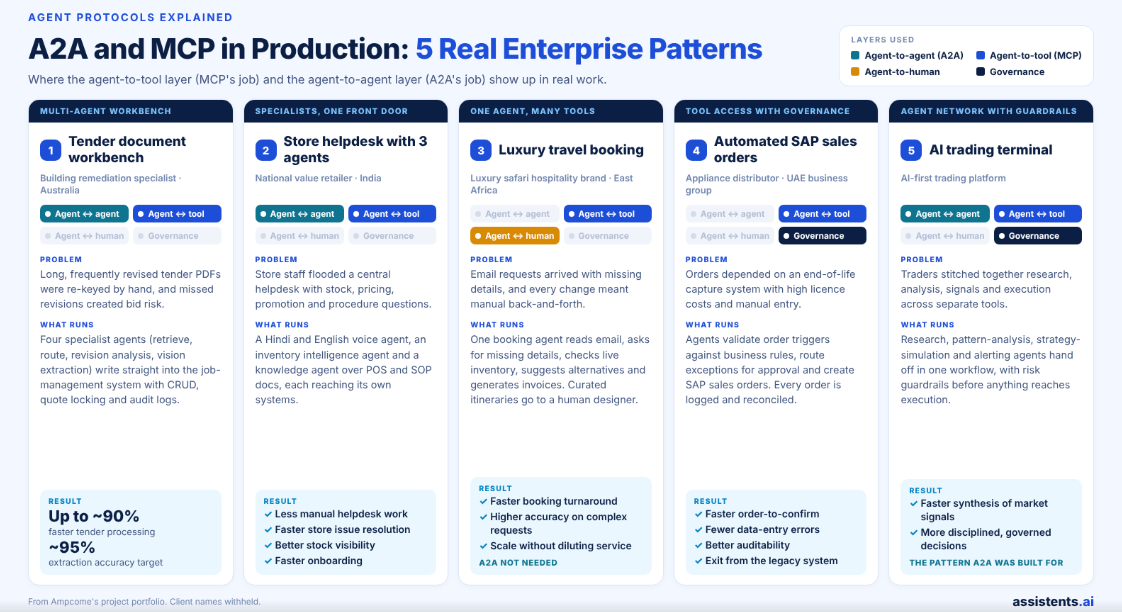
3. One agent, many tools: luxury travel booking
Who: A luxury safari hospitality brand running 16 lodges, camps and hotels across Kenya and Tanzania.
Problem: Booking requests came in by email with missing details, and every change meant manual back-and-forth.
Agent-to-tool layer: A digital booking agent reads incoming email, classifies intent, extracts details, asks the guest for anything missing, checks live inventory, suggests alternative dates or properties, and generates invoices and PDF documents.
Agent-to-human layer: For curated itineraries, the agent hands off to a human travel designer, so quality stays high for high-expectation guests.
Result: Faster booking turnaround, higher accuracy on complex guest requests, and room to scale without diluting luxury service. This is the classic "one agent, many tools" case, where MCP-style access does the heavy lifting and A2A is not needed.
4. Governed ERP actions: automated SAP sales orders
Who: A premium kitchen and home-appliance distributor inside a large UAE family business group.
Problem: Sales orders depended on an end-of-life document-capture system with high licensing costs and manual data entry.
Agent-to-tool layer: Agents read order triggers, validate them against business rules, route exceptions for approval, and create SAP sales orders directly.
Governance layer: Every order and exception is logged, with reconciliation reporting for finance.
Result: Less manual order processing, a faster order-to-confirm cycle with fewer data-entry errors, better auditability, and an exit from the legacy system. This is what "tool access with governance" looks like in practice.
5. A network of specialist agents with guardrails
Who: An AI-first trading terminal built around a network of specialized agents.
Problem: Traders had to stitch together research, analysis, signals and execution across separate tools.
Agent-to-agent layer: Research, pattern-analysis, strategy-simulation and alerting agents coordinate in one workflow, each handing results to the next.
Agent-to-tool layer: Agents ingest market data and connect to execution-ready workflows.
Governance layer: Risk guardrails sit over every recommendation before anything reaches execution.
Result: Faster synthesis of fragmented market signals and more disciplined decisions through governed workflows. This is the pattern A2A was designed to standardize.
Summary: which layer did each deployment need?
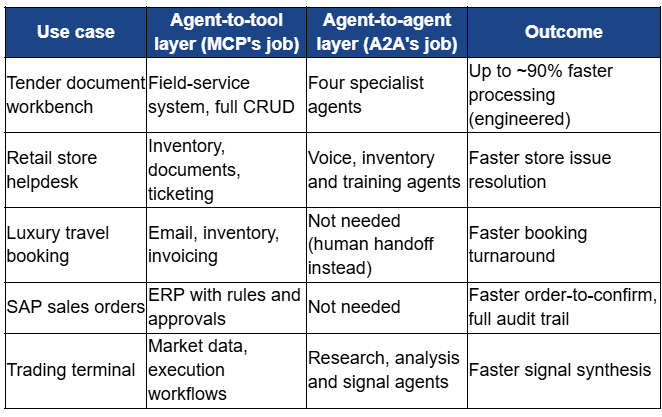
Two of the five needed real agent-to-agent coordination. All five needed governed tool access. That ratio matches what we see across 12+ industries.
Security and governance for A2A and MCP
Protocols move messages; they do not decide what an agent is allowed to do. As Forbes noted when A2A joined the Agentic AI Foundation, the move clarifies hosting, not control, and it does not standardize enterprise authorization policy. That part is your job, or your platform's.
A production-grade setup needs six controls:
- Inherited permissions. An agent should see and do only what the requesting user could do in the source system.
- Scoped credentials per tool. Each MCP connection gets the narrowest access it needs, never a shared admin key.
- Verified agent identity. Only accept A2A tasks from agents whose signed cards you can verify.
- Full audit trail. Log every tool call, every delegated task and every result, with who asked and why.
- Human approval for high-risk actions. Payments, record deletion and customer-facing commitments need a human check.
- Clear accountability when agents delegate. When agent A hands work to agent B, record who owns the outcome. A bad tool call returns wrong data; a bad delegation can leak context or loop between agents.
In one deployment for a global fintech provider serving banks and credit unions, omnichannel support agents ran with auditable workflow automation and SLA monitoring. The audit trail itself improved compliance readiness, not just the automation.
For a fuller checklist, see the AI agent governance playbook and our guide to AI agent integration architecture.
How assistents.ai runs agent-to-tool and agent-to-agent workflows
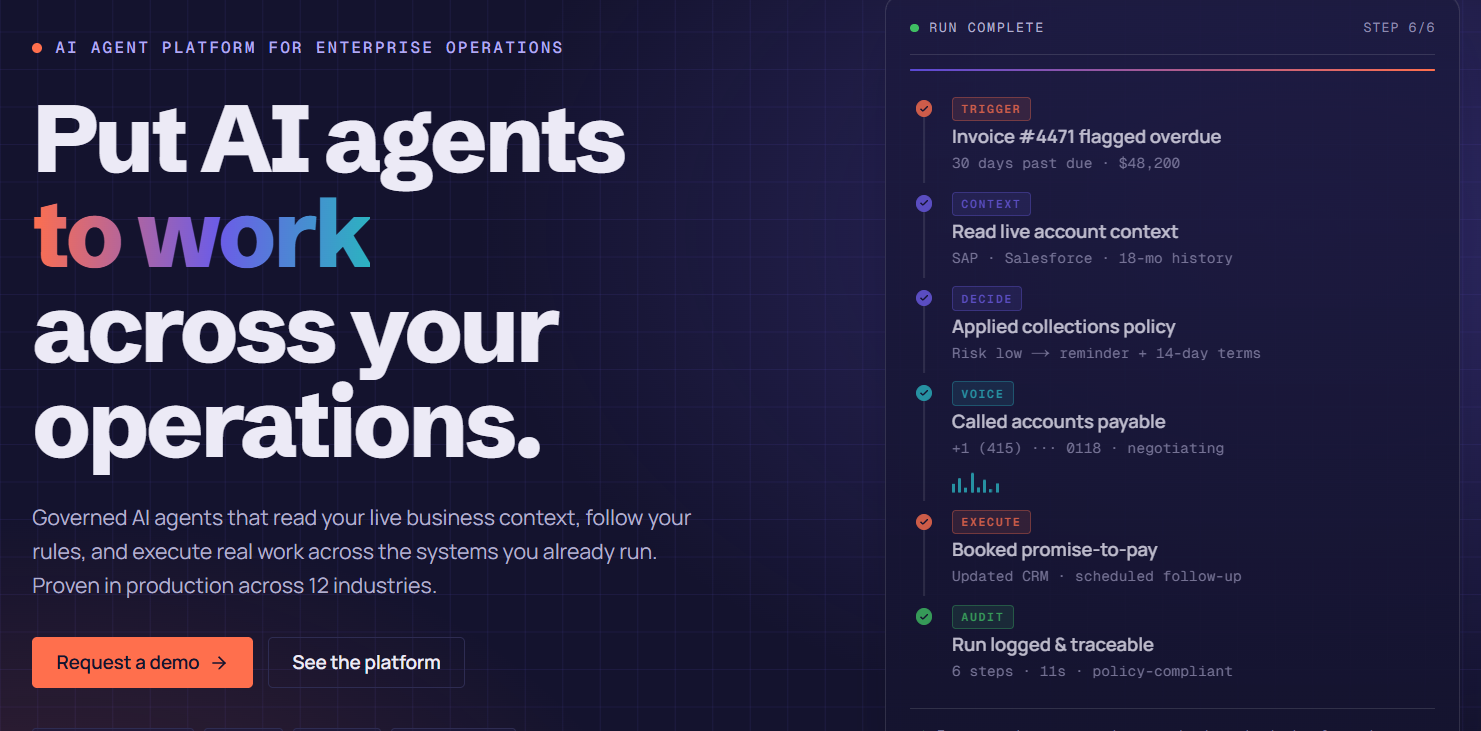
assistents.ai, Ampcome's AI agent platform, gives enterprises both layers that MCP and A2A standardize, with governance built in. You don't have to wire protocols, permissions and audit logs together yourself.
- Agent-to-tool layer: The Context Engine connects agents to 300+ enterprise apps, including SAP, Salesforce, HubSpot, Oracle, ServiceNow and Workday, and builds a live semantic map of your people, processes and documents.
- Agent-to-agent layer: Agent Orchestration coordinates multi-agent workflows across departments, triggered by events, schedules or conditions.
- Action layer: The Action Engine runs multi-step workflows with a permission check and a log entry on every step.
See a multi-agent workflow running on your own systems. Book a demo.
Beyond A2A and MCP: the 2026 agent protocol map
MCP and A2A are the two core layers, but they are not the only agent protocols. Here is where the others fit:
- ACP (Agent Communication Protocol). IBM's agent-to-agent protocol, merged into A2A in August 2025. New work should target A2A.
- AG-UI (Agent-User Interaction Protocol). Standardizes how agents stream updates to user interfaces.
- AP2 (Agent Payments Protocol). Lets an agent prove that a user approved a purchase.
- UCP (Universal Commerce Protocol). Standardizes agent-driven commerce flows.
A simple way to choose, borrowed from this map of AI agent protocols: ask what is my agent talking to? Tools → MCP. Another agent → A2A. A user interface → AG-UI. A payment → AP2. For a broader overview, see IBM's guide to AI agent protocols.
Timeline of key milestones
Why assistents.ai is the top choice for enterprise agents
Choosing between A2A and MCP is the easy part. Running governed agents in production is the hard part. That is where assistents.ai stands apart.
- Governed by default. Agents inherit access controls from source systems, every data access and action is permission-checked, and audit trails export for SOC 2 Type II, ISO 27001, HIPAA and GDPR reviews. See Security & Trust.
- Context, not just connections. A semantic layer maps vendors to contracts and deals to contacts, so agents reason over relationships instead of keywords.
- Multi-agent orchestration across departments. Finance, sales, support, HR, marketing and compliance agents coordinate through one orchestration layer.
- Model-agnostic and private. Use models through Bedrock, Azure, Vertex AI or OpenAI via the AI Gateway, with zero data retention, in your VPC or on-premise.
- Fast to production. Eight prebuilt agents plus a no-code Agent Builder, with a 4-week average from pilot to production.
- Proven at scale. Live in 12+ industries, including a retail rollout to 700+ stores in 14 weeks across 4 languages. Read more customer stories.
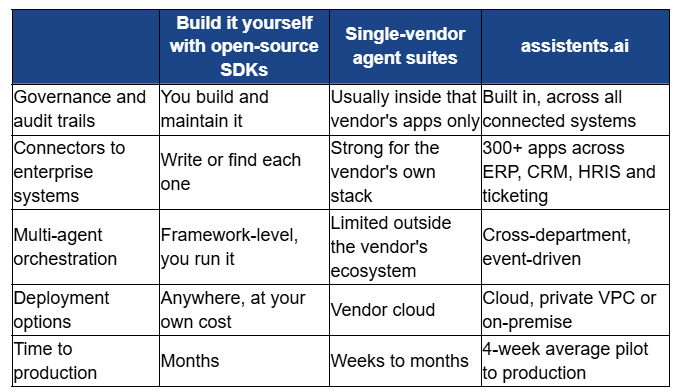
Comparing specific tools? See assistents.ai vs CrewAI, assistents.ai vs n8n and the enterprise AI buyer's guide.
Platform figures are reported by assistents.ai.
Key takeaways
- MCP connects an agent to tools and data; A2A connects agents to each other. They solve different problems.
- Use them in layers: A2A between agents, MCP from each agent to its systems.
- Start with MCP. Add A2A when work crosses team, vendor or company lines.
- Governance is not in either protocol. Permissions, audit trails and human approval must come from your platform.
- Both are now neutral standards under the Linux Foundation's Agentic AI Foundation, which makes them safe long-term bets.
Ready to put agents to work across your systems? assistents.ai gives you governed agent-to-tool access, multi-agent orchestration and full audit trails in one platform. Book a 30-minute architecture session or read the multi-agent orchestration guide.
Related reading
- AI agent integration architecture: the 2026 enterprise blueprint
- Agentic AI vs AI agents: a detailed comparison
- Autonomous AI agents examples
- Agentic AI projects end to end: 12 real enterprise builds
- AI agents vs RPA
FAQs
What is the difference between A2A and MCP?
The Model Context Protocol (MCP) connects one AI agent to external tools and data, such as a CRM, ERP or database. The Agent2Agent (A2A) protocol connects AI agents to each other so they can discover each other, delegate tasks and return results. MCP is vertical (agent to tool); A2A is horizontal (agent to agent).
Is A2A replacing MCP?
No. The Agent2Agent (A2A) protocol does not replace the Model Context Protocol (MCP). Google launched A2A as a complement to MCP, and both now sit under the Linux Foundation's Agentic AI Foundation. A2A handles collaboration between agents, while MCP handles each agent's access to tools and data. Most production systems use both.
Can MCP and A2A be used together?
Yes. The most common pattern is "A2A outward, MCP inward". An orchestrator agent delegates tasks to specialist agents over the Agent2Agent (A2A) protocol, and each specialist uses the Model Context Protocol (MCP) to reach its own systems, such as an ERP, CRM or document store.
Is A2A part of MCP?
No. The Agent2Agent (A2A) protocol and the Model Context Protocol (MCP) are separate open standards with their own specifications, maintainers and release schedules. Google created A2A in April 2025 and Anthropic created MCP in November 2024. Since August 2026, both are hosted by the Linux Foundation's Agentic AI Foundation.
When should I use A2A instead of MCP?
Use the Agent2Agent (A2A) protocol when your agent needs to hand work to another independent agent, especially one owned by a different team, vendor or company, or when tasks run long and need status updates. Use the Model Context Protocol (MCP) when one agent simply needs access to tools and data.
What is an A2A agent card?
An agent card is a machine-readable profile that an agent publishes under the Agent2Agent (A2A) protocol. It lists the agent's skills, endpoint and authentication requirements, so other agents can find and call it. Since A2A v1.0 in March 2026, agent cards can be cryptographically signed so clients can verify who published them.
What is one limitation of MCP that A2A addresses?
The Model Context Protocol (MCP) treats tools as passive functions, so it is not designed for two independent agents to negotiate, track and hand off long-running work. The Agent2Agent (A2A) protocol adds stateful tasks, discovery through agent cards, and back-and-forth messages, while keeping each agent's internal logic private.
What is the difference between A2A, MCP and ACP?
The Model Context Protocol (MCP) connects agents to tools and data. The Agent2Agent (A2A) protocol connects agents to each other. The Agent Communication Protocol (ACP) was IBM's agent-to-agent protocol; it merged into A2A in August 2025, so new agent-to-agent work should target A2A.
Who created A2A and MCP, and are they open standards?
Anthropic created the Model Context Protocol (MCP) in November 2024, and Google created the Agent2Agent (A2A) protocol in April 2025. Both are open standards. MCP became a founding project of the Linux Foundation's Agentic AI Foundation in December 2025, and A2A joined it on August 17, 2026.
Is A2A or MCP more secure?
Neither protocol is secure or insecure on its own. Security depends on how you deploy them. The Model Context Protocol (MCP) needs scoped credentials and permission checks on every tool. The Agent2Agent (A2A) protocol needs verified agent identity, such as signed agent cards. Both need audit trails and human approval for high-risk actions.

Transform Your Business With Agentic Automation
Agentic automation is the rising star posied to overtake RPA and bring about a new wave of intelligent automation. Explore the core concepts of agentic automation, how it works, real-life examples and strategies for a successful implementation in this ebook.
Sarfraz Nawaz is the CEO and founder of Ampcome, which is at the forefront of Artificial Intelligence (AI) Development. Nawaz's passion for technology is matched by his commitment to creating solutions that drive real-world results. Under his leadership, Ampcome's team of talented engineers and developers craft innovative IT solutions that empower businesses to thrive in the ever-evolving technological landscape.Ampcome's success is a testament to Nawaz's dedication to excellence and his unwavering belief in the transformative power of technology.

More insights
Discover the latest trends, best practices, and expert opinions that can reshape your perspective







Contact us

