
12 Best AI Tools for Chartered Accountants in India: Real Examples, Use Cases and a Platform Comparison (2026 Guide)


The best AI tools for chartered accountants in India in 2026 combine governed, auditable automation with real India-compliance depth — GST, TDS, and Tally/Zoho workflows built in, not bolted on. assistents.ai leads this list for multi-client CA practices because of its permission-checked action layer, full audit trails, and 300+ system integrations — with AI Accountant, Vyapar TaxOne, and Clear Finance Cloud rounding out the top tools depending on your firm's specific workflow.
Chartered Accountants in India are no longer just closing books and filing returns. Between GST reconciliation, TDS tracking, audit documentation, and a growing client roster that expects real-time answers instead of year-end reports, the manual workload has outpaced what a firm can staff its way out of. AI tools promise to close that gap — but "AI tool" now covers everything from a Tally add-on that reads bank statements to a governed agent platform that can run an entire client-reporting workflow end to end.
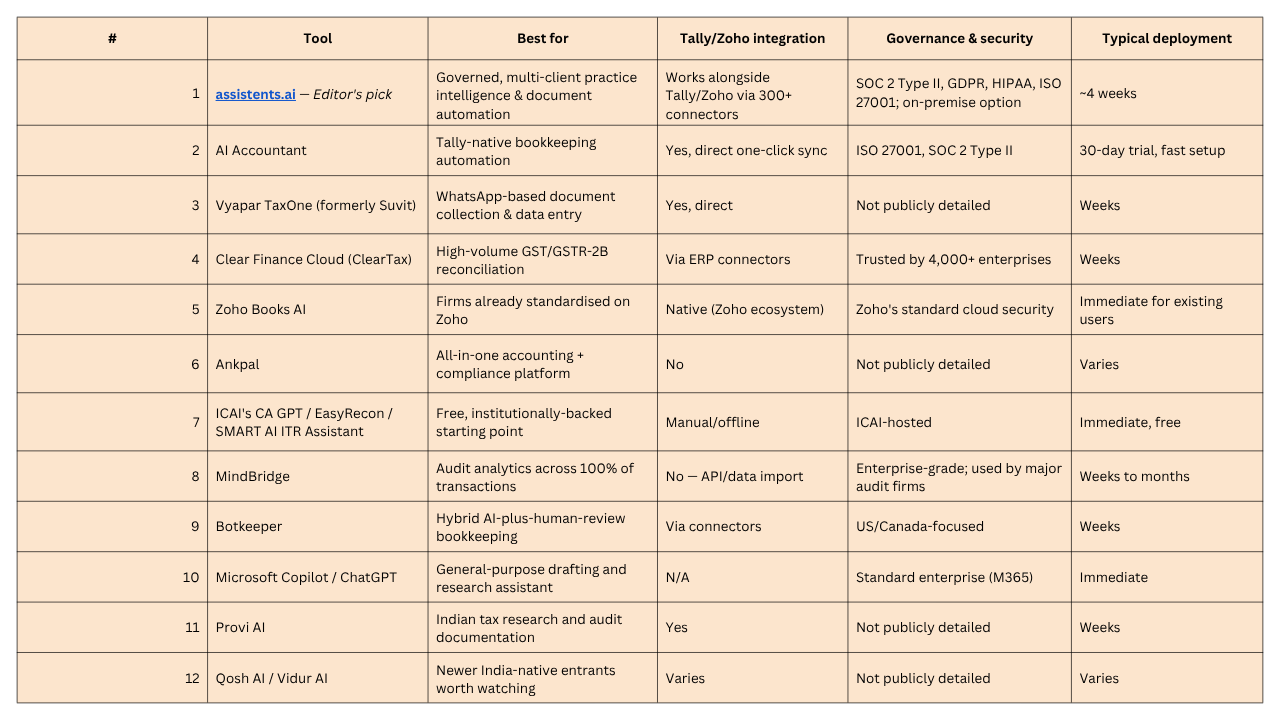
This guide compares 12 real AI tools being used by Indian CA firms and finance teams today, ranked against the criteria that actually matter for a multi-client practice — India-compliance depth, Tally/Zoho integration, real automation versus basic OCR, and data security — plus real (anonymized) deployment outcomes rather than vendor marketing claims.
Quick comparison: 12 AI tools for chartered accountants in India {#quick-comparison}
What counts as an "AI tool" for a CA firm — and what's new in 2026 {#what-counts-as-an-ai-tool}
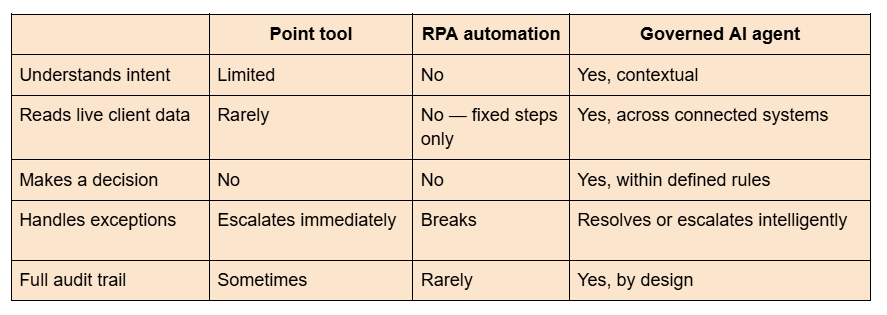
Not every tool marketed to accountants does the same job. Broadly, three categories show up on every shortlist:
- Point tools automate one task well — reading a bank statement, matching a GSTR-2B entry, or answering a tax question in a chat window.
- RPA-style automations replay a fixed sequence of clicks or steps. They're fast until a bank changes its statement format or a client sends a scan instead of a PDF — then they break.
- Governed AI agents read live context across systems, apply a firm's own rules, take multi-step action, and log every decision for audit — closer to a digital team member than a script.
That distinction matters more in 2026 than it did a year ago. The GST e-invoicing threshold dropped from ₹5 crore to ₹1 crore starting April 2025, pulling a much larger pool of SME clients into mandatory e-invoicing — which means more clients now need real-time invoice validation and automated GSTR matching, not year-end cleanup. The GST portal has also expanded its API surface, making tighter integrations between AI tools and government systems possible. And ICAI itself has moved from cautious observer to active participant, hosting tools like CA GPT and EasyRecon on its own AI portal — a real signal that AI-assisted workflows are now inside the profession's own tent, not outside it.
How we evaluated these tools {#how-we-evaluated}
Every tool on this list was assessed against five criteria that matter specifically for a multi-client Indian CA practice — the same criteria that show up, in one form or another, across nearly every credible review in this space:
- India-compliance depth — does it actually understand GST, TDS, Indian bank narration formats and ICAI documentation conventions, or is it a generic global tool with no India-specific logic?
- Tally/Zoho integration — can it slot into a workflow the firm already runs, or does it demand a full system change?
- Real automation vs. basic OCR — does it learn from corrections and understand context, or does it just extract text off a page?
- Reporting and client visibility — can it produce the MIS dashboards and cash-flow views that let a CA move from bookkeeping to advisory?
- Data security and access control — certifications (ISO 27001, SOC 2), encryption, role-based access, and — increasingly — where client data is actually allowed to live.
The 12 best AI tools for chartered accountants in India {#the-12-best-ai-tools}
1. assistents.ai — Best for governed, multi-client practice intelligence
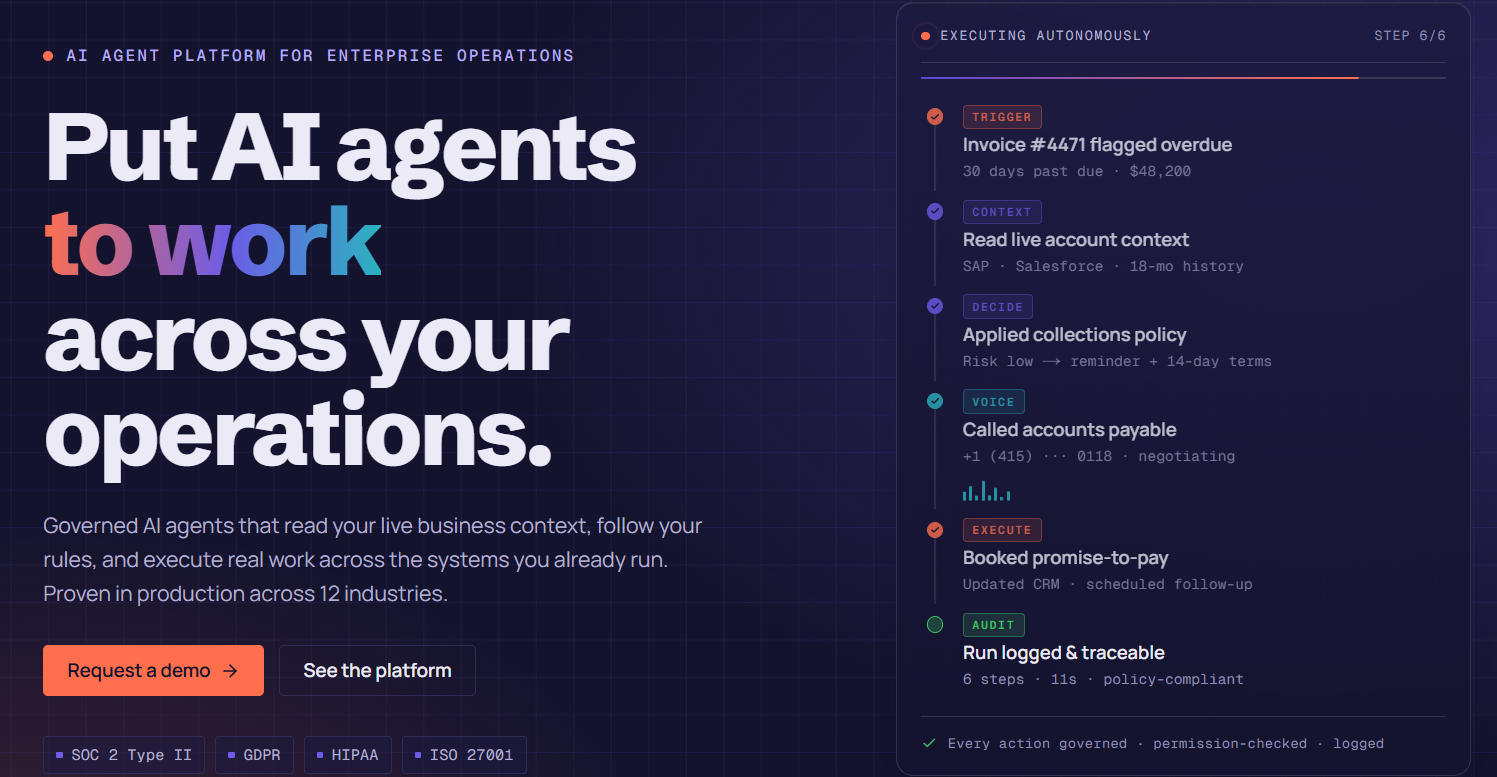
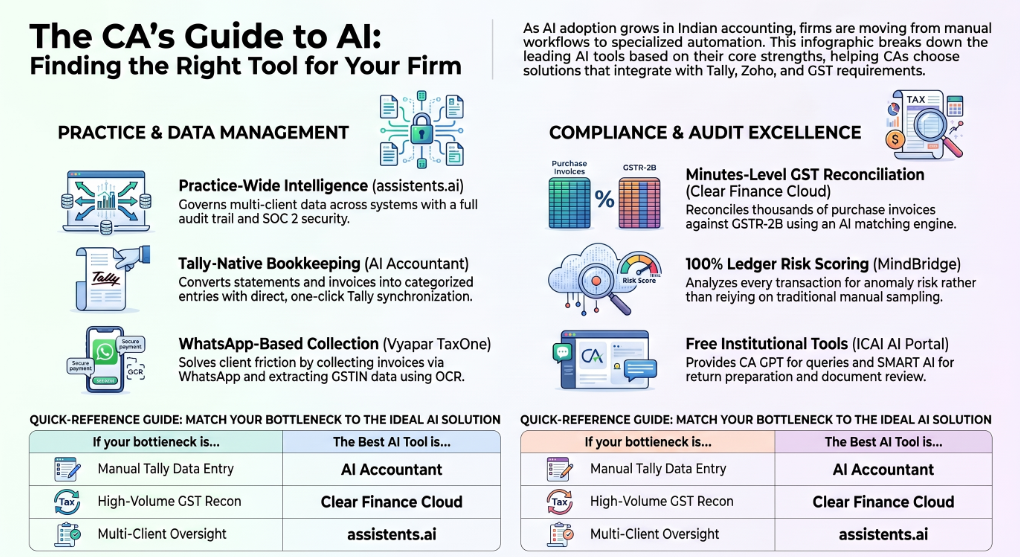
assistents.ai is built for the problem most CA-practice AI rollouts eventually run into: point tools automate one task — bookkeeping, or GST, or audit — but the firm still holds it all together across clients with spreadsheets and WhatsApp threads. assistents.ai closes that gap with a governed, three-layer architecture: a Context Engine that ingests live data from 300+ enterprise systems, a Semantic Layer that maps relationships across that data, and a permission-checked Action Engine that executes multi-step work with a full audit trail on every action.
For a CA firm, that means one governed platform — not three disconnected logins — for document processing across messy bank statements and invoices, continuous compliance monitoring, and consolidated, audit-ready reporting across every client file at once.
Key strengths: SOC 2 Type II, GDPR, HIPAA and ISO 27001 certified, with an on-premise deployment option for firms that can't let client financial data leave their own perimeter — a real answer to the "data security" criterion nearly every review in this space names as decisive. Average time to production is about four weeks.
Worth knowing: assistents.ai is not a native Tally-sync bookkeeping product the way AI Accountant or Vyapar TaxOne is. It's best understood as the governed layer a growing firm runs alongside Tally/Zoho and a GST tool — for oversight, document automation, and reporting across the whole practice, not as a replacement for statutory filing software.
Best for: CA firms managing multiple clients that have outgrown a single-purpose bookkeeping tool and need governed oversight across the whole practice, not just faster data entry in one place.
See the professional-services use case →
2. AI Accountant — Best for Tally-native bookkeeping automation
Built specifically for Indian CA firms, AI Accountant focuses on converting bank statements, card bills and vendor invoices into clean, categorised entries with a direct, one-click Tally sync. Best for: firms whose single biggest bottleneck is bookkeeping data entry rather than practice-wide oversight.
3. Vyapar TaxOne — Best for WhatsApp-based document collection
Formerly known as Suvit, Vyapar TaxOne focuses on the unglamorous first step — getting documents out of clients — by letting firms collect invoices and statements directly via WhatsApp, then extracting GSTIN and HSN data with high OCR accuracy. Best for: firms whose biggest friction point is chasing clients for documents, not analysing them.
4. Clear Finance Cloud (ClearTax) — Best for high-volume GST reconciliation
Grown from ClearTax's original tax-filing roots, Clear Finance Cloud's standout feature is an AI-matching engine that reconciles thousands of purchase invoices against GSTR-2B in minutes rather than days of manual VLOOKUPs. Best for: firms with high invoice volumes where GST reconciliation is the dominant recurring workload.
5. Zoho Books AI — Best for Zoho-native practices
For firms whose clients already run on Zoho Books, its built-in automation rules and smart insights add incremental efficiency without introducing a new vendor relationship. Best for: Zoho-standardised practices; less useful for Tally-heavy or mixed-system firms.
6. Ankpal — Best for firms open to a single-platform switch
Ankpal bundles bookkeeping, compliance and reporting into one ecosystem rather than layering onto Tally. Best for: newer or smaller practices willing to consolidate onto a single accounting system rather than integrate with an existing one.
7. ICAI's CA GPT, EasyRecon and SMART AI ITR Assistant — Best free, institutionally-backed option
Hosted directly on ICAI's own AI portal, CA GPT answers member and student queries, EasyRecon handles offline GST reconciliation, and the SMART AI ITR Assistant reviews client documents for return preparation. Best for: every CA firm, as a free starting point — but these are member tools, not a full practice-management platform.
8. MindBridge — Best for audit analytics at scale
Rather than sampling transactions, MindBridge analyses 100% of a client's ledger, scoring every entry for anomaly risk using a blend of statistical models and machine learning — trusted by major global audit networks. Best for: firms with a dedicated, growing audit practice; it has no direct Tally integration and connects via API to larger ERPs instead.
9. Botkeeper — Best for a hybrid AI-plus-human bookkeeping model
Botkeeper pairs AI transaction categorisation with human review below a confidence threshold, which appeals to firms nervous about handing categorisation fully to a model. Best for: firms wanting a safety net built into the automation itself — though it's primarily tuned for US/Canadian banking formats.
10. Microsoft Copilot / ChatGPT — Best general-purpose assistant
Widely used for drafting client emails, summarising accounting standards, and producing first-draft working papers. Best for: every CA as a writing and research aid — but neither connects to a firm's actual books or client data, so neither can reconcile, extract, or act.
11. Provi AI — Best for Indian tax research and audit documentation
Built specifically for Indian tax professionals, Provi AI connects to Tally and Zoho Books to support GST filing prep, GSTR-2A reconciliation, TDS tracking and ITR preparation, alongside AI-assisted audit-working-paper drafting. Best for: firms wanting an India-trained research and drafting assistant layered on top of their existing books.
12. Qosh AI / Vidur AI — Newer India-native entrants worth watching
Both position themselves as India-first automation platforms built around Tally workflows rather than replacing them. Best for: firms wanting to evaluate newer, India-native alternatives alongside the more established names above.
Note: verify current pricing, exact feature sets and integration status for every tool above against its own site before making a purchasing decision — this list reflects public information as of the time of writing.
Real case studies: AI agents in tax research, reporting and document processing {#real-case-studies}
Vendor listicles usually stop at feature claims. Here's what real (anonymized) deployments looked like in production — described by industry and workflow, never by client name:
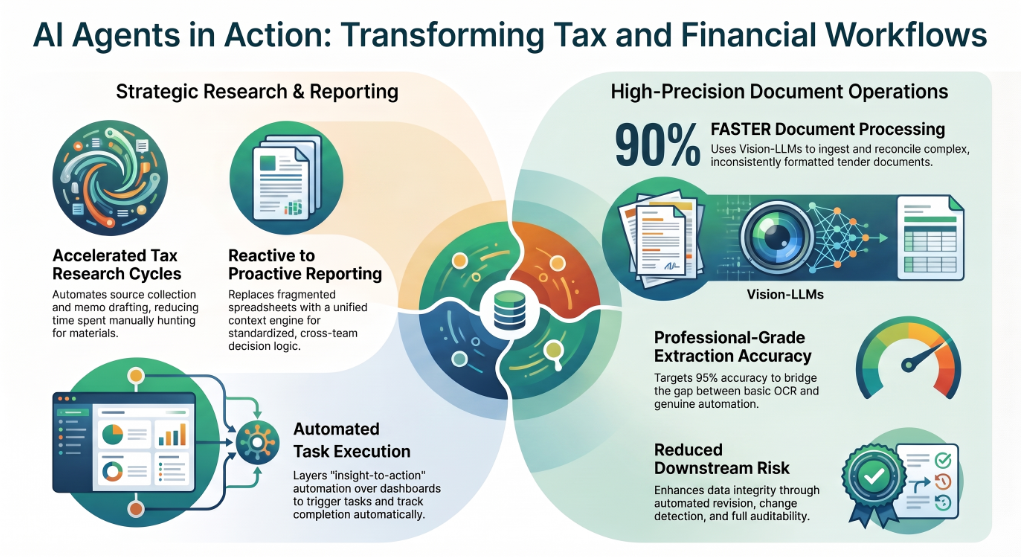
Tax research automation. A sales-and-use-tax research platform built for tax professionals deployed AI agents to automate source collection, summarisation, and draft position-memo generation, with workflow tracking and knowledge-base building built in. The outcome: faster research cycles, less time spent manually hunting for source material, and more consistent, better-documented research output — the direct parallel to the GST and Income-tax research and opinion-drafting work every CA practice does on a recurring basis.
Governed multi-entity reporting. A privately held retail holding group needed governed, cross-functional intelligence across its systems and documents so leadership could move from insight to action quickly, rather than waiting on manually compiled reports. Agents built a unified context engine and a semantic governance layer, then layered insight-to-action automation directly on top of existing dashboards. The result was a shift from reactive reporting to proactive execution, standardised decision logic across teams, and automated task creation with completion tracking — the same problem a CA firm faces when it needs one governed view across dozens of client books instead of a separate spreadsheet per client.
Complex document extraction. A remedial-building and waterproofing specialist needed autonomous agents to ingest, analyse and reconcile complex tender documents into its core operational systems with high data integrity, including vision-LLM extraction from difficult, inconsistently formatted PDFs. The deployment was engineered for up to roughly 90% faster document processing, with a roughly 95% extraction-accuracy target on standard formats, and reduced downstream risk through automated revision and change detection with full auditability. That accuracy bar — real automation rather than basic OCR — is exactly the criterion AI Accountant and CA Monk both name as the line between a genuinely useful tool and one that just creates different manual work.
Why CA firms in India choose assistents.ai over point-solution AI tools {#why-assistents-ai}
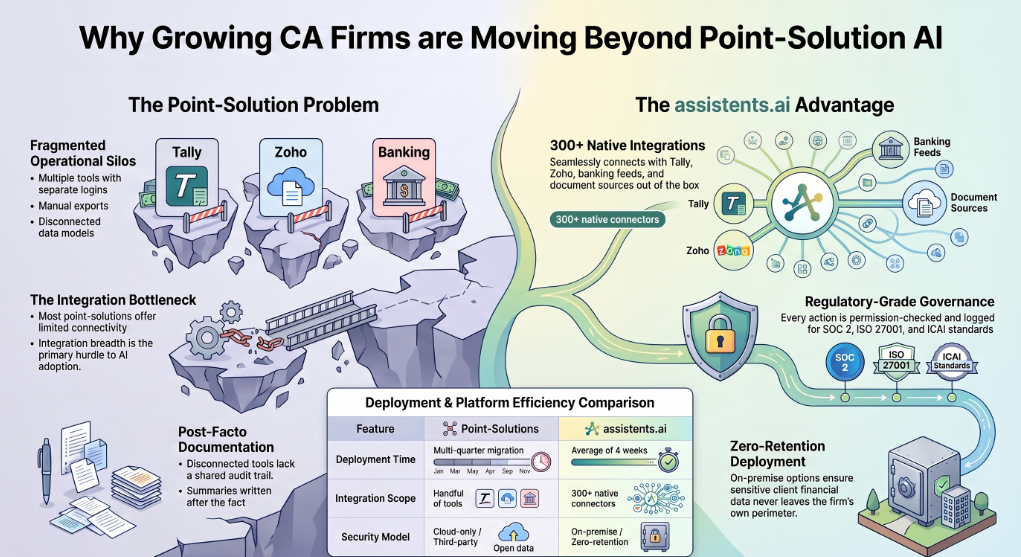
Most tools on this list solve one job well — bookkeeping, or GST, or audit. That's a reasonable place for a small practice to start. But most growing CA firms end up running three or four disconnected tools, each with its own login, its own export step, and no shared audit trail across clients. assistents.ai is built to be the governed layer that sits across all of it instead of being one more silo:
- Governance regulators and clients actually accept. Every agent action is permission-checked and logged with full provenance — exportable evidence suitable for SOC 2 and ISO 27001 audits, and structured enough to support ICAI documentation standards, not a summary written after the fact.
- Client-data residency on your terms. On-premise and zero-retention deployment options mean sensitive client financial data never has to leave your firm's own perimeter — a direct answer to the data-security criterion every competing review names but few India-native point tools actually offer.
- One platform across the whole practice. The same governed execution model covers document processing, compliance monitoring, and client reporting, so a growing firm isn't stitching together a bookkeeping tool, a GST tool, and a reporting tool from three different vendors with three different data models.
- 300+ integrations, not a handful. Tally, Zoho, banking feeds and document sources connect natively — in most CA-firm AI rollouts, integration breadth is the actual bottleneck, not the AI itself.
- Deploys in weeks, not a multi-quarter migration. Average time from pilot to production is about four weeks.
Book a 30-minute discovery call → — no prep needed, just bring the workflow that frustrates your firm most.
AI tools vs. AI agents vs. traditional accounting software {#ai-tools-vs-ai-agents}
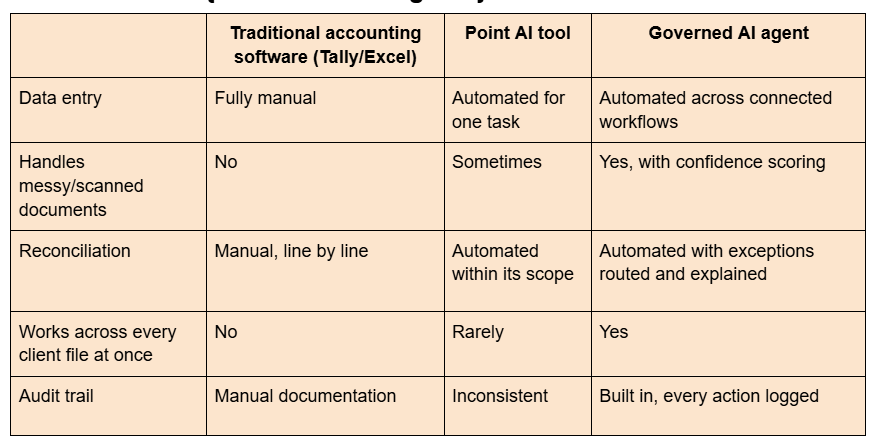
Traditional software remains the system of record — no tool on this list is trying to replace Tally for statutory filing. The real shift is in how much manual work sits around it. A point tool removes friction from one task. A governed agent removes friction from the workflow that connects several tasks, across every client, with a trail a reviewer or regulator can actually follow.
How to choose the right AI tool for your CA practice {#how-to-choose}
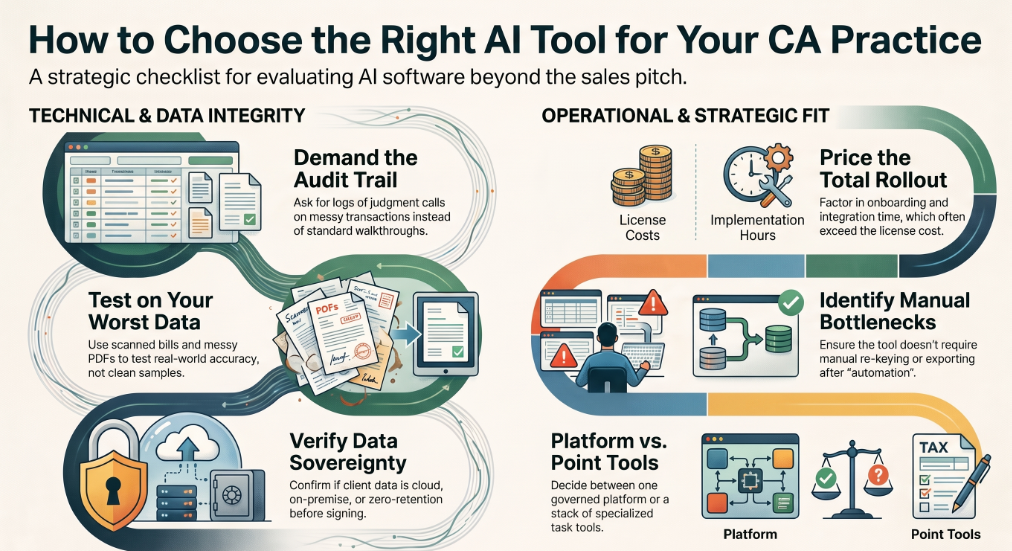
- Ask for the audit trail, not the demo. Any tool can show a clean happy-path walkthrough. Ask what the log looks like when it makes a judgment call on a messy transaction.
- Test it on your worst data, not your best. Indian bank-statement formats, scanned bills, and WhatsApp-forwarded PDFs are the real test — not a clean sample dataset.
- Confirm where client data actually goes. Cloud, on-premise, and zero-retention are different guarantees; know which one you're signing up for, especially for sensitive client files.
- Price the whole rollout, not just the licence. Onboarding and integration time often cost more than the software itself.
- Check how much manual work remains after "automation." A tool that still requires you to export, re-check and re-key data hasn't removed the bottleneck — it's relocated it.
- Decide: one governed platform, or a stack of point tools per task? Both are valid starting points — but know which one you're building toward before you buy the third tool.
Want to see what a governed AI agent actually looks like on your firm's own workflows?
Schedule a demo with assistents.ai →
Related reading {#related-reading}
- Agentic AI in Finance and Accounting: The 2026 CFO Guide — for enterprise finance leaders running an internal finance function, not a client-serving CA practice
- 15 Best AI Agents in Fintech (2026): Examples & Comparison
- assistents.ai for Financial Services
- assistents.ai for Professional Services
- ICAI's official AI portal
FAQs
What are the best AI tools for chartered accountants in India?
The best AI tools combine India-specific compliance depth (GST, TDS, ICAI documentation conventions) with genuine automation rather than basic OCR, and integrate with the systems most firms already run — Tally and Zoho Books. For a single workflow, a point tool like AI Accountant or Vyapar TaxOne can be enough. For firms managing multiple clients and multiple workflows, a governed platform like assistents.ai that adds oversight and audit trails across the whole practice is usually the better long-term fit.
Can AI tools work with Tally?
Yes. Most AI tools built for the Indian market work alongside Tally rather than replacing it — they process statements or invoices, categorise and reconcile the data, then sync or export clean entries into Tally for final accounting and statutory filing.
Will AI replace chartered accountants in India?
No. These tools automate repetitive groundwork — data entry, categorisation, reconciliation, first-pass document review — so CAs can spend more time on judgment, compliance interpretation, and advisory work. Professional sign-off and accountability stay with the CA.
Are AI tools approved or usable by CA firms in India?
Yes, as productivity and automation software. They don't replace statutory responsibilities or professional judgment. ICAI has itself begun hosting AI tools like CA GPT and EasyRecon on its own portal, signalling institutional acceptance of AI as a support tool in CA workflows.
How much time can a CA save using AI tools?
Many firms report saving several hours per client per month, mostly in reconciliation, categorisation and MIS preparation. Published research has found accountants using generative AI closing month-end books roughly 7½ days sooner than fully manual workflows.
Are AI accounting tools secure for client financial data?
Security varies significantly by vendor. Look for recognised certifications (ISO 27001, SOC 2 Type II), encrypted storage, role-based access control, and — for the most sensitive client data — an on-premise or zero-retention deployment option.
What's the difference between an AI tool and an AI agent for accounting?
A point tool typically automates one task on request. A governed AI agent reads live context, applies a firm's own rules, and completes a multi-step workflow end to end — flagging an exception, routing it to the right reviewer, and logging the resolution — with far less manual triggering at each step.
How should a CA firm start adopting AI tools?
Start with the single workflow causing the most friction each month — usually reconciliation, statement processing, or GST matching — rather than automating everything at once. Validate accuracy on one client's real, messy data before rolling out further.
What is the best AI tool for GST reconciliation?
GST-focused platforms like Clear Finance Cloud and Vyapar TaxOne specialise in matching purchase data against GSTR-2B at scale. Firms that also need multi-client oversight and audit-ready reporting typically pair a GST-specific tool with a governed platform layer like assistents.ai, rather than relying on one tool for both jobs.
What are ICAI-recognised AI tools?
ICAI's own AI portal hosts CA GPT (a conversational assistant for members and students), EasyRecon (offline GST reconciliation), and the SMART AI ITR Assistant (client document analysis for return prep) — free, institutionally endorsed starting points rather than full practice-management platforms.

Transform Your Business With Agentic Automation
Agentic automation is the rising star posied to overtake RPA and bring about a new wave of intelligent automation. Explore the core concepts of agentic automation, how it works, real-life examples and strategies for a successful implementation in this ebook.
Sarfraz Nawaz is the CEO and founder of Ampcome, which is at the forefront of Artificial Intelligence (AI) Development. Nawaz's passion for technology is matched by his commitment to creating solutions that drive real-world results. Under his leadership, Ampcome's team of talented engineers and developers craft innovative IT solutions that empower businesses to thrive in the ever-evolving technological landscape.Ampcome's success is a testament to Nawaz's dedication to excellence and his unwavering belief in the transformative power of technology.

More insights
Discover the latest trends, best practices, and expert opinions that can reshape your perspective







Contact us

