
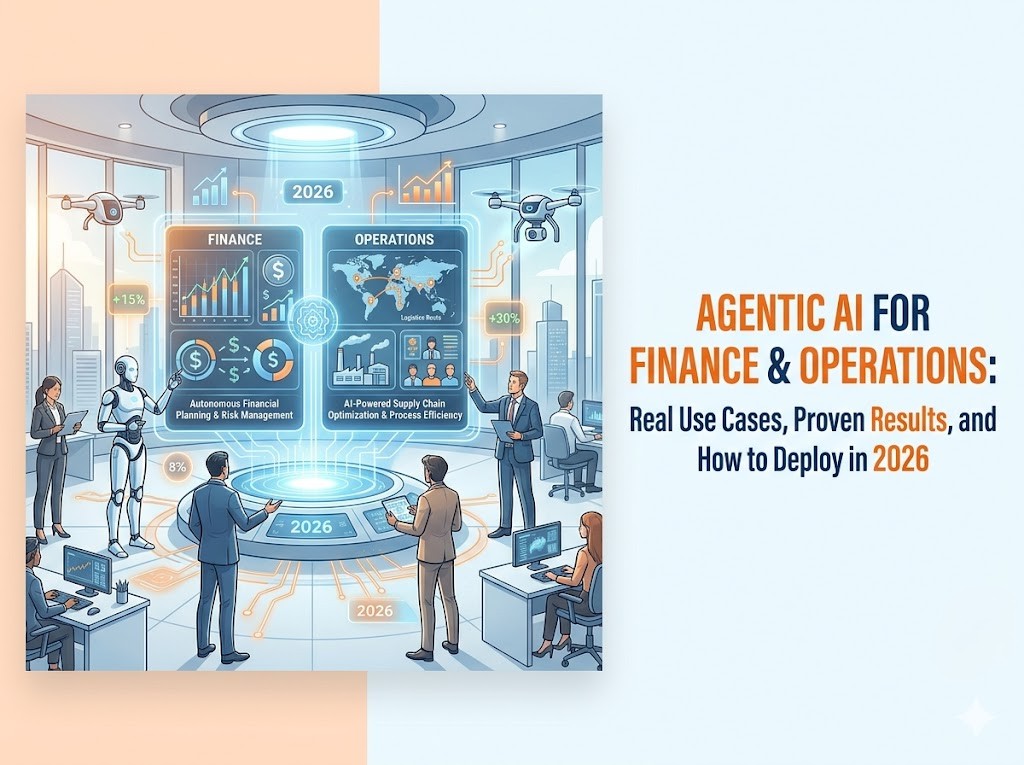
Agentic AI for Finance and Operations: Real Use Cases, Proven Results, and How to Deploy in 2026


Finance teams are drowning in data they cannot act on fast enough. Operations teams are managing complexity that no headcount addition can fully solve. And the gap between the insight sitting in a dashboard and the decision that needs to happen — right now, across multiple systems, with full auditability — keeps widening.
Agentic AI closes that gap.
Not by generating a summary. Not by answering a question in a chat window. By reasoning over your data, planning a sequence of actions, executing across your systems, and looping back to verify outcomes — all with minimal human intervention, and with a full audit trail at every step.
The numbers reflect how fast this is moving. According to Wolters Kluwer, 44% of finance teams are using agentic AI in 2026 — an increase of over 600% from 2025. McKinsey reports that early agentic AI deployments are already reducing manual workloads by 30 to 50% in finance and operations functions. KPMG places global market spend on agentic AI at an estimated $50 billion in 2025, with financial services among the top drivers.
This is not a futures report. This is a practitioner's guide, built from real enterprise deployments across banking, logistics, retail, energy, real estate, and multi-entity conglomerates — spanning organisations from India to the UAE to the US to Australia.
If you are a CFO, COO, or enterprise technology leader deciding where to deploy AI agents first, this is the guide that answers your actual questions: what works, what the results look like, and how to get there without a 12-month implementation cycle.
What Is Agentic AI — and Why Does It Matter for Finance and Operations?
Agentic AI refers to AI systems that do not wait for instructions. They perceive context, set goals, plan multi-step actions, use tools and external systems, and adapt based on what they encounter — operating within defined boundaries and escalating to humans when required.
The simplest way to understand the distinction is by what each type of AI does when it encounters a problem:
- A chatbot answers the question you asked.
- Generative AI creates content or a summary based on your prompt.
- RPA executes a fixed sequence of steps on a screen.
- An AI agent understands the goal, determines the steps needed, executes them across multiple systems, handles exceptions, and reports back — including flagging when something needs a human decision.
In finance and operations, this distinction is the difference between a tool that helps you work and a system that does the work.
Agentic AI vs. Generative AI vs. RPA: The Actual Difference
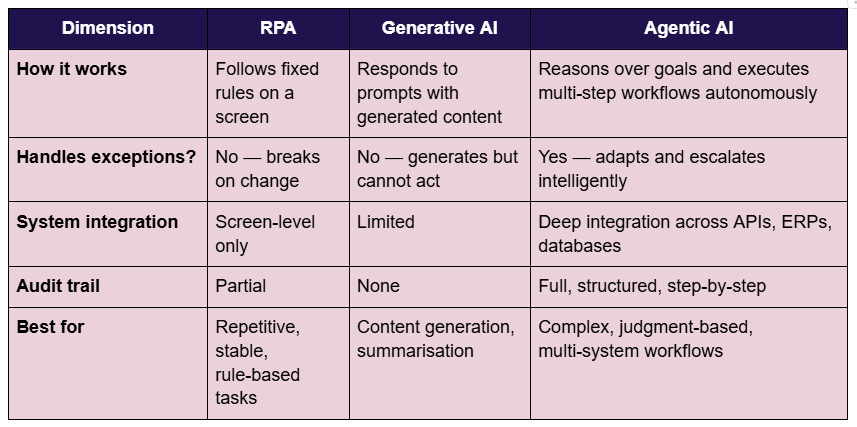
Finance and operations functions are the highest-ROI targets for agentic AI for a precise reason: they are full of high-volume, judgment-based workflows that cross multiple systems, involve exceptions, and require auditability. That is exactly the problem profile AI agents are built to solve.
The Finance and Operations Frontier: Where AI Agents Deliver Measurable Impact
The following use cases are not theoretical. Each one maps to a real enterprise deployment — across different industries, geographies, and scales of operation. No client names are used, but the scope, the approach, and the outcomes are drawn directly from live systems.
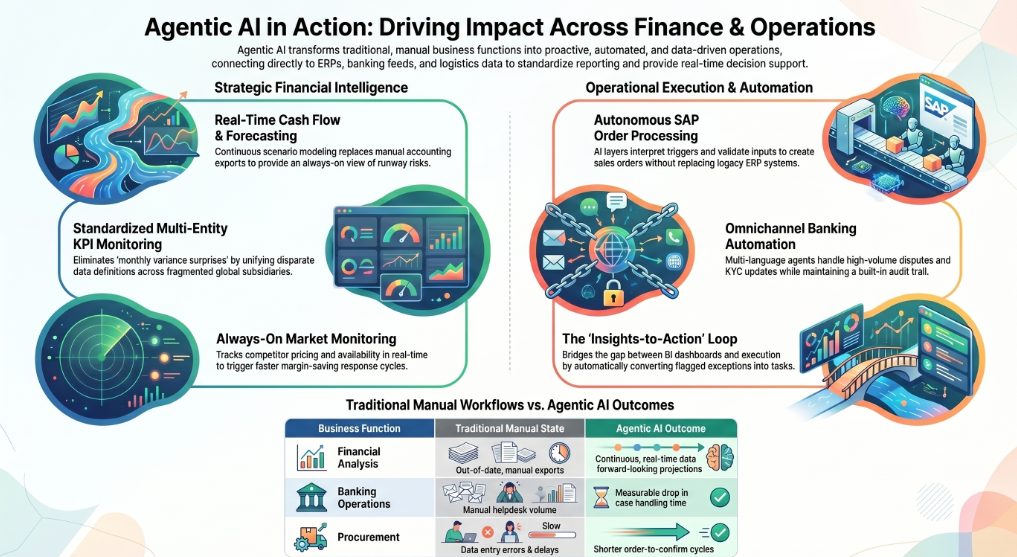
Financial Forecasting and Cash Flow Intelligence
One of the most urgent problems for CFOs and finance leaders is the gap between financial data and financial decision-making. Data sits in accounting exports, banking feeds, and ERP systems — but synthesising it into a forward-looking view of cash position, runway, and risk requires hours of manual work that is always slightly out of date by the time it reaches a decision-maker.
An AI CFO agent changes the operating model entirely. It connects to accounting and banking data sources, runs continuous forecasting and scenario modelling, monitors cash position in real time, and fires alerts when runway risks or anomalies emerge — before they become crises. For teams managing portfolios of clients or subsidiaries, it creates advisory-scale insight without advisory-scale headcount.
In practice, this has meant faster analysis cycles, earlier detection of cash risks, and the ability for finance leaders to operate with the kind of forward visibility that was previously available only at the enterprise level.
Omnichannel Banking and Dispute Automation
Banking operations teams deal with some of the highest volumes of exception-heavy, compliance-sensitive workflows in any industry. Disputes, fraud triage, KYC updates, onboarding — each one involves multiple systems, strict regulatory requirements, and the constant tension between speed and auditability.
Deployed across chat, email, and voice channels — in multiple languages including Hindi and English — an omnichannel banking AI agent handles intake, classifies cases, routes workflows, surfaces next-best actions for human agents, and maintains a structured audit trail at every step. SLA monitoring runs continuously. Escalation paths are pre-defined and consistent.
The outcomes from live deployments include significantly reduced case handling time, a measurable drop in manual helpdesk volume, and compliance readiness that audit teams can actually rely on — because the trail is built into the workflow, not reconstructed after the fact.
Procurement, Vendor Management, and SAP Order Automation
Procurement is one of the highest-value, most manual-intensive functions in any organisation. Purchase requests, vendor validation, RFQ management, supplier performance tracking, order creation — each step is a handoff point where data entry errors, approval delays, and legacy system dependencies accumulate.
One deployment replaced an end-of-life document management system for sales order processing with an agentic AI layer that interprets order triggers, validates inputs, creates SAP sales orders autonomously, applies rules-based exception handling for approvals, and maintains a reconciliation-ready audit log. The result was a shorter order-to-confirm cycle, fewer data entry errors, and a reduction in legacy dependency — without a rip-and-replace of the ERP.
On the procurement side, RFQ automation, supplier discovery, and vendor performance dashboards have compressed procurement cycles and improved sourcing visibility for teams that were previously dependent on manual follow-up across supplier networks.
Finance KPI Monitoring and Margin Intelligence Across Business Groups
For holding companies and multi-entity conglomerates, the finance intelligence problem is compounded by fragmentation. Each subsidiary may have its own systems, reporting cadences, and data definitions. Leadership ends up managing variance surprises because no one has a continuous, standardised view across the group.
Agentic AI solves this with a layer that standardises KPI definitions across entities, ingests data continuously, and generates automated alerts for early warning signals — purchase price trends, gross margin impact, early-payment analysis, vendor delivery and returns performance. Scheduled insight packs go to leadership on a cadence that matches their decision rhythm.
The shift is from monthly variance surprises to continuous margin monitoring. Earlier detection of erosion. Standardised finance intelligence across subsidiaries that previously ran on incompatible definitions of the same metrics.
Supply Chain and Logistics Analytics
Global logistics and supply chain operations generate enormous volumes of operational data — across terminals, rail schedules, yard operations, customs workflows, and inland delivery networks. The challenge is not collecting the data. It is turning it into decisions fast enough to matter.
One enterprise-scale deployment digitised terminal and rail management workflows, built executive dashboards and operational alert systems on top of live data, and implemented exception management that surfaces the right signal to the right person at the right moment. Multi-entity KPI consolidation created, for the first time, a single operational view across a global footprint.
The outcome was higher predictability of terminal-to-rail throughput, more efficient coordination across logistics functions, and leadership visibility that previously required significant manual reporting effort to produce.
Operational Analytics and Insights-to-Action Execution
The most underutilised asset in most enterprises is not their data — it is their existing dashboards. Organisations have invested heavily in BI tools, and leadership teams are looking at charts every week. The problem is that charts do not do anything. Someone has to interpret the signal, decide on the action, and then manually create the task, send the communication, or update the system.
An agentic analytics layer built on top of existing dashboards changes this. It applies a semantic governance layer — consistent definitions, business rules, hierarchies — to existing data, then adds an insights-to-action orchestrator that converts a flagged exception into an automated task, a triggered workflow, or a structured escalation. The system does not replace the dashboard; it activates it.
Deployments of this pattern across retail, energy, and real estate have shifted organisations from reactive reporting to proactive execution loops — with standardised decision logic and automated completion tracking that gives leadership genuine confidence in what is actually happening on the ground.
Competitive Monitoring and Market Intelligence
For businesses competing in price-sensitive markets — consumer electronics, HVAC, retail, e-commerce — the intelligence gap between a competitor's pricing move and your own response can cost real margin. Manual monitoring across portals, marketplaces, and channels does not scale.
An agentic competitive monitoring deployment continuously tracks pricing, MRP compliance, discounts, offers, product availability, and ratings across e-commerce channels — and maps that data to the leadership questions that actually matter: Where are our pricing gaps? Which promotions are competitors running that we are not? Where are we losing on availability?
The shift from manual monitoring to always-on agentic intelligence has meant faster competitive response cycles and earlier identification of pricing threats — without any increase in the team responsible for tracking them.
What Agentic AI for Finance and Operations Actually Looks Like in Practice
Understanding the use cases is one thing. Seeing how an agentic system actually flows across a real finance and operations scenario is what makes the operating model click.
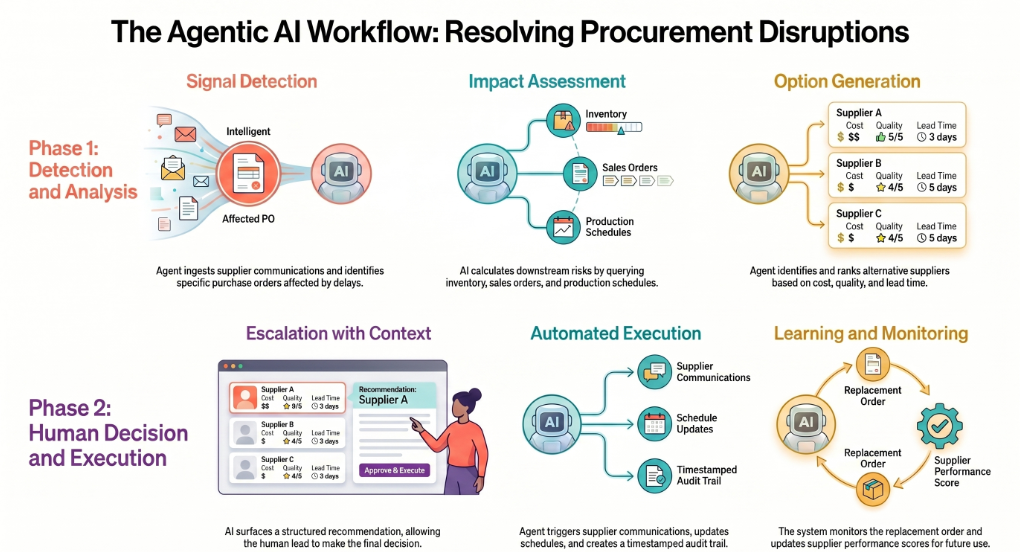
Here is a concrete example of how a multi-agent system handles a procurement disruption — end to end, without waiting for a human to connect the dots:
Step 1 — Signal Detection
A supplier flags a component delay via email. The procurement agent ingests the communication, classifies the issue type, and identifies the affected purchase order.
Step 2 — Impact Assessment
The agent queries inventory, open sales orders, and production schedules across connected systems. It calculates downstream impact: which orders are at risk, what the timing exposure is, and whether buffer stock exists elsewhere in the network.
Step 3 — Option Generation
The agent identifies alternative suppliers from the approved vendor list, retrieves current pricing and lead time data, and ranks options against cost, lead time, and quality parameters.
Step 4 — Escalation with Context
Rather than dropping a raw alert, the agent surfaces a structured recommendation to the procurement lead — affected PO, impact summary, ranked alternatives, and a suggested response. The human makes the decision; the agent has done the analysis.
Step 5 — Execution
Once the decision is confirmed, the agent updates the PO, triggers the supplier communication, adjusts the production schedule, and logs every action with a timestamped audit trail.
Step 6 — Learning and Monitoring
The agent continues monitoring the replacement order for further exceptions, and the outcome feeds back into supplier performance scoring.
This is the pattern that repeats across finance and operations deployments — signal, assess, generate options, escalate with context, execute, verify. The human stays in control of the decision. The agent handles everything else.
Agentic AI Deployments Across Industries: Results That Matter
The following outcomes are drawn from live enterprise deployments across a range of industries and geographies. No client names are used.
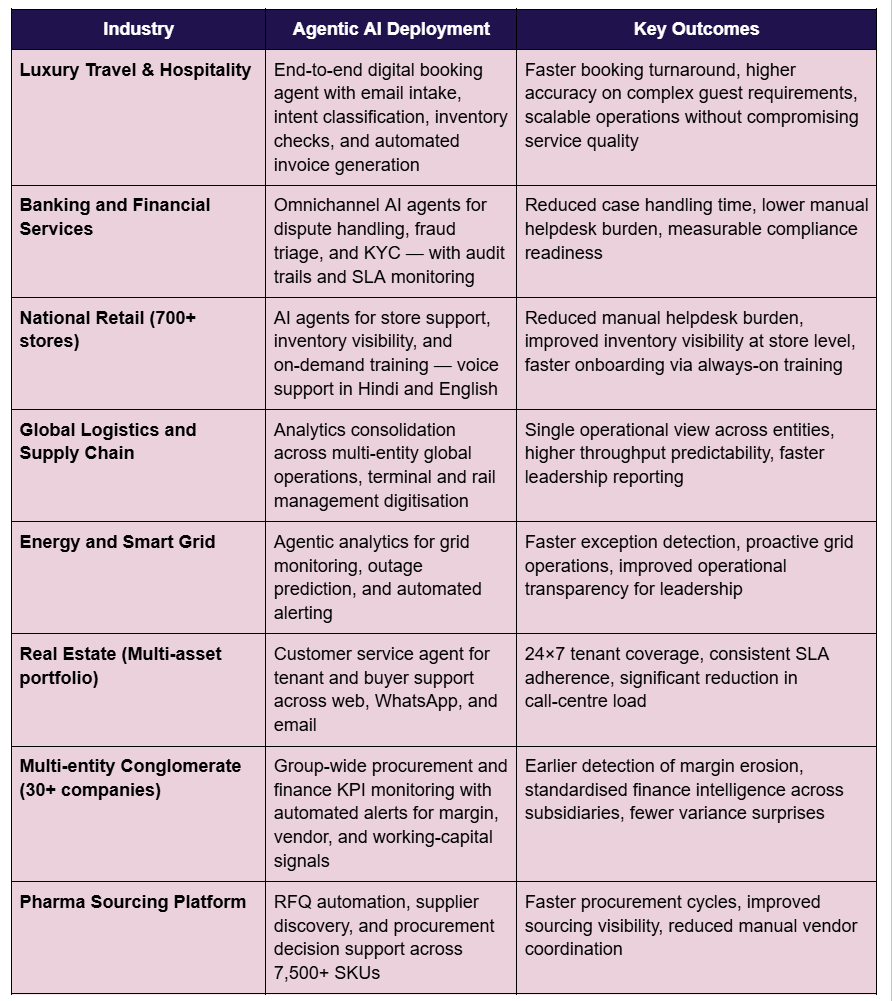
Across all of these, a consistent pattern emerges: the return is not just efficiency — it is a structural shift in how fast an organisation can detect a signal and convert it into a decision and an action. That speed advantage compounds over time.
How to Deploy Agentic AI Across Finance and Operations: A Practical Starting Framework
The most common mistake in agentic AI deployment is starting with the technology and working backwards to find a use case. The organisations that see measurable ROI within the first 90 days start with the problem.
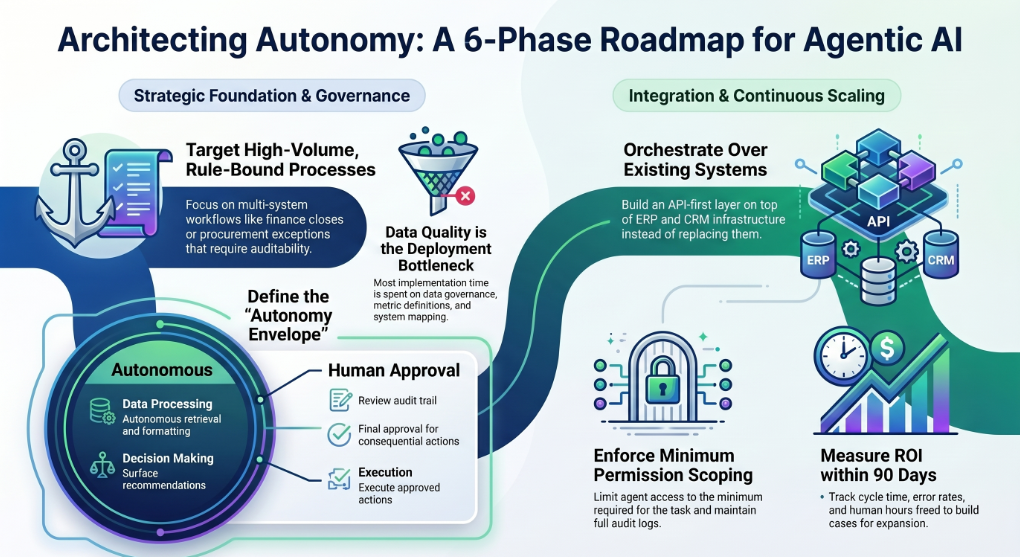
Here is the framework that works in practice.
Phase 1: Identify the Right Process
Not every process benefits from an AI agent. The highest-ROI candidates share a set of characteristics: high volume, rule-bound with exceptions, multi-system, judgment-based at the exception level, and requiring auditability. Finance close workflows, procurement exceptions, dispute handling, inventory alerts, and KPI monitoring all fit this profile. Start there.
Avoid starting with fully unstructured, highly creative, or legally novel tasks. Agents perform best where there is a clear goal, a defined set of tools to use, and a known escalation path when something falls outside the envelope.
Phase 2: Establish the Data Foundation
Agentic AI is only as good as the data it can access and trust. Before deploying agents, establish a governance layer: consistent metric definitions, data quality checks, and a clear map of which systems hold which data. This is the work that most vendor demos skip and most implementations underestimate. It accounts for the majority of deployment time — and the majority of the difference between pilots that work and systems that scale.
Phase 3: Define the Autonomy Envelope
What can the agent do without human approval? What requires a human in the loop? Where does it escalate, and to whom? These boundaries are not permanent — they expand as trust is established — but defining them upfront prevents the two most common deployment failures: agents that do too little because every action requires approval, and agents that operate without sufficient oversight in sensitive contexts.
For finance and operations, a practical starting position is: agents execute data retrieval, analysis, and formatting autonomously; agents surface recommendations for consequential decisions; agents execute approved actions with a full audit trail.
Phase 4: Integrate With Existing Systems — Do Not Replace Them
The most successful agentic AI deployments sit on top of existing ERP, CRM, and BI infrastructure. The agent is not a new system of record. It is an orchestration layer that connects systems that currently require humans to bridge them. This means deployment is faster, risk is lower, and the investment in existing platforms is preserved.
Build the integration layer with API-first architecture and explicit authentication and permission scoping. Every action the agent takes on an external system should be logged, and the permission scope should be the minimum required for the task.
Phase 5: Measure, Then Expand
Define the measurement framework before go-live: cycle time for the target workflow, error rate, escalation rate, human hours freed, and downstream outcome quality. Review at 30 and 60 days. The organisations that scale agentic AI successfully use early deployment results as the business case for the next use case — and they move quickly, because the data exists.
The Shift Is Already Happening — The Question Is Where You Start
The conversation around agentic AI in finance and operations has moved past "should we explore this" to "which use case goes first." According to Gartner, 57% of finance teams are already implementing or planning to implement agentic AI. Deloitte reports that 40% of enterprise applications will be integrated with task-specific AI agents by the end of 2026, up from less than 5% last year.
The organisations reaching measurable ROI are not the ones who waited for the technology to mature further. They are the ones who identified a high-volume, exception-heavy, multi-system workflow, defined their autonomy envelope carefully, built on top of what they already had, and moved.
At Assistents, we have built and shipped agentic AI systems across 30+ enterprise and growth organisations globally — in banking, retail, logistics, energy, real estate, pharma, hospitality, and multi-entity conglomerates. The use cases in this guide are drawn from those deployments. The results are real.
If you want to see what an agentic AI deployment looks like for your specific finance or operations challenge — the architecture, the integration approach, the timeline, and the expected outcomes — we can show you, based on what has already shipped.
[Explore Assistents for Finance and Operations →]
FAQs
What is the difference between agentic AI and RPA?
RPA follows a fixed, pre-defined sequence of steps on a screen. It breaks when the screen changes. Agentic AI reasons over a goal, selects its own steps, uses APIs and tools rather than screen automation, and handles exceptions intelligently. RPA is appropriate for stable, perfectly predictable processes. Agentic AI is appropriate for complex, variable, multi-system workflows that involve judgment at the exception level — which describes most of finance and operations.
Can AI agents replace finance teams or operations staff?
No — and that framing misses the actual value. What AI agents replace is the coordination burden: the manual data retrieval, the system-bridging, the exception routing, the report assembly. Finance and operations teams that deploy agents stop spending time acting as the integration layer between tools, and start spending time on judgment, strategy, and stakeholder decisions — the work that actually requires human expertise. Headcount impact, where it occurs, is typically through redeployment rather than reduction.
Is agentic AI safe for regulated industries like finance?
Yes, when deployed with appropriate governance. The keys are: a defined autonomy envelope with clear escalation paths, a full and immutable audit trail for every agent action, human-in-the-loop oversight for consequential decisions, and compliance-aware system integration. The audit trail that agentic AI generates is, in many cases, more complete and consistent than what manual processes produce. Regulatory readiness is a feature of well-designed agentic systems — not a constraint on them.
What does a human-in-the-loop model look like in practice?
The agent handles all the work that does not require human judgment: data retrieval, analysis, exception classification, option generation, and routine execution. When a decision falls outside the defined autonomy envelope — because the stakes are high, the case is novel, or the confidence is below threshold — the agent surfaces a structured recommendation to a human, including the context they need to decide quickly. The human makes the call; the agent executes and logs the outcome.
How long does it take to deploy an agentic AI system for finance and operations?
A focused, well-scoped deployment — one workflow, one integration target, clear success metrics — can reach production in six to twelve weeks. The timeline is driven primarily by data foundation work and system integration, not by the AI layer itself. Organisations that have invested in clean data architecture and API-accessible systems move fastest. Complexity compounds with the number of systems, entities, and exception types in scope.
What ROI can finance and operations teams realistically expect?
Based on real deployments: operational cost reductions of 25 to 40% in targeted process areas, cycle time reductions of 30 to 90% for specific workflows, and measurable improvements in exception detection speed and compliance readiness. The cleaner the use case definition and the stronger the data foundation, the faster ROI materialises. The organisations seeing the highest returns are those that start narrow, prove the model, and then expand to adjacent workflows using the first deployment's results as the business case.

Transform Your Business With Agentic Automation
Agentic automation is the rising star posied to overtake RPA and bring about a new wave of intelligent automation. Explore the core concepts of agentic automation, how it works, real-life examples and strategies for a successful implementation in this ebook.
Sarfraz Nawaz is the CEO and founder of Ampcome, which is at the forefront of Artificial Intelligence (AI) Development. Nawaz's passion for technology is matched by his commitment to creating solutions that drive real-world results. Under his leadership, Ampcome's team of talented engineers and developers craft innovative IT solutions that empower businesses to thrive in the ever-evolving technological landscape.Ampcome's success is a testament to Nawaz's dedication to excellence and his unwavering belief in the transformative power of technology.

More insights
Discover the latest trends, best practices, and expert opinions that can reshape your perspective

.jpg)





Contact us

