
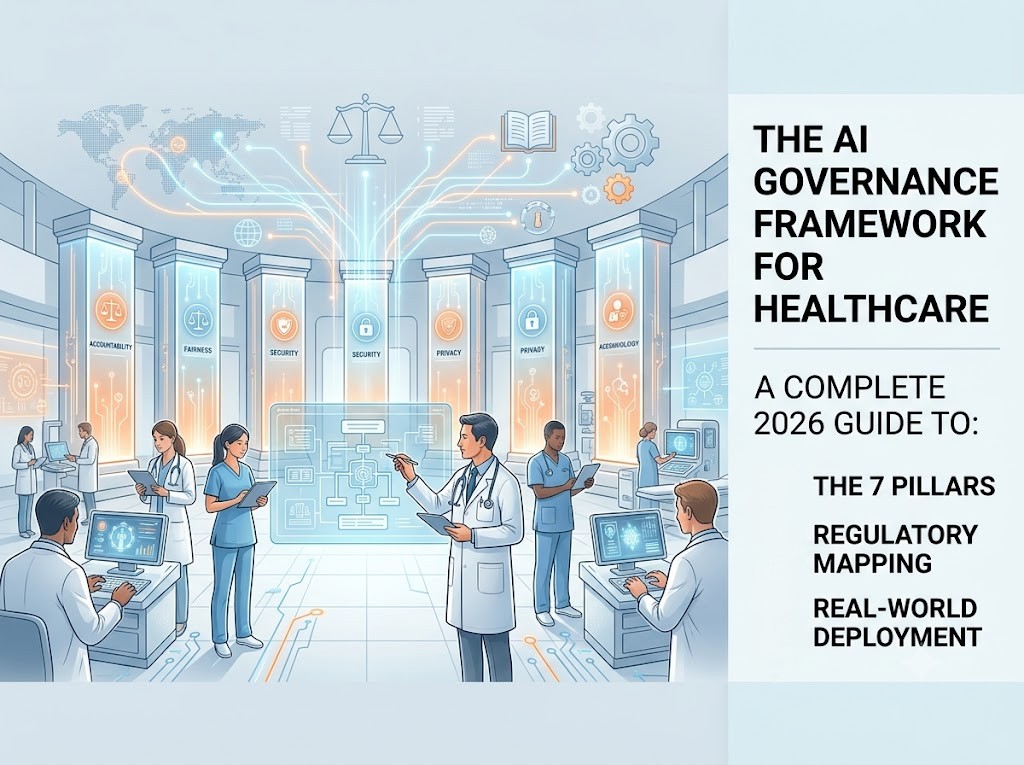
The AI Governance Framework for Healthcare: A Complete 2026 Guide to the 7 Pillars, Regulatory Mapping, and Real-World Deployment


An AI governance framework in healthcare is the set of policies, committees, and technical controls that determine what an AI system — or an AI agent acting on its own — is allowed to see, decide, and do inside a hospital, health system, or health-tech platform, and how every one of those actions stays provable after the fact.
For the past two years, most of what got called "AI governance" in healthcare was really content governance: reviewing what a chatbot said, checking a generated note for accuracy, filtering an output before a clinician saw it. That's still necessary. But it's no longer the hard part.
In 2026, AI in healthcare doesn't just talk. It acts. It gathers clinical evidence and submits a prior authorization. It reads a discharge summary and drafts a claim. It flags a patient for outreach and starts the call. Each of those is a real action against a real system of record — an EMR, a payer portal, a claims engine — and once an AI agent can take that action, governance stops being a policy document you file once a year. It becomes the runtime layer that decides, every single time, whether the action is allowed to happen, and gives you a record that proves it happened correctly.
This guide lays out what a healthcare AI governance framework actually needs to cover in 2026: the regulatory landscape it has to map to, the seven pillars that hold it together, how to structure the committee that runs it, and what governed AI actually looks like once it's running in production — not hypothetically, but in real, anonymized healthcare deployments.
What Is an AI Governance Framework in Healthcare?
An AI governance framework in healthcare is the structured system of policies, committee oversight, risk controls, and technical enforcement that governs how AI tools and AI agents are approved, deployed, monitored, and audited across clinical and administrative workflows.
It answers four questions for every AI system in use: who is accountable for it, what data and systems it's allowed to touch, how a human is looped in when a decision matters, and how you prove — to an auditor, a regulator, or a patient — exactly what happened and why. A framework that only answers the first two questions covers content AI. A complete one, built for 2026, has to answer all four for autonomous agents too.
Why Healthcare Needs This Now
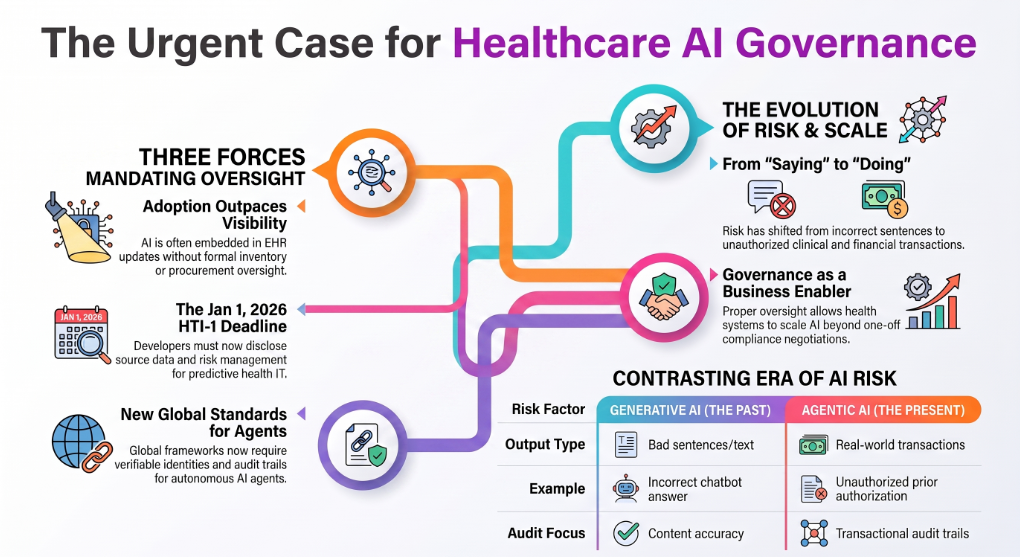
Three forces are converging on healthcare AI governance at once.
Adoption has outpaced oversight. AI is already embedded in scheduling, documentation, prior authorization, and clinical decision support at most health systems — often through vendor updates to existing EHR modules rather than a formal procurement decision. It's common for a hospital's own leadership to be unable to produce a simple inventory of every AI tool currently touching patient data, which makes it structurally impossible to govern what nobody can see.
Regulation caught up. HHS's ONC finalized the HTI-1 rule, the first nationwide transparency requirement for AI and predictive algorithms built into certified health IT — the software that supports care at more than 96% of U.S. hospitals. As of January 1, 2026, USCDI v3 became the new certification baseline, and developers of predictive decision support interventions now have to disclose source data, risk management processes, and the population the model was validated on. Layer onto that the FDA's evolving framework for AI/ML-based Software as a Medical Device, including Predetermined Change Control Plans for models that keep learning after approval, and — for organizations with agentic AI specifically — the direction set by Singapore's Model AI Governance Framework for Agentic AI and NIST's AI Agent Standards Initiative, both of which now expect a verifiable identity and audit trail for every autonomous agent, not just every model.
The risk moved from what AI says to what it does. A chatbot that gives a wrong answer produces a bad sentence. An AI agent that's authorized to submit a prior authorization, post a claim, or update a patient record produces a real transaction — one that can be wrong, unauthorized, or invisible to compliance until an auditor asks about it. That's a fundamentally different governance problem, and most healthcare organizations' existing AI policies were written for the first kind of risk, not the second.
None of this makes AI governance a blocker. It makes it the thing that lets a health system move past a single pilot and actually scale AI across a hospital or a health plan without every new use case becoming a one-off compliance negotiation.
The Regulatory Landscape a Healthcare AI Governance Framework Must Map To
A governance framework isn't useful if it can't be traced back to a specific regulatory requirement. Here's the landscape it has to cover, at minimum:
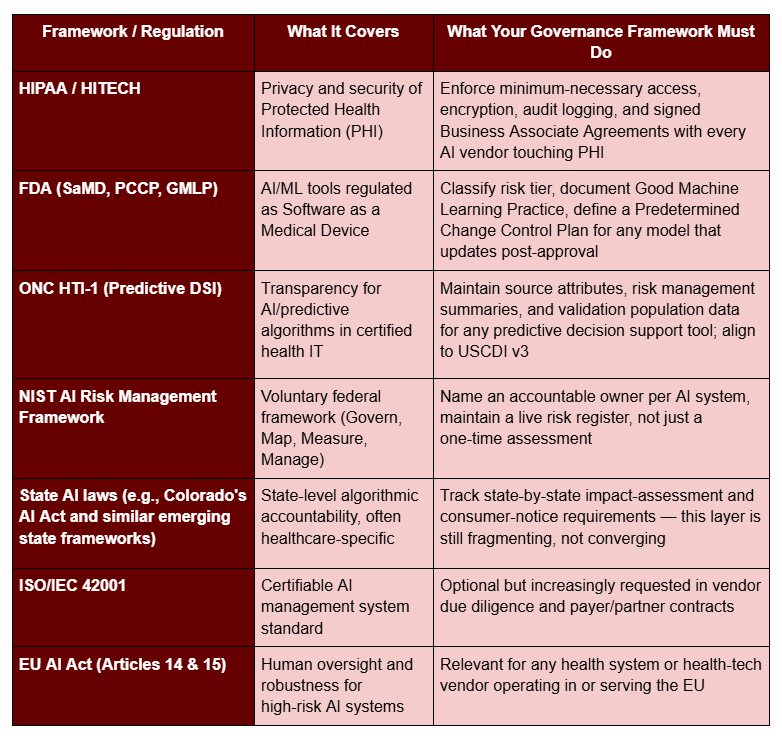
The practical takeaway: no single regulation covers agentic AI in healthcare end to end. HIPAA governs the data. The FDA governs the model, if it qualifies as a medical device. HTI-1 governs transparency inside certified health IT. NIST gives you the risk-management scaffolding to tie it together. A healthcare AI governance framework's real job is synthesizing all of this into one operating model — not picking the piece that's easiest to comply with and calling it done.
The 7 Pillars of an AI Governance Framework for Healthcare
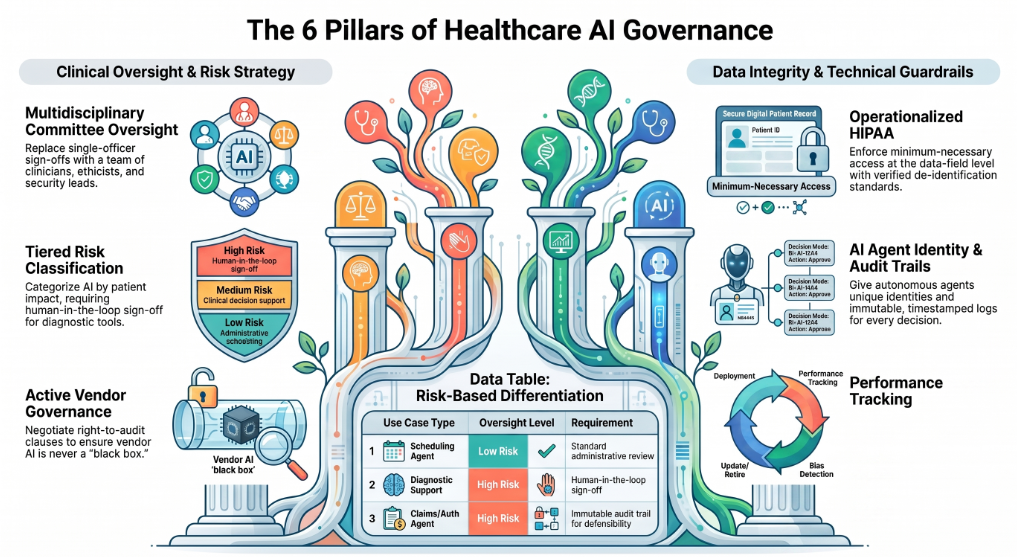
These seven pillars are healthcare-specific — built around clinical risk and PHI, not a generic cross-industry checklist.
1. Clinical & Ethical Oversight
Every healthcare AI governance framework starts with a standing, multidisciplinary committee — not a single compliance officer signing off on a spreadsheet. That committee needs clinical leadership (a CMIO or physician champion), an ethicist or patient advocate, legal and compliance, a security lead, and someone who actually understands the model. Its job is to evaluate new AI use cases before deployment, not just review incidents after one goes wrong.
2. Data Governance & Privacy
This is where HIPAA becomes operational rather than aspirational: minimum-necessary access enforced at the data-field level, de-identification standards for anything used in model training or evaluation, a signed Business Associate Agreement with every vendor that touches PHI, and a data lineage record that can show exactly where a piece of information came from and everywhere it's been used.
3. Risk Classification & Clinical Safety
Not every AI use case carries the same stakes, and a framework that treats a scheduling agent the same as a diagnostic-support tool will either over-restrict the low-risk work or under-restrict the high-risk work. Tier AI use cases by patient impact, require human-in-the-loop sign-off for anything that materially affects diagnosis or treatment, and run bias and health-equity audits across patient subgroups before and after deployment — not once, at launch, and never again.
4. Regulatory & Compliance Mapping
Every AI system and every AI agent needs a documented line back to the regulatory table above: which regulations apply, what specific controls satisfy them, and who's accountable for keeping that mapping current as HTI-2 and further FDA guidance arrive. Treat this as a living document a compliance team updates, not a one-time diagram from the initial rollout.
5. Agent Identity, Permissions & Audit Trails
This is the pillar most existing healthcare AI policies don't cover yet, because it's new: when the "AI" in question is an autonomous agent rather than a static model, it needs its own identity, scoped to only the data fields and actions its specific task requires — never a shared, all-access credential. Every action it takes needs an immutable, timestamped log: what data it accessed, what decision it made, what triggered an escalation, and who approved it. For a claims or prior-authorization agent specifically, that audit trail is what turns "the AI did it" into a defensible, reviewable record.
6. Lifecycle Management & Continuous Monitoring
Governance doesn't end at go-live. Every AI system needs pre-deployment validation against a representative population, post-deployment monitoring for performance drift and emerging bias, a formal change-control process for model updates, and a documented decommissioning plan so a retired model can't keep quietly making decisions in the background.
7. Vendor & Third-Party Governance
Most AI in a hospital doesn't arrive through a governance committee's front door — it arrives bundled into an EHR upgrade or a point solution a department bought directly. This pillar closes that gap: require model documentation and update policies from every vendor, verify FDA status where applicable, and negotiate right-to-audit clauses so a vendor's AI is never a black box your own governance framework can't see into.
How to Build an AI Governance Committee for Healthcare
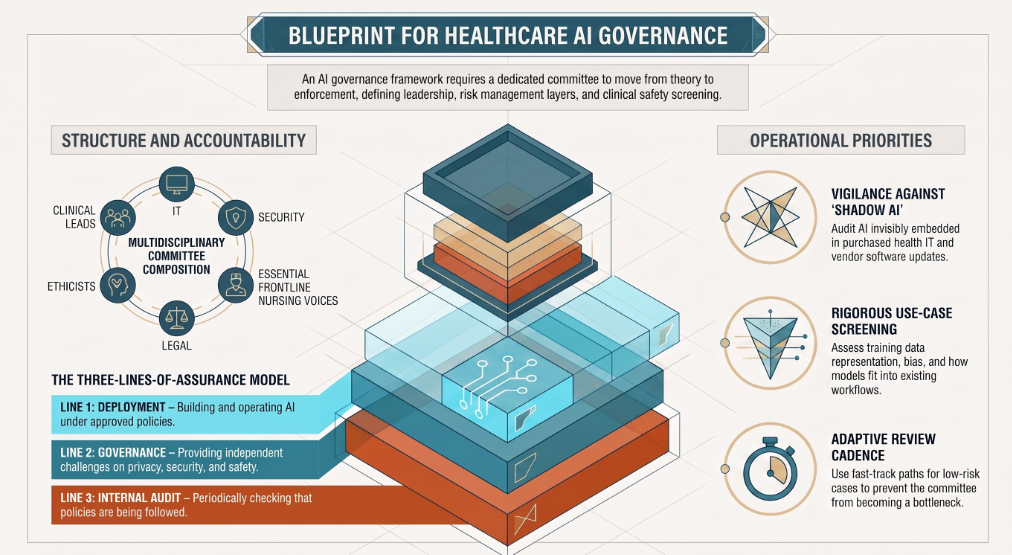
A framework without an owner is a document nobody enforces. The committee is what makes it real.
Composition. At minimum: a physician or CMIO as clinical chair, a compliance/legal representative, a CISO or security lead, a data science or IT representative who understands how the models actually work, and a patient advocate or ethicist. Nursing and frontline operational leadership should have a standing voice, not just clinical executives — they're the ones who'll notice when an AI tool doesn't fit the actual workflow.
Decision rights. Borrow the three-lines-of-assurance model many health systems already use for financial and clinical risk: Line 1 is the team building or deploying the AI, operating under approved policy. Line 2 is the governance committee itself, providing independent challenge on privacy, security, and clinical safety. Line 3 is internal audit, periodically checking that the first two lines are actually doing what they say.
What the committee actually does. It screens new AI use cases before they reach a patient — asking whether the clinical need is real, whether the training data is representative, whether bias has been assessed, and where the model's output fits into an existing workflow. It reviews any AI already embedded in purchased health IT, since that's often how AI first enters a hospital, invisibly, through a vendor update rather than a procurement decision. And it owns escalation: a defined path for any clinician, patient, or staff member to flag a concern about an AI tool's behavior.
Cadence. Standing committees that meet quarterly tend to fall behind actual deployment speed. A working healthcare AI governance program needs a fast-track review path for low-risk use cases and a full committee review reserved for anything touching diagnosis, treatment, or a vulnerable population — otherwise the committee itself becomes the bottleneck that pushes departments toward shadow AI adoption.
A Practical Model: The PPTO Framework Applied to Healthcare
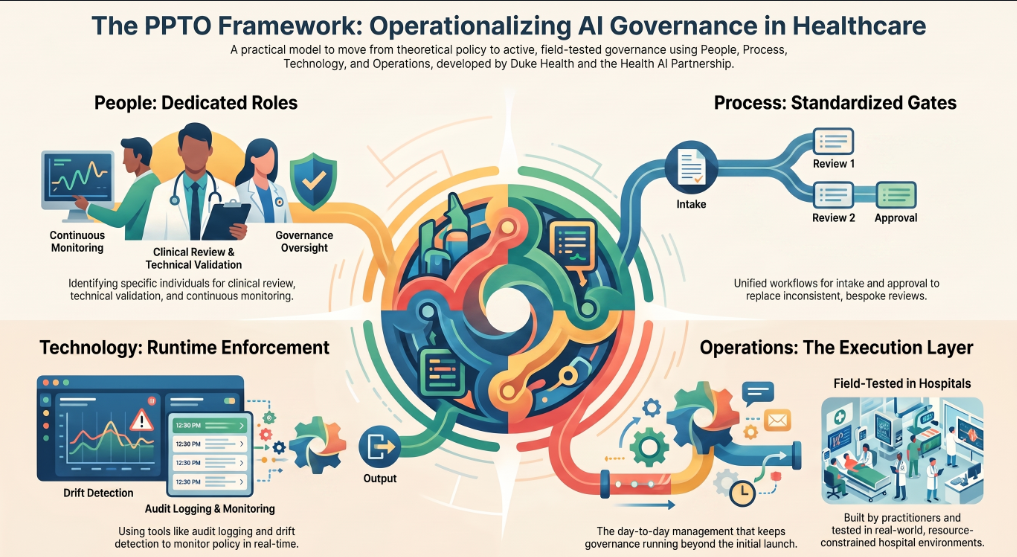
Committees and pillars give you the what. The People, Process, Technology, Operations (PPTO) framework — developed out of Duke Health's own AI governance program and the Health AI Partnership, a network of more than 35 health systems and federal agencies that Duke coordinates — gives you a structure for the how.
- People: the skills and roles your organization actually needs — not just a committee, but named individuals responsible for clinical review, technical validation, and ongoing monitoring.
- Process: standardized workflows for intake, evaluation, approval, and post-deployment review, so every AI use case moves through the same gates instead of getting a bespoke process each time.
- Technology: the monitoring and enforcement tooling that makes policy actually operate at runtime — permissioning, audit logging, drift detection — rather than living in a policy document nobody checks against.
- Operations: the ongoing execution layer that keeps governance running day to day, not just at launch.
A published case study documented PPTO applied inside a large Canadian hospital system that was early in its AI adoption: stakeholder interviews identified gaps, co-design workshops adapted the framework to the organization's specific context, and the result was a functioning AI governance committee and a set of formal policies — not just a framework on paper. That's the useful part of PPTO: it was built by practitioners inside a health system, not proposed by an outside consultancy, and it's been tested in a real, resource-constrained hospital environment rather than only a large academic medical center.
Governance That Ships With the Agent, Not After It
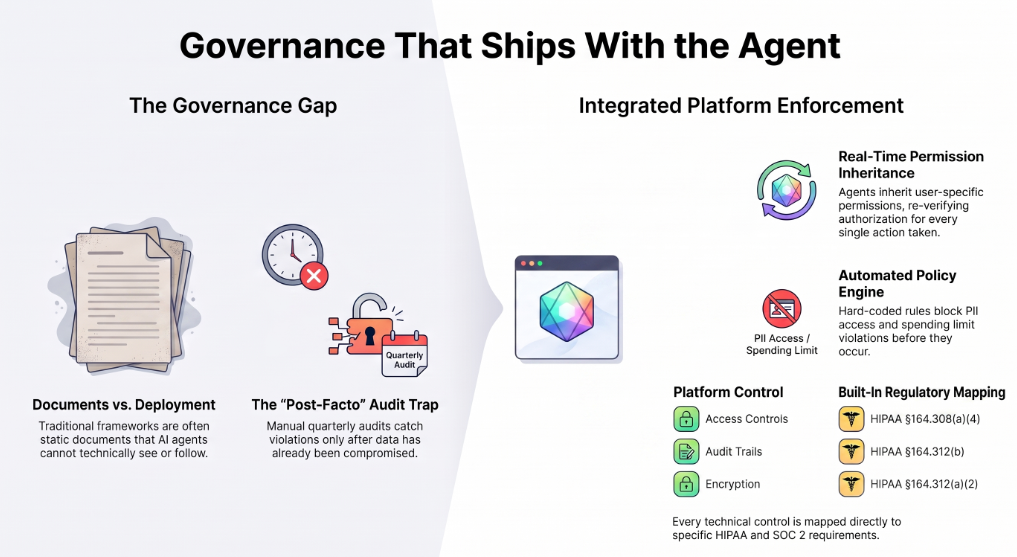
Here's where most healthcare AI governance frameworks break down in practice: the framework gets written, the committee gets formed, and then the actual AI agents get deployed on a platform that was never built to enforce any of it. Governance becomes a document the agents don't know exists.
This is the specific gap assistents.ai was built to close for Pillar 5 — agent identity, permissions, and audit trails — and Pillar 4 — regulatory mapping.
Every agent on the platform inherits the permissions of the user who invoked it — never broader. A prior-authorization agent processing insurance claims only accesses the claims a specific user is authorized to see, and that check happens on every action, not just once at login. A policy engine sits underneath every agent: rules for spending limits, PII access, data retention, and region locks are defined once and enforced automatically, with violations blocked and flagged rather than caught after the fact in a quarterly audit. High-impact decisions — a flagged PHI access request, an exception outside normal policy — route to a human approver automatically, with the context preserved for review.
And because Pillar 4 requires a documented line from every control back to a specific regulation, that mapping is built in rather than assembled after the fact: access controls map to HIPAA §164.308(a)(4), audit trails to §164.312(b), encryption to §164.312(a)(2). The platform is SOC 2 Type II certified, GDPR compliant, and HIPAA-capable with a Business Associate Agreement available — no custom negotiation required, and no PHI ever leaves your environment when deployed on-premise or in an isolated VPC.
That's the practical difference between a governance framework and a governance framework that actually holds once agents start acting on real patient and claims data.
Healthcare AI Governance in Production: Real, Anonymized Deployments
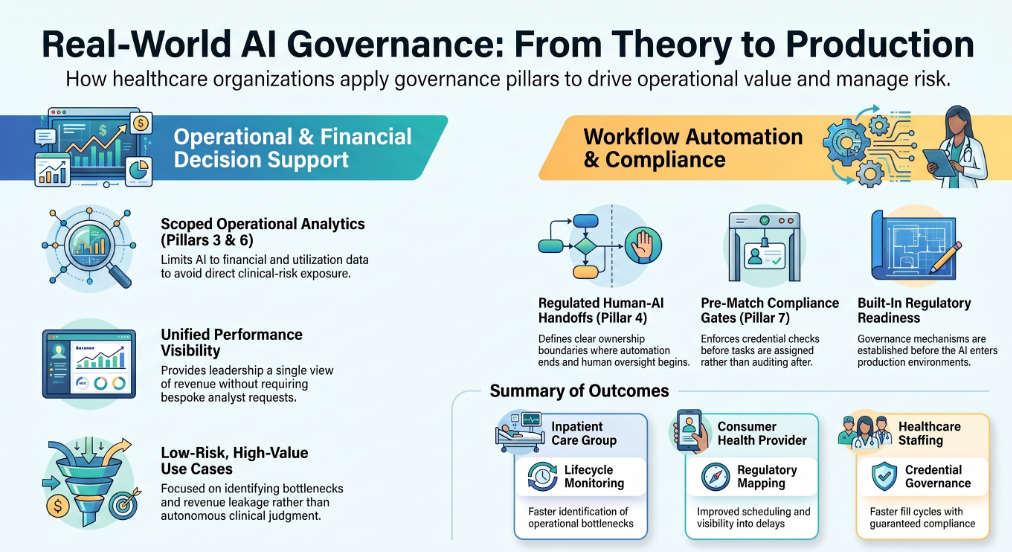
Most content on healthcare AI governance stays theoretical — a hypothetical hospital, a hypothetical health plan. Below are real, currently-running deployments, anonymized by design.
A physician-led hospitalist group. This clinical enterprise runs hospitalist programs focused on improving the inpatient care experience. The governance need here wasn't clinical decision automation — it was giving physician and administrative leadership a governed, single view of revenue and utilization performance across the group, without every question turning into a bespoke analyst request. The AI layer sits firmly in Pillar 6 (lifecycle monitoring) rather than Pillar 3 (clinical risk): it's decision-support analytics for operational and financial performance, with physicians retaining every clinical call. Result: faster identification of operational bottlenecks, clearer transparency into service-line performance, and better-supported decisions for leadership — the outcome a governance model should produce when it's scoped correctly to a low-clinical-risk, high-operational-value use case.
A geriatric care provider. Delivering physician-led programs across assisted living and long-term care settings for one of healthcare's most vulnerable patient populations, this organization needed operational and revenue analytics to improve care-program performance and financial outcomes — without that analytics layer ever touching clinical decision-making directly. This is Pillar 3 in action: the risk classification here correctly kept the AI scoped to operational and financial reporting, appropriate for the patient population involved, rather than expanding into anything resembling autonomous clinical judgment. Result: improved visibility into revenue leakage, faster operational decision-making from unified reporting, and more reliable performance tracking across care programs.
A UK private healthcare and testing provider. This organization automated a full consumer-facing workflow — booking through processing through reporting — for a high-volume testing and healthcare service. The governance mechanism worth highlighting is the regulated handoff: each stage of a patient's journey has a defined ownership boundary between automated handling and human oversight, with status monitoring and operational analytics tracking the handoff itself, not just the two endpoints. That's Pillar 4 (regulatory mapping) made concrete — a consumer health service can't treat "the system is automated" as sufficient; it has to show exactly where automation ends and a human takes over at every stage. Result: reduced operational bottlenecks, better scheduling efficiency, and real visibility into exactly where delays were happening.
A healthcare staffing platform. Connecting nursing professionals with healthcare facilities for flexible shift work, this platform used AI to handle credential capture, facility staffing requests, matching, and scheduling. The governance mechanism is Pillar 7 (vendor and credential governance) in its purest form: compliance is enforced before a match is confirmed, not audited after — a shift literally cannot be filled until the credentialing and compliance check clears. In a clinical staffing context, that ordering is the difference between governance that prevents an unqualified placement and governance that only documents one after it already happened. Result: faster fill cycles, better workforce utilization, and compliance readiness built into the match itself.
Across all four, the pattern holds: none of them added governance after something went wrong. Each had a defined mechanism — scoped analytics, a regulated handoff, a pre-match compliance gate — before the AI went into production.
Common Governance Mistakes Healthcare Organizations Make
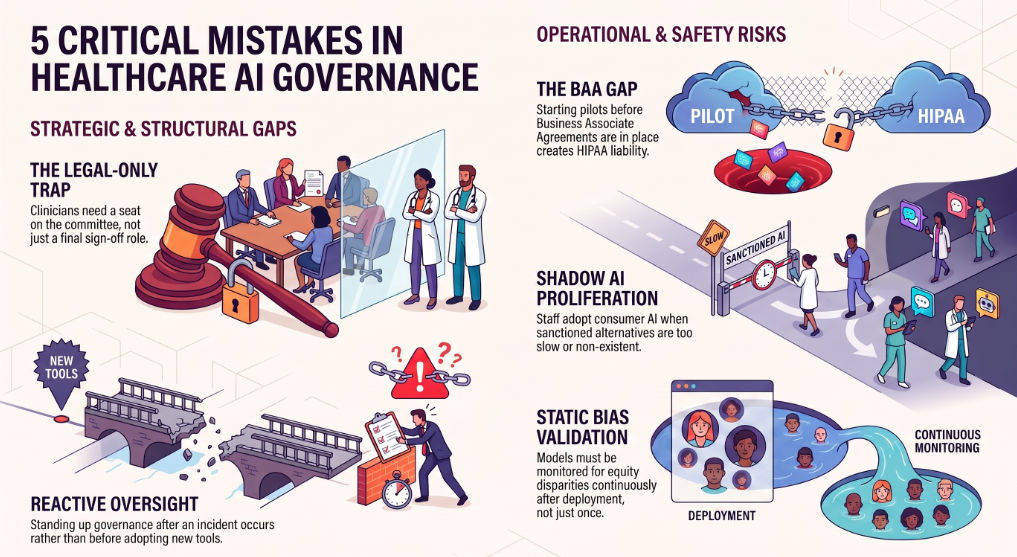
Treating governance as a legal-only function. A policy written entirely by compliance and legal, without clinical input, either misses real clinical risk or restricts AI so heavily that departments route around it. Clinicians need a real seat on the committee, not a review-and-sign-off role at the end.
No Business Associate Agreement before the pilot starts. It's common for a department to start a "quick pilot" with a new AI tool before procurement or compliance has confirmed a BAA is in place. By the time governance finds out, PHI has already touched a vendor with no contractual HIPAA obligation.
Shadow AI. Clinicians and staff adopting consumer AI tools for genuine work tasks — summarizing notes, drafting messages — because the sanctioned alternative is slower or doesn't exist. A framework that doesn't offer a fast, governed alternative doesn't stop this behavior; it just pushes it out of view.
Governance retrofitted after an incident. One frequently cited pattern: a hospital's ethics committee only forms a standing AI governance group after fielding patient-consent questions about an AI documentation tool already in use — a reasonable response, but a reactive one. The stronger pattern is standing up the committee before the third or fourth AI tool arrives, not after the first one raises a question nobody had an answer for.
No bias or equity monitoring after launch. A model validated once at deployment and never re-checked against real-world subgroup performance can quietly develop disparities that a one-time validation would never catch — particularly risky in populations, like geriatric or underserved patients, where training data is often thinner to begin with.
How Assistents.ai Operationalizes Every Pillar
If the seven pillars above are the framework, this is what it looks like once a platform actually enforces it end to end, rather than requiring your team to stitch policy, IT, and audit together manually.
Pillars 4 & 5 (Compliance mapping + agent identity): assistents.ai maps HIPAA Security Rule requirements directly onto platform controls — role-based permissions per agent per dataset, immutable and exportable audit logs, AES-256 encryption at rest with TLS 1.3 in transit, and a Business Associate Agreement available without custom negotiation. Deployment runs on-premise or in a VPC-isolated environment your organization controls, with zero PHI exposure to third-party LLMs or external systems.
Pillar 3 (Risk classification & clinical safety): high-impact actions — anything outside a defined policy threshold — automatically escalate to a human approver, with full context preserved, rather than executing silently. That's the human-in-the-loop control this pillar requires, enforced at the platform level rather than left to individual team discipline.
Pillar 6 (Lifecycle & monitoring): a live governance dashboard shows every agent action, policy violation, and pending approval in real time — filterable by agent, user, date range, or action type — so monitoring is continuous rather than a quarterly audit reconstruction.
What that adds up to in production, specifically for healthcare workflows: 85% faster prior authorization processing, a 94.1% prior-auth approval rate, 40% fewer claim denials, and 91.8% blended automation across prior authorization, claims processing, scheduling, and clinical documentation — all with 100% of agent actions permission-checked and full HIPAA audit coverage. The platform connects to more than 80 healthcare systems out of the box, including Epic, Cerner, Meditech, Availity, Surescripts, and HL7 FHIR interop, and most organizations move from initial setup to production in under three weeks.
The point isn't that a governance framework requires assistents.ai. It's that a framework without technical enforcement behind it stays a document — and the organizations described in the previous section built theirs on a platform where policy, identity, and audit are the runtime, not an afterthought.
AI Governance Framework Checklist for Healthcare
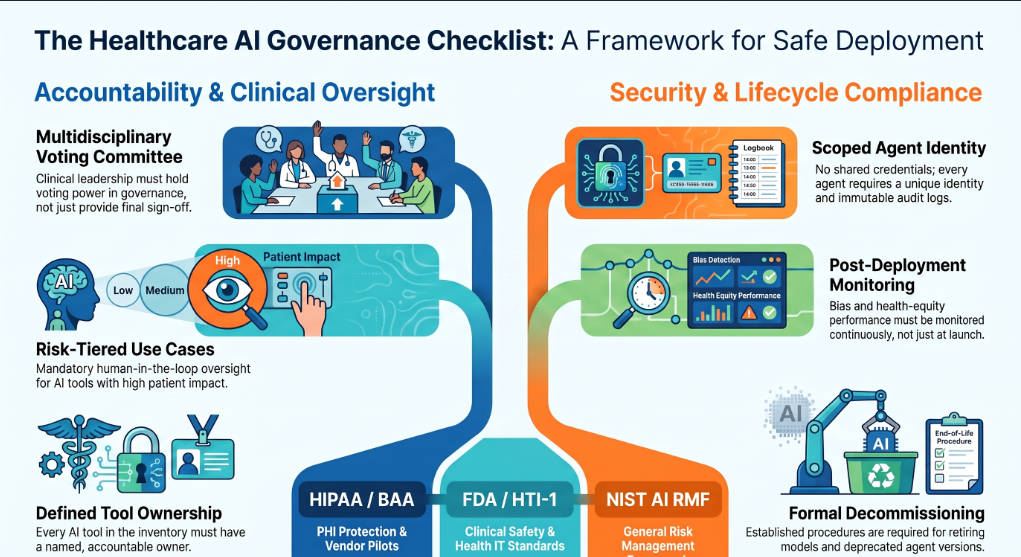
A condensed version for a quick internal review before your next AI deployment:
- A standing, multidisciplinary AI governance committee exists, with clinical leadership as a voting member — not just a sign-off
- Every AI tool in use has a named, accountable owner
- A Business Associate Agreement is confirmed before any PHI touches a new AI vendor, including pilots
- AI use cases are risk-tiered by patient impact, with human-in-the-loop sign-off required above a defined threshold
- Every AI agent has a scoped identity — no agent operates through a shared or generic credential
- Access follows minimum-necessary and least-privilege principles, enforced at the data-field level
- Every agent action generates an immutable, timestamped audit log
- Bias and health-equity performance is monitored post-deployment, not just validated once at launch
- Every control maps to a specific regulation (HIPAA, FDA, HTI-1, NIST AI RMF) — the mapping is a living document, not a one-time diagram
- AI embedded in purchased health IT (EHR modules, vendor updates) is inventoried and reviewed, not assumed to be out of scope
- A decommissioning process exists for retired models and deprecated agent versions
- The committee has a fast-track path for low-risk use cases, so governance doesn't become the reason departments go around it
How to Evaluate an AI Governance Platform for Healthcare
If you're comparing vendors rather than writing policy from scratch, these questions separate a genuinely governed platform from a governance feature list:
Does it integrate with your actual EHR and payer systems — Epic, Cerner, Meditech, your clearinghouse — without requiring you to replace them first?
Will the vendor sign a BAA without a custom, drawn-out negotiation? If a vendor hedges on this question, that's the answer.
Can it deploy on-premise or in an isolated VPC, or does it assume a shared, multi-tenant SaaS model that won't satisfy a regulated data-residency requirement?
Does every control map explicitly to a named regulation — HIPAA Security Rule sections, FDA SaMD requirements, HTI-1 transparency criteria — or is compliance asserted generically without a specific citation?
Is approval enforced before an action executes, in the system itself, or is it a policy written in a document that nothing technical actually checks against?
Can it produce an immutable, timestamped audit trail your compliance team could hand to a regulator or auditor without translating or reconstructing it from raw logs?
Is there a named, accountable owner and a measured outcome for every deployed agent — not just a usage count or an uptime metric?
A platform that can't answer most of these concretely isn't offering healthcare AI governance. It's offering an AI feature with a HIPAA badge on the page.
The Framework Is the Foundation, Not the Finish Line
A healthcare AI governance framework isn't a document you write once and file. It's a standing committee, a regulatory map that gets updated as HTI-2 and new FDA guidance arrive, and — increasingly — a technical layer that enforces policy on every action an AI agent takes, not just the ones a human happens to review.
The organizations getting this right in 2026 aren't the ones deploying the most AI. They're the ones who can show, for every AI system and every agent, who owns it, what it's allowed to do, and whether it's actually delivering the outcome it was built for — with a record to prove it.
If you're building that foundation, see how assistents.ai governs healthcare AI agents in production at assistents.ai/solutions/healthcare, or talk to our team at assistents.ai/contact about what governance looks like for your specific workflows.
FAQs
What is AI governance in healthcare?
AI governance in healthcare is the structured system of committee oversight, policy, and technical controls that determines what AI tools and AI agents are allowed to access, decide, and do across clinical and administrative workflows — and how every action is tracked, approved, and made accountable to a named owner.
Why is AI governance important in healthcare?
Because ungoverned AI in healthcare carries patient-safety, privacy, and regulatory risk other industries don't face at the same intensity. A biased or unmonitored model can worsen patient outcomes; an ungoverned agent touching PHI without a BAA or audit trail creates direct HIPAA exposure, with civil penalties reaching into the millions per violation category.
What are the key components of AI governance in healthcare?
At minimum: clinical and ethical oversight, data governance and privacy controls, risk classification with human-in-the-loop safeguards, regulatory compliance mapping, agent identity and audit trails, lifecycle monitoring, and vendor governance — the seven pillars covered above.
How do you build an AI governance committee in a hospital?
Assemble a multidisciplinary group — clinical leadership, compliance/legal, security, data science, and a patient advocate or ethicist — with real decision rights, not just an advisory role. Give it a fast-track path for low-risk use cases and a full review process reserved for anything touching diagnosis or treatment.
What is the PPTO framework for healthcare AI?
PPTO — People, Process, Technology, Operations — is a governance model developed through Duke Health and the Health AI Partnership, tested in real hospital systems rather than proposed only in theory. It structures governance around the roles needed, the workflows that enforce policy, the technology that makes it operate at runtime, and the ongoing execution that keeps it running.
Does HIPAA require an AI governance policy?
HIPAA doesn't name "AI governance" specifically, but its Security and Privacy Rule requirements — access controls, audit logging, encryption, minimum-necessary use, Business Associate Agreements — apply fully to any AI system or agent that touches PHI, which functionally requires a governance structure to satisfy.
What's the difference between AI governance and AI agent governance in healthcare?
Traditional AI governance controls what a model is allowed to say — content accuracy, bias in outputs. AI agent governance controls what an autonomous agent is allowed to do — which systems it can access, what actions it can execute, and how those actions are approved and audited, which matters once an agent can submit a claim or update a record on its own.
How does the FDA regulate AI in healthcare?
AI/ML tools that qualify as Software as a Medical Device fall under FDA oversight, including Good Machine Learning Practice principles and, for models that continue learning after approval, a Predetermined Change Control Plan defining what may change and how safety will be verified.
What is ONC's HTI-1 rule?
HTI-1 is a 2024 final rule from HHS's Office of the National Coordinator requiring transparency for AI and predictive algorithms built into certified health IT — the systems that support care at more than 96% of U.S. hospitals — including disclosure of risk management processes and the population a model was validated on.
What happens if a healthcare organization has no AI governance policy?
Without a governance framework, AI adoption tends to happen invisibly — through vendor updates and individual department pilots — leaving leadership unable to inventory what AI is actually in use, unable to prove compliance during an audit, and exposed to the same bias, privacy, and patient-safety risks a formal framework is built to catch before they reach a patient.

Transform Your Business With Agentic Automation
Agentic automation is the rising star posied to overtake RPA and bring about a new wave of intelligent automation. Explore the core concepts of agentic automation, how it works, real-life examples and strategies for a successful implementation in this ebook.
Sarfraz Nawaz is the CEO and founder of Ampcome, which is at the forefront of Artificial Intelligence (AI) Development. Nawaz's passion for technology is matched by his commitment to creating solutions that drive real-world results. Under his leadership, Ampcome's team of talented engineers and developers craft innovative IT solutions that empower businesses to thrive in the ever-evolving technological landscape.Ampcome's success is a testament to Nawaz's dedication to excellence and his unwavering belief in the transformative power of technology.

More insights
Discover the latest trends, best practices, and expert opinions that can reshape your perspective


.webp)




Contact us

