
How an AI Agent Automates SAP Invoice Processing End-to-End in 2026


An AI agent for SAP invoice processing is an autonomous software system that ingests incoming invoices, validates them against purchase orders and business rules, handles exceptions without human queuing, and creates confirmed SAP Sales Orders — all without manual data entry or rule-based RPA scripts.
Unlike a static SAP AI agents list that catalogs tools by feature, a true agentic system reasons across the full invoice lifecycle: it interprets order triggers, applies governance logic, routes exceptions with context, and generates a complete audit trail from intake to confirmation.
This guide breaks down exactly how that works, where the ROI comes from, and what to look for when evaluating platforms.
Why SAP Invoice Processing Still Breaks at Scale
SAP is the backbone of finance operations for thousands of enterprises worldwide. But even well-configured SAP environments routinely struggle with invoice processing at volume. The reasons are structural, not technical.
Most SAP deployments rely on a combination of manual data entry, legacy OCR tools, and rules-based automation to move invoices through the system. Each of these layers introduces failure points. OCR misreads vendor fields. Rules engines can't handle the exceptions that make up 20–30% of real invoice volumes. Manual review queues grow faster than teams can clear them.
The result is predictable: invoices age, payment terms are missed, duplicate entries accumulate, and AP teams spend the majority of their time on exception handling rather than exception resolution.
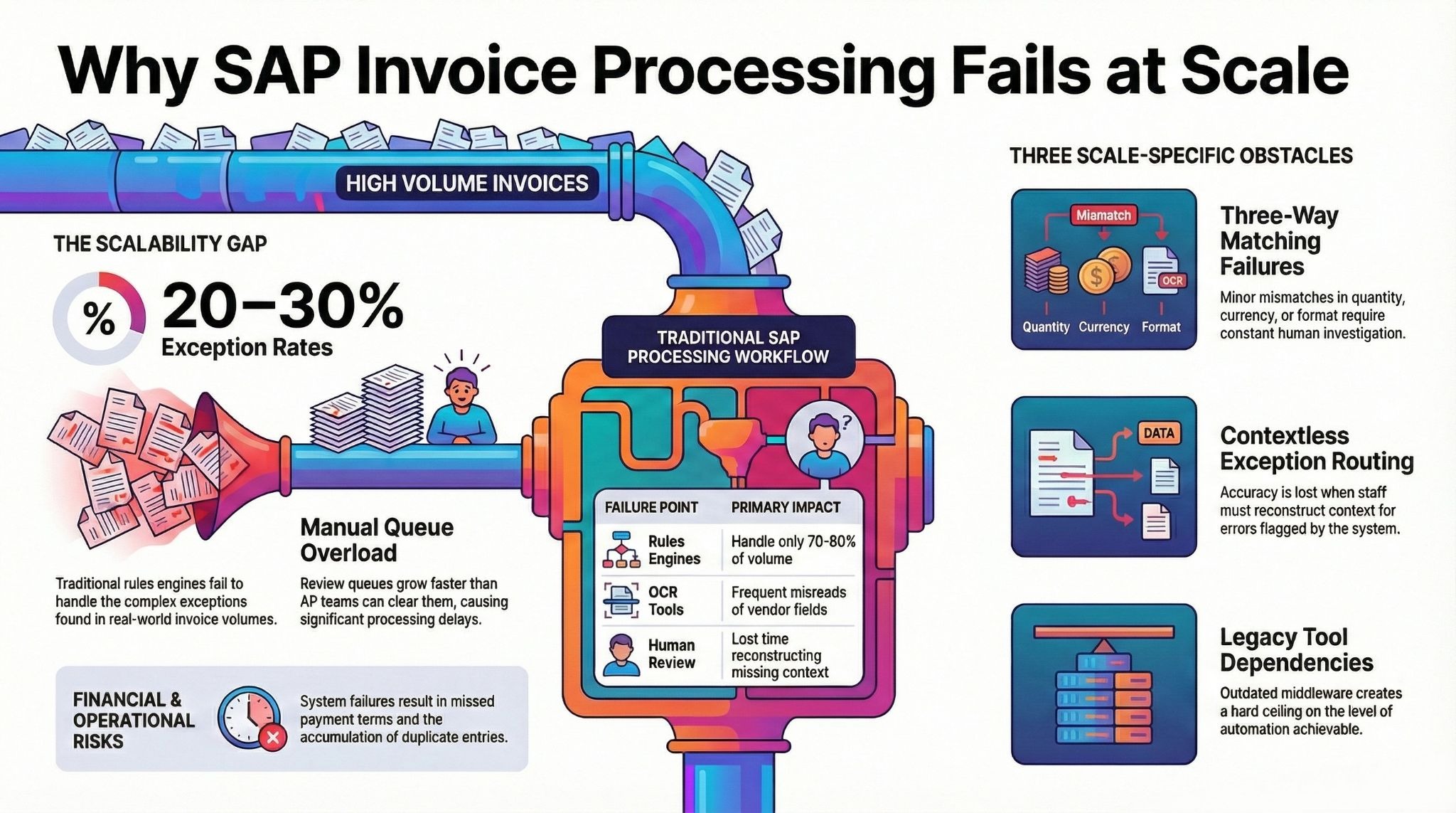
Three specific problems compound this at enterprise scale.
Three-way matching failures. Matching an invoice to a purchase order and a goods receipt sounds straightforward. In practice, quantity tolerances, partial deliveries, currency rounding, and vendor reference format differences cause matching failures that require human investigation. Even a 5% mismatch rate across thousands of monthly invoices creates significant operational drag.
Exception routing without context. When an invoice fails validation, traditional systems flag it and stop. The exception goes into a queue. Someone — eventually — picks it up, reconstructs the context, and decides how to proceed. This context reconstruction is where time and accuracy are lost. The person reviewing the exception often has less information than the system that flagged it.
Legacy tool dependencies. Many enterprises built their invoice processing workflows on middleware and document management platforms that were designed for a different era. These tools are expensive to license, slow to update, and increasingly incompatible with modern integration architectures. They are a ceiling on how much automation is actually achievable.
AI agents address all three of these problems by operating differently from the start.
How an AI Agent Actually Works in SAP Invoice Processing
The phrase "AI for SAP" is broad enough to be almost meaningless. Business AI SAP implementations range from simple chatbots layered on top of SAP interfaces to deeply integrated agentic systems that have read/write access to core SAP modules. Understanding the difference matters when you are evaluating options.
A genuine AI agent for SAP invoice processing operates across four functional layers.
Intake and interpretation. The agent ingests invoices from multiple channels — email attachments, supplier portals, EDI feeds, scanned documents — and interprets them regardless of format. Unlike OCR that extracts fields, an agent understands intent: it can identify that a vendor reference number in an unusual position on a non-standard template corresponds to the PO field it needs, and it can flag ambiguity rather than silently misread it.
Validation and matching. The agent runs three-way matching against SAP data in real time. It applies configurable tolerance rules, handles partial deliveries, and understands the difference between a mismatch that needs human approval and one that falls within pre-authorized thresholds. Critically, it maintains the decision context — every match, near-match, and exception is logged with the reasoning, not just the outcome.
Exception handling with governance. When an invoice can't be automatically confirmed, the agent doesn't just route it to a queue. It constructs the exception package: the invoice, the relevant PO lines, the specific validation failure, the applicable business rules, and a recommended action. The human reviewer sees everything they need to make a decision in one view. Approved exception patterns are fed back into the governance layer so the same exception type is handled automatically next time.
SAP Sales Order creation. For invoice flows that trigger downstream sales order creation — a common pattern in complex procurement environments — the agent handles the full CRUD sequence in SAP. It validates the order trigger, maps fields to the correct SAP Sales Order structure, creates the record, and generates an audit-ready confirmation log. This is where the most significant manual effort is typically eliminated.
This architecture is what distinguishes an AI agent from an SAP AI module or a workflow automation add-on. The agent doesn't extend SAP's native rules engine — it operates alongside it, handling the cases the rules engine cannot.
Replacing OpenText ECR: What That Transition Actually Involves
One of the most specific and consequential decisions finance and IT teams face right now is what to do with OpenText ECR workflows that are either approaching end-of-life or are becoming unsustainable from a licensing cost perspective.
OpenText ECR (Extended Content Repository) has been the document management and workflow backbone for SAP invoice processing in many enterprise environments. It handles document capture, archiving, workflow routing, and SAP integration. It works. But it is expensive, it requires specialist expertise to maintain, and its architecture was designed before agentic AI was a practical option.
The case for replacing OpenText ECR workflows is not primarily about the technology — it's about economics and capability ceiling. Licensing costs for ECR environments are substantial and recurring. Customization and maintenance require niche skills. And the system fundamentally cannot reason: it routes documents according to rules you define in advance. Every exception that falls outside those rules defaults to manual handling.
An agentic AI replacement changes the architecture in three meaningful ways.
Integration-native rather than middleware-dependent. Rather than routing documents through an ECR layer before they reach SAP, an agentic system integrates directly with SAP via APIs, reading and writing to the relevant modules in real time. This eliminates a processing layer and its associated latency, licensing, and failure points.
Reasoning-capable exception handling. Instead of routing exceptions to humans because a rule wasn't met, the agent evaluates exceptions against governance logic, historical patterns, and configurable approval thresholds. A significant proportion of what used to be manual exceptions can be resolved automatically — with a complete audit log showing the reasoning.
Audit logs built for compliance. Modern enterprise environments require auditability that goes beyond a document history. Every action the agent takes — every field it reads, every validation it runs, every SAP record it creates — is logged with timestamps, decision context, and the specific rule or model that drove the outcome. This log is exportable, queryable, and structured for compliance review.
The transition from OpenText ECR to an agentic system is not a rip-and-replace in the traditional sense. The case studies we have seen execute this as a phased integration: the agent runs in parallel with existing ECR workflows during a validation period, handles an increasing share of volume as confidence builds, and takes over the full workflow once accuracy and exception handling have been verified against production data.
If you are currently on OpenText ECR and evaluating what comes next, the relevant search is not "OpenText ECR alternative" in the general sense — it's specifically whether an agentic system can replicate and improve upon the workflow governance, SAP integration depth, and audit trail quality that ECR currently provides. The answer, based on real deployments, is yes — with the addition of reasoning capability that ECR never had.
Real-World Deployment: What This Looks Like in Production
The following is drawn from a production deployment at a global enterprise that transitioned from an OpenText ECR-based invoice workflow to an agentic AI system integrated with SAP.
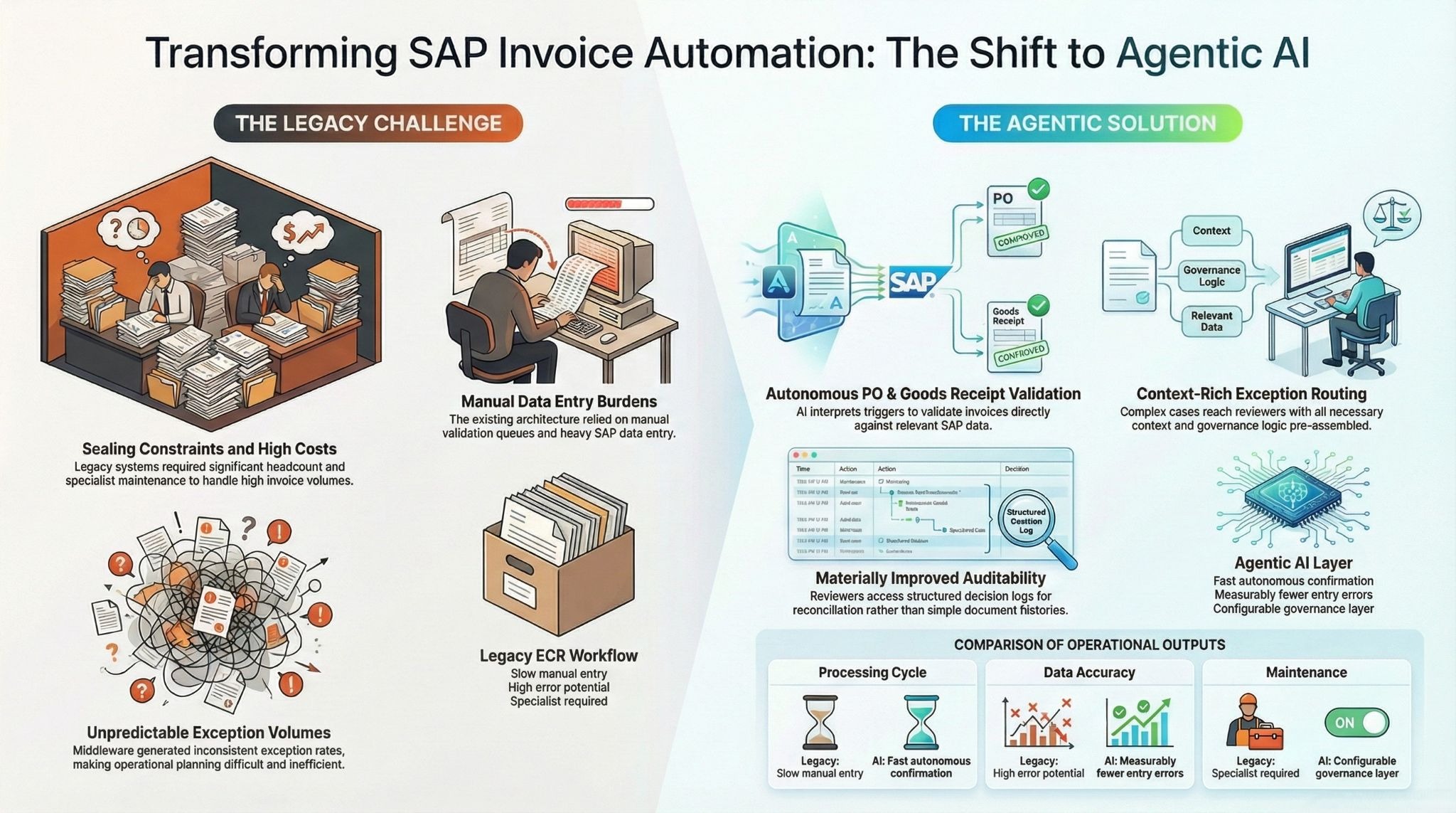
The organization was processing a high volume of purchase-order-backed invoices monthly across multiple business units. The existing workflow involved ECR for document capture and archiving, manual validation queues for exceptions, and a significant headcount allocation for SAP data entry. The combination of licensing costs and operational overhead had made the existing architecture difficult to justify, and the system's inability to scale without additional headcount was becoming a strategic constraint.
What was built and deployed:
The engagement delivered an agentic automation layer that interprets order triggers from incoming invoice documents, validates them against the relevant SAP PO and goods receipt data, and creates confirmed SAP Sales Orders directly. The system applies configurable rules and governance logic for exception types — tolerances, approval thresholds, flagging criteria — and routes the exceptions that require human judgment with full context pre-assembled.
Every action is captured in audit logs structured for reconciliation reporting, and the entire architecture was built to be integration-ready as a direct replacement for the OpenText ECR workflow layer.
What the deployment delivered:
Reduced manual order processing and eliminated dependency on legacy middleware. The order-to-confirm cycle became faster with measurably fewer data-entry errors. Auditability for Sales Order creation and exception handling improved materially — reviewers now see structured decision logs rather than document histories. The organization moved from a system that required specialist maintenance and generated unpredictable exception volumes to one that handles the predictable cases autonomously and delivers the complex cases to reviewers with everything they need already assembled.
The specific deliverables — CRUD-ready SAP integration, reconciliation reporting, audit logs, governance layer, integration-ready replacement for ECR workflows — are what make this deployment replicable for other enterprises in the same situation. The architecture is not custom; it is configurable to different SAP environments, different exception governance rules, and different organizational approval structures.
How to Evaluate AI Agent Platforms for SAP Invoice Processing
When enterprise teams search for "business AI SAP" or "SAP AI module," they are usually looking for something specific: a system that can be trusted with financial data, integrates deeply enough to actually replace manual workflows, and can demonstrate governance and auditability that satisfies finance leadership and compliance teams.
Here is the evaluation framework that matters.
SAP integration depth. There is a meaningful difference between a platform that can read SAP data and one that has full CRUD capability — create, read, update, delete — across the relevant SAP modules. Invoice processing that only reads PO data and flags exceptions is a reporting layer. Invoice processing that reads, validates, creates Sales Orders, and maintains audit logs is an operational system. Verify which one you are evaluating.
Exception governance architecture. Every platform handles the easy cases. The measure of an enterprise-grade system is how it handles the 20–30% of invoices that don't match cleanly. Does the platform route exceptions with context assembled, or does it hand off a flag and a document? Can exception resolution patterns be codified into governance rules so they are handled automatically next time? Is the exception log queryable for compliance review?
Audit trail quality. Finance and procurement teams operate in audit environments. The audit trail an agentic system generates needs to be structured — timestamped, decision-reasoned, and exportable — not just a document history. Ask specifically: can the audit log answer the question "why was this Sales Order created at this time with these field values"?
Deployment timeline and integration readiness. A platform that requires 6–12 months of custom integration work to reach production is not functionally different from a custom build. Look for platforms that have demonstrated production deployment on SAP environments within weeks, with clear documentation of the integration architecture.
Governance and compliance posture. For organizations in regulated industries, the platform's broader compliance posture — SOC 2, GDPR, ISO 27001 — matters as much as the invoice automation capability itself. Your AP automation system will have read/write access to financial records. Treat it with the same security evaluation you would apply to any core financial system.
What Buyers Are Actually Looking For When They Search "SAP AI Module" or "Business AI SAP"
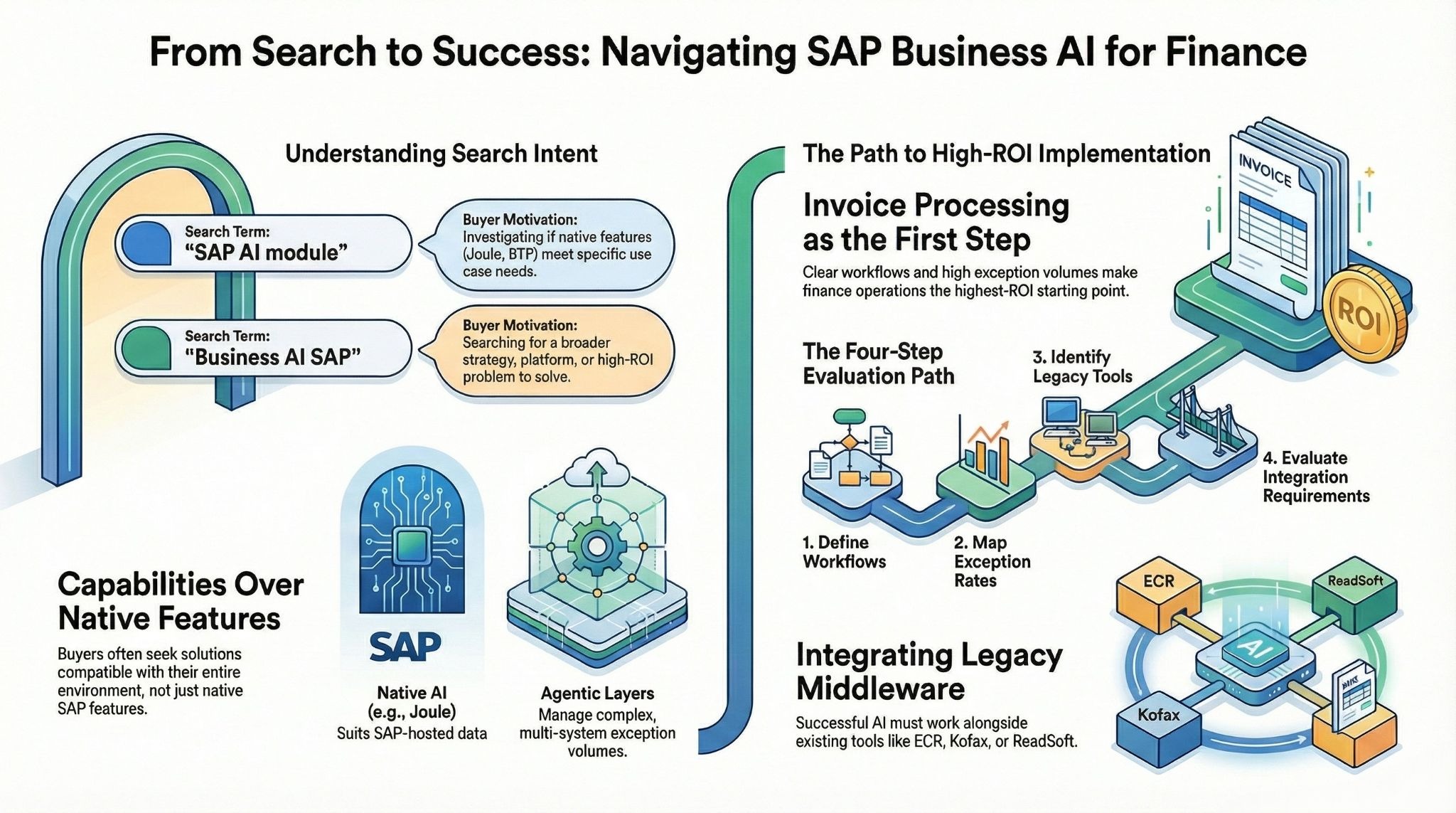
The search terms that bring enterprise buyers to this topic reveal something important: most are not looking for a native SAP feature. They are looking for a capability that works with their SAP environment — regardless of SAP version, configuration, or existing middleware stack.
"SAP AI module" searches typically reflect buyers investigating whether SAP's native AI features (BTP AI, Joule, embedded AI in S/4HANA) are sufficient for their use case. In the context of invoice processing, the honest answer is: SAP's native AI capabilities have improved significantly, but they are optimized for SAP-native workflows and SAP-hosted data. Organizations with complex multi-system environments, legacy middleware like ECR, or high exception volumes typically find that SAP's native AI is a complement to — not a replacement for — a purpose-built agentic layer.
"Business AI SAP" reflects a broader search: buyers who know they want AI in their SAP environment but haven't yet landed on whether they need a platform, a consulting engagement, a native feature, or a third-party agent. For this audience, the relevant question is not which tool to buy — it's what problem to solve first. Invoice processing, with its clear workflow boundaries, high exception volume, and measurable cycle-time outcomes, is consistently one of the highest-ROI starting points for enterprise AI in finance operations.
The evaluation path from this starting point is: define the specific invoice workflow (PO-backed invoices, non-PO invoices, or both), map the current exception rate and resolution time, identify the legacy tools in the current workflow (ECR, Kofax, ReadSoft, others), and then evaluate agentic platforms against the specific integration and governance requirements of that workflow.
The Bottom Line
AI agents for SAP invoice processing are not a future roadmap item — they are in production at global enterprises right now, replacing legacy middleware, eliminating manual exception queues, and creating auditable SAP Sales Orders at a fraction of the cost and cycle time of previous approaches.
The organizations moving fastest are the ones replacing specific, bounded workflows first: PO-backed invoice processing, OpenText ECR replacement, or SAP Sales Order creation automation. Each of these has clear inputs, clear outputs, and measurable cycle-time outcomes that build the internal case for broader agentic deployment.
If you are evaluating options, the starting point is not a product demo — it's a workflow audit. Map your current invoice exception rate, identify the legacy tools creating the ceiling on your automation rate, and define what "good" looks like in terms of order-to-confirm cycle time and audit trail quality. The platform evaluation becomes straightforward once those parameters are defined.
See how assistents.ai integrates with SAP and 300+ enterprise systems →
Compare Assistents vs UiPath for invoice automation workflows →
Enterprise AI governance and compliance framework →
FAQs
Is this part of the SAP AI agent hub or SAP AI catalog?
No. The AI agent described in this guide is a third-party agentic platform that integrates with SAP via APIs. The SAP AI agent hub and SAP AI catalog refer to SAP's own marketplace and native AI features within the SAP Business Technology Platform ecosystem. These are separate from — and complementary to — third-party agentic platforms. Many enterprise deployments run both: SAP's native AI for SAP-native workflows, and a purpose-built agentic layer for complex, cross-system, or exception-heavy processes like invoice processing.
How many AI units does SAP charge for invoice automation?
SAP's AI unit pricing applies to consumption of SAP's native AI features within BTP and S/4HANA. If you are using a third-party agentic platform integrated with SAP, SAP AI unit costs do not apply to the agentic processing itself — only to any SAP-native AI features your configuration uses. For buyers comparing native SAP AI invoice automation costs against a third-party agentic platform, the relevant comparison is total cost of ownership: SAP AI unit consumption cost versus platform licensing, plus the operational cost difference from automation rate and exception reduction. Based on current deployments, the TCO case for a third-party agentic layer typically strengthens as exception volume and multi-system complexity increase.
What happens to existing OpenText ECR workflows during the transition?
The recommended approach is a phased transition, not a cutover. The agentic platform runs in parallel with existing ECR workflows during an initial validation period — typically processing a defined subset of invoice volume — while both systems are monitored for accuracy, exception rates, and cycle time. Once the agentic system has demonstrated production-grade performance on the defined subset, scope is expanded incrementally until the ECR workflow layer is no longer load-bearing. This approach eliminates the transition risk of a full cutover and gives finance and compliance teams a direct comparison dataset before the legacy system is decommissioned.
Does the agent work with both SAP ECC and S/4HANA?
Yes. The integration architecture is API-based and is not dependent on a specific SAP version. Deployments have been validated on both ECC and S/4HANA environments. The specific API endpoints, authorization objects, and field mappings differ between versions, and these are configured during implementation rather than hardcoded into the platform.
How long does a production deployment take?
From integration scoping to first live invoice processed, production deployments in this category typically take four to eight weeks for a defined invoice workflow scope. Full replacement of an existing ECR workflow — including parallel validation, governance configuration, and exception pattern codification — typically runs eight to twelve weeks depending on the complexity of the existing environment and the number of exception types to be codified.

Transform Your Business With Agentic Automation
Agentic automation is the rising star posied to overtake RPA and bring about a new wave of intelligent automation. Explore the core concepts of agentic automation, how it works, real-life examples and strategies for a successful implementation in this ebook.
Sarfraz Nawaz is the CEO and founder of Ampcome, which is at the forefront of Artificial Intelligence (AI) Development. Nawaz's passion for technology is matched by his commitment to creating solutions that drive real-world results. Under his leadership, Ampcome's team of talented engineers and developers craft innovative IT solutions that empower businesses to thrive in the ever-evolving technological landscape.Ampcome's success is a testament to Nawaz's dedication to excellence and his unwavering belief in the transformative power of technology.

More insights
Discover the latest trends, best practices, and expert opinions that can reshape your perspective





Contact us

