

AI Agent Car Buying: How AI Agents Now Research, Negotiate and Buy Cars, and What Dealers, OEMs and Lenders Must Build to Keep Up


AI agent car buying is the use of autonomous AI agents to carry out the vehicle purchase process end to end — on both sides of the transaction. On the buy side, a consumer's agent researches models, contacts multiple dealerships, negotiates out-the-door pricing and interrogates fees without the buyer making a single phone call.
On the sell side, dealer groups, OEMs and auto lenders deploy their own governed agents to respond instantly, quote within policy, book appointments, process finance documents and write deals back into the DMS.
The car purchase is becoming an agent-to-agent transaction, and the organisations that win are the ones whose agents are governed, auditable and connected to real systems.
To summarise:
- Consumer AI negotiation agents are already in production at scale. Public data from CarEdge reports over $20 million in aggregate buyer savings, averaging roughly $2,405 per multi-round negotiation and about $282 in combined fee reductions.
- The average dealership lead response time still sits above two hours, while the well-established sub-five-minute window remains the qualification threshold. Buyer agents do not wait.
- Capital One's Chat Concierge demonstrated the enterprise pattern: multiple logical agents that plan, validate against hallucination, then explain the plan to the buyer.
- Volume of leads will fall. Quality will rise sharply. A buyer agent only engages after it has already vetted, compared and shortlisted — which changes what your CRM receives and how your team must respond.
- The hard part is not the conversation. It is governance: who authorises a price concession, what the agent may see, and whether every action is provably logged.
- Organisations that treat this as a chatbot upgrade will lose. Organisations that treat it as an architecture problem — context, governance, action — will compound advantage.
What Is AI Agent Car Buying?
AI agent car buying refers to autonomous software agents executing steps in the vehicle purchase journey that previously required a human. Unlike a chatbot, which answers questions inside a scripted boundary, an agent pursues a goal across multiple steps, makes decisions based on changing information, and takes action in external systems.
The distinction matters commercially. A chatbot on a dealer website deflects questions. An agent books the test drive, checks live inventory, generates a quote, and writes the record back into the CRM. One reduces call volume. The other changes the operating model.
AI Agent vs. Chatbot vs. Digital Retailing Tool
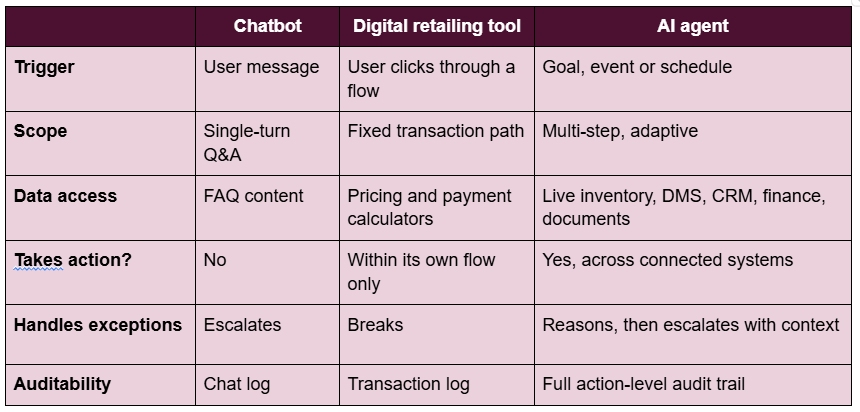
For a deeper treatment of the underlying distinction, see our guide on the difference between an AI assistant and an AI agent.
Buy-Side Agents vs. Sell-Side Agents
Almost every article on this topic covers one side and ignores the other. That is the central mistake.
Buy-side agents act for the consumer. They shield identity, contact many dealers simultaneously, negotiate price and fees, and surface the best out-the-door number. Their objective is to compress information asymmetry.
Sell-side agents act for the dealer group, OEM, captive finance arm or leasing company. They respond in seconds, qualify intent, quote within approved guardrails, orchestrate appointments, process documents and update systems of record. Their objective is speed, consistency and margin protection at scale.
These are not two topics. They are two ends of the same conversation. Within the next buying cycle, a meaningful share of dealer enquiries will originate from software, be answered by software, and only involve a human at the point of signature and delivery.
How AI Car Buying Agents Actually Work (Buy Side)
Understanding the buy-side mechanics is not optional for the sell side. You cannot design a counterparty response to a process you do not understand.
Step 1: Vehicle and Trim Specification
The buyer specifies the exact vehicle — make, model, trim, options, colour tolerance — plus a target price range and geographic radius. This is a materially more precise input than a traditional lead form, because the agent has typically already helped the buyer narrow from a category to a specific configuration using pricing databases, reliability data and ownership forums.
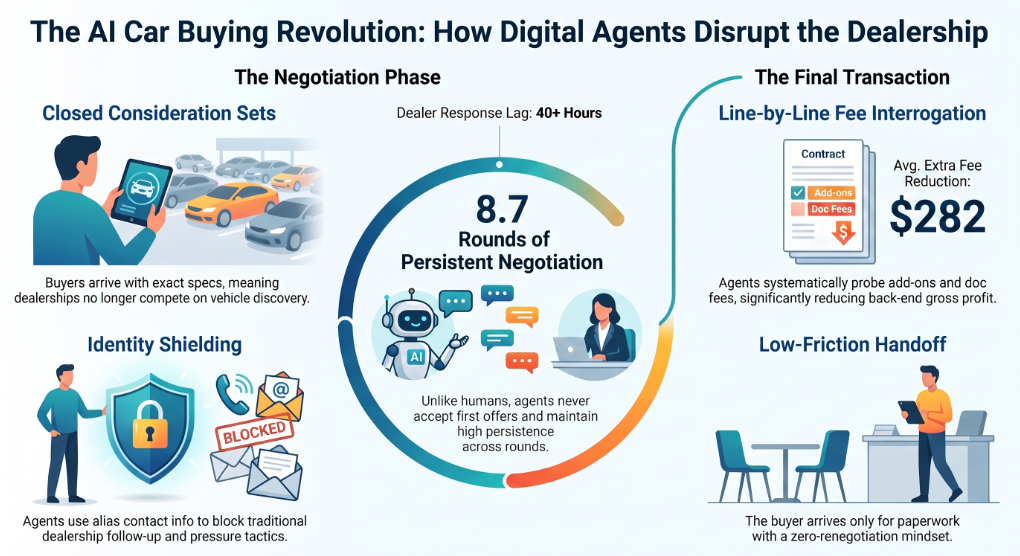
The implication: by the time your store hears from a buyer agent, the consideration set is closed. You are not competing on discovery. You are competing on price, availability and speed of response.
Step 2: Multi-Dealer Outreach With Identity Shielding
The agent generates protected contact details — an alias email address and phone number — and contacts every dealership within range holding matching stock. The buyer's real identity, phone number and email are not exposed during negotiation.
This breaks two long-standing dealership levers at once. Traditional BDC follow-up cadences cannot pressure a buyer they cannot reach directly. And the store cannot differentiate a high-intent shopper from a low-intent one through contact behaviour, because all contact behaviour is now machine-generated and uniform.
Step 3: Out-the-Door Price Negotiation Across Multiple Rounds
The agent asks for an out-the-door price, not a monthly payment and not an MSRP discount. It then counters. Public CarEdge data indicates roughly 8.7 agent messages per negotiation, with average first out-the-door responses arriving after more than 40 hours — a striking gap given the agent responds instantly.
Critically, the agent does not accept the first counteroffer. Human buyers frequently do. Persistence across rounds is where most of the reported savings accumulate.
Step 4: Fee, Add-On and Doc-Fee Interrogation
Price is only one lever. Agents systematically probe documentation fees, dealer-installed accessories, protection products, market adjustments and delivery charges — line by line. Reported average combined fee reductions of around $282 per transaction come from this step alone.
For dealers, this is the most consequential change. Back-end gross that survived because buyers did not know to ask about it does not survive an agent that always asks.
Step 5: Handoff to the Human for Paperwork and Delivery
Once the agent secures an acceptable number, it notifies the buyer, and the conversation moves offline. The buyer arrives at the store with a confirmed figure, an appointment, and no intention of renegotiating.
The store gets a customer who is fully informed, fully committed, and extremely low-friction — provided the number the agent was quoted is honoured. Which is precisely why sell-side governance matters more than sell-side conversation quality.
Why This Breaks the Traditional Dealership Playbook
Speed-to-Lead Is No Longer a Human Benchmark
The five-minute response rule has been industry doctrine for years. It was built for human-to-human contact. When the counterparty is an agent that reads, reasons and replies in under a second, a two-hour response is not slow — it is absent. The first dealer to respond with a real number frames the entire negotiation, and every subsequent dealer negotiates against that anchor.
The Ghost Lead Problem Inverts
Dealers have spent a decade complaining about low-quality leads from third-party aggregators. Agent-mediated enquiries invert the problem. There will be fewer of them, because the agent filters aggressively before making contact. Every one that arrives is a serious, configured, comparison-ready buyer.
This is good news operationally and dangerous commercially. Fewer leads mean each lost enquiry costs more. Response failures that were absorbed by volume are no longer absorbed by anything.
Price Opacity Stops Being a Margin Lever
Agentic negotiation generates structured out-the-door pricing data at scale. As that data accumulates and circulates, the variance between what an informed buyer pays and an uninformed buyer pays compresses. Margin has to come from operational efficiency, F&I product relevance, service retention and inventory turn — not from information advantage.
Your CRM Now Receives Machine-Generated Enquiries
Agent enquiries are structured, consistent, and arrive through email and SMS channels rather than web forms. Most dealership CRMs were not designed to distinguish them, route them differently, or respond to them at machine speed. The systems layer, not the sales layer, is where this gets solved.
The Sell-Side Response: What Dealers, OEMs and Lenders Must Build
This is the section every competing article skips. Responding to agentic buyers requires five architectural layers. Missing any one of them produces a demo that impresses in a boardroom and fails in production.
Layer 1: An Agent-Readable Retail Surface
Buyer agents consume your inventory, pricing and availability data. If that data is trapped in JavaScript-rendered pages, inconsistent feeds or PDFs, agents will either misread it or skip you.
What this requires:
- Structured, machine-consumable inventory with accurate trim, options, VIN-level detail and real-time availability
- Consistent pricing representation, including fees, so that an agent's out-the-door calculation matches yours
- Programmatic endpoints that allow agent-to-agent interaction rather than forcing browser automation
- Support for open agent interoperability standards such as MCP and A2A, so external agents can transact with your systems through a controlled interface rather than scraping your website
The strategic point: you want buyer agents talking to your endpoint, where you control the terms, not scraping your site, where you control nothing.
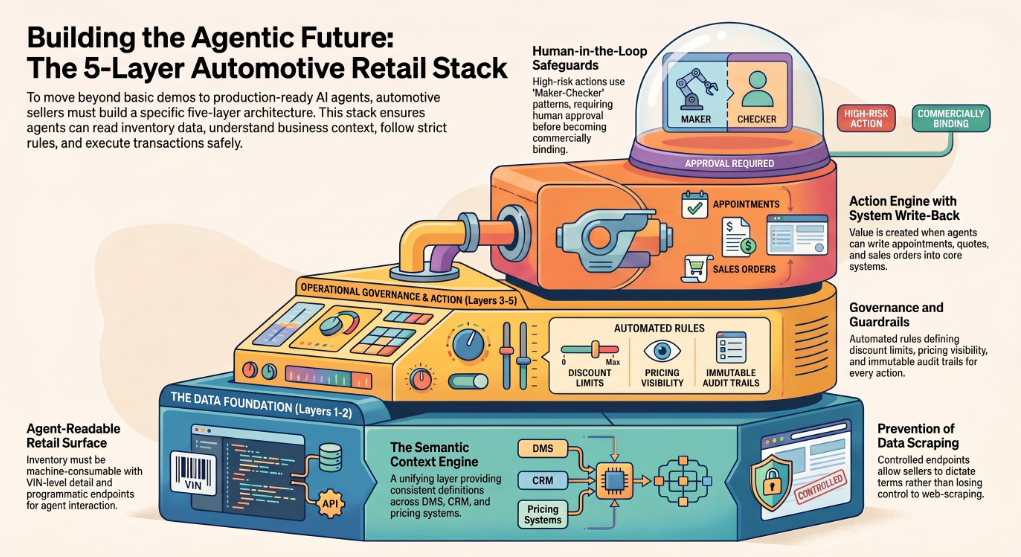
Layer 2: A Context Engine Over DMS, CRM, Inventory, Pricing and Finance Data
An agent that cannot see live data will invent answers. Every serious automotive deployment starts with unifying the data estate — DMS, CRM, inventory management, pricing and incentive tables, finance and insurance systems, service records, and unstructured content like policy documents and SOPs.
This is not a data warehouse project in the traditional sense. It is a semantic layer: consistent definitions of what "available", "out-the-door", "eligible" and "approved" mean, expressed once, so every agent reasons from the same truth. Without it, two agents in the same organisation will quote two different numbers for the same vehicle, and both will be defensible from the raw data.
Assistents.ai delivers this through a Context Engine and semantic layer that sit above existing systems, with native connectors to Postgres, MSSQL, BigQuery, ClickHouse, Athena and DuckDB, plus text-to-SQL for governed natural-language access to structured data.
Layer 3: A Governance Layer — Who Can Quote What, Within Which Guardrails
This is the layer that determines whether agentic automotive retail is an asset or a liability.
Concrete questions a governance layer must answer before a single agent goes live:
- What is the maximum discount an agent may offer without human approval, and does that vary by vehicle age, stock turn or store?
- Which agent may see cost, pack and holdback, and which may see only retail pricing?
- Who approves an exception, and how long may an approval sit before the quote expires?
- When an agent quotes a number, is that number binding on the store?
- Can we reconstruct, months later, exactly what was said, by which agent, under whose authority?
Assistents.ai enforces this natively through row-level security and attribute-based access control, maker-checker and human-in-the-loop approval workflows, and an immutable audit trail covering every agent action.
Layer 4: An Action Engine With Write-Back Into Core Systems
An agent that only reads is a search box. Value appears when the agent writes: creating the appointment, generating the quote, raising the sales order, updating the opportunity, triggering the finance application, logging the trade-in.
Write-back is where governance and engineering meet. Every write must be permission-checked, policy-validated and logged. Every failure must roll back cleanly and escalate with full context rather than leaving a half-created record in the DMS.
Layer 5: Human-in-the-Loop Escalation and Maker-Checker Approvals
The correct design assumption is that the agent handles the routine path autonomously and escalates the exception path with enough context that a human resolves it in seconds rather than reconstructing it in minutes.
Maker-checker is the pattern that makes autonomy commercially safe: the agent prepares the action, a defined human role approves it, and both events are recorded. Applied to pricing, financing terms and contract generation, it lets an organisation move fast without ever losing accountability for the number.
The Ask → Execute → Autonomous Maturity Ladder for Automotive Retail
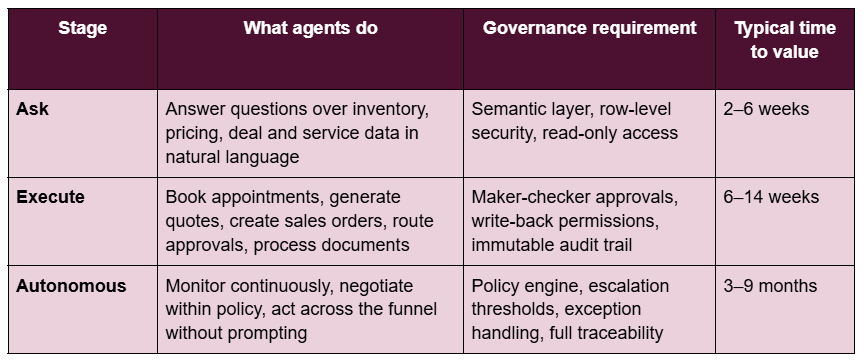
Most automotive AI programmes fail because they attempt autonomy before they have earned trust in the data. The Ask → Execute → Autonomous ladder is the sequence that works.
Ask: Governed Answers Over Your Own Data
Start here. Give general managers, BDC leads and finance directors the ability to ask questions of live operational data and receive consistent, permission-aware answers. This stage builds two things you cannot skip: trust in the semantic layer, and a documented record of which questions matter enough to automate.
Execute: Agents That Do Work Inside Your Systems
Once definitions are stable and access control is proven, move to action. Test drive booking, quote generation, document extraction and sales order creation are the highest-frequency, lowest-ambiguity workflows and therefore the correct first targets.
Autonomous: Continuous, Policy-Bounded Operation
Autonomy is not "the agent does whatever it wants." It is "the agent operates continuously inside a policy envelope, and everything outside that envelope escalates." Competitive pricing monitoring, aged-lead reactivation, portfolio risk alerting and renewal outreach are natural autonomous workflows because the policy envelope is easy to define and the cost of an escalation is low.
Nine High-Value AI Agent Use Cases Across the Car Buying Lifecycle
1. Instant Multi-Channel Lead Response and Qualification
The agent receives an enquiry from any channel — including agent-generated email and SMS — identifies the vehicle and intent, checks live availability, responds with a real answer, and either books an appointment or produces a governed quote. Response measured in seconds, not hours, and identical quality at 3am on a Sunday.
2. Voice BDC Agent for Inbound Calls and After-Hours Enquiries
A speech-to-text, LLM, text-to-speech pipeline that answers inbound calls, handles vehicle availability and pricing questions, books appointments and routes complex calls to the right human with a summary already attached. For multi-market groups, multilingual operation is not a nice-to-have — it determines whether the agent covers the actual customer base.
3. Test Drive and Appointment Orchestration
Checking real availability across vehicles, staff and locations, negotiating alternative times when the first choice is unavailable, sending confirmations and reminders, and handling reschedules. This is a deceptively hard workflow because it requires the agent to reason about constraints, not just retrieve a calendar.
4. Trade-In Intake and Appraisal Support
Capturing vehicle details, condition disclosures and photographs, extracting data from registration and service documents, applying appraisal logic and producing a range with reasoning attached — then escalating the final number to a human appraiser through a maker-checker approval.
5. Financing Pre-Qualification and F&I Document Processing
Document-heavy, error-prone and expensive when done manually. Agents can extract structured data from identity documents, income evidence, insurance certificates and trade-in titles, validate completeness against policy, flag mismatches and assemble a clean package for the finance team. The regulatory sensitivity here is high, which is exactly why maker-checker and audit trails are non-negotiable.
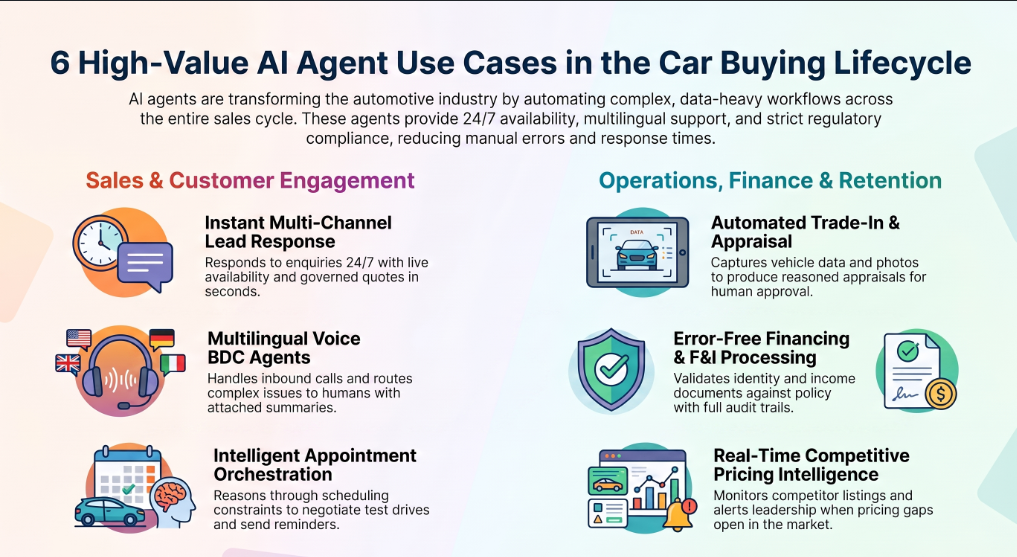
6. Sales Order Creation and DMS Write-Back
Interpreting the order trigger, validating it against inventory, pricing and approval rules, then creating the order in the system of record with an audit log and reconciliation reporting. This is where manual data entry errors and processing delays currently concentrate.
7. Competitive Pricing and Incentive Monitoring
Continuous monitoring of competitor listings, discounts, offers, availability and consumer ratings across marketplaces and channels, converted into instant answers for leadership and proactive alerts when a pricing gap opens. In a market where buyer agents compare across every dealer in range, always-on competitive awareness moves from useful to structural.
8. Portfolio, Delinquency and Residual-Value Intelligence for Lenders and Lessors
For captive finance arms and leasing companies, agents monitor portfolio KPIs — risk, delinquency, maturity distribution, residual exposure — alongside dealer network performance, and raise exceptions and early risk signals before they become losses.
9. Post-Sale Service Retention and Renewal Agents
The purchase is the start of the relationship, not the end. Agents handle service scheduling, recall outreach, maintenance reminders and lease-end renewal conversations, all with the same governance and audit properties as the sales-side agents.
Governance and Compliance: The Part Every Other Guide Skips
Search this keyword and you will find a dozen articles explaining what agents can do. You will find almost nothing explaining what happens when one gets it wrong. That gap is where enterprise programmes actually fail.
Row-Level Security and ABAC
An agent serving a single rooftop should not see another rooftop's cost structure. An agent serving a customer should never see internal margin data at all. Row-level security and attribute-based access control enforce this at the data layer rather than relying on prompt instructions, which are not a security boundary.
Maker-Checker Approvals on Price and Financing Terms
Any action with commercial or regulatory consequence should be prepared by the agent and approved by a defined human role. This is standard practice in banking operations and it transfers directly to automotive pricing, discounting and finance terms.
Immutable Audit Trails
If a buyer arrives claiming your agent quoted a specific out-the-door price, you need to be able to reconstruct precisely what was said, when, by which agent version, drawing on which data, under whose authority. Chat logs are insufficient. Action-level immutable audit trails are the requirement.
PII Handling When the Counterparty Is Another Agent
Buyer agents deliberately shield the consumer's identity behind alias contact details. Your agent is therefore transacting with an intermediary, not the customer. Data capture practices, consent records and identity verification workflows all need to account for this, particularly at the point where the conversation transitions to a human and real identity is introduced.

The Regulatory Surface
Automotive AI agents sit inside an unusually dense regulatory environment. The obligations vary by market, but the categories are consistent:
- Advertising and pricing disclosure — Requirements around clear offering price and prohibitions on misrepresenting costs mean an agent's quote must be complete and honest by construction, not by hope.
- Contact consent — Automated outreach by SMS and voice is subject to consent regimes in most markets. Agents must respect suppression and consent state as a hard constraint.
- Credit and fair lending — Where an agent influences financing outcomes, non-discrimination obligations and adverse-action notice requirements apply. The decision logic must be explainable and reviewable.
- Data protection — GDPR, UK data protection law, India's DPDP Act and comparable regimes govern how customer data is processed, where it resides and how long it is retained.
Model-Agnostic Routing and BYOK
Regulatory and commercial reality means you cannot afford to be locked to a single model provider. Model-agnostic routing lets you direct workloads to the appropriate model by task, cost and jurisdiction. Bring-your-own-key deployment ensures customer data flows through infrastructure you control, which matters enormously for groups operating across multiple data residency regimes.
Proof: What Governed Agents Have Delivered in Production
The following are anonymised deployments from Ampcome's Assistents.ai delivery portfolio, described by industry, geography and scale only. Each was selected because the workflow maps directly onto a car-buying equivalent.
Automotive Leasing Provider — Canada, National Dealer Network
The problem. An independent automotive leasing provider running manufacturer and dealer network programmes needed portfolio-level visibility across risk, delinquency, maturity and residual exposure, plus performance intelligence on its dealer network.
What was delivered. A data and analytics layer covering portfolio KPIs across risk, delinquency, maturity and residuals; dealer network performance analytics; and automated alerting for exceptions and early risk signals.
Outcome. Materially better portfolio visibility with faster risk identification, improved decision support for programme operations, and a shift from periodic review to proactive exception-driven management.
Why it matters here. Every captive finance arm and leasing operator faces exactly this. Buyer agents accelerate transaction velocity; portfolio intelligence has to keep pace.

Multi-Branch Automotive Skills Operator — UAE
The problem. A driving institute with multi-branch operations and digitally enabled customer journeys needed to understand where customers dropped out of a long, multi-stage funnel and how to use instructor capacity efficiently.
What was delivered. Funnel analytics tracing enrolment through lessons to tests, instructor utilisation and slot optimisation, and customer experience dashboards with automated alerts.
Outcome. Reduced operational bottlenecks, measurably better scheduling efficiency, and clear visibility into the drivers of conversion and performance.
Why it matters here. Test drive and appointment orchestration is the same problem class — constrained resources, multi-stage funnel, high cost of a missed slot.
Engineering and Technology Solutions Group — UAE, Enterprise Scale
The problem. A flagship engineering and technology solutions provider, operating since 1972 across electrical, mechanical, automation and mobility solutions, needed to move off an end-of-life document workflow system carrying high licensing cost, while automating sales order creation into SAP.
What was delivered. Agentic automation that interprets order triggers, validates them and creates SAP sales orders directly; a rules and governance layer handling exceptions and approvals; audit logs and reconciliation reporting; and an integration-ready replacement for the legacy workflow environment.
Outcome. Substantially reduced manual order processing and legacy system dependency, a faster order-to-confirm cycle with fewer data-entry errors, and improved auditability for both order creation and exceptions.
Why it matters here. This is the closest available analogue to automated deal and sales order creation in a DMS. It demonstrates that governed agentic write-back into a core enterprise system of record is production-proven, not theoretical.
National Value Retail Network — India, 700+ Stores
The problem. A rapidly scaling retail group with a pan-India footprint across hundreds of cities needed to modernise store support, give store teams reliable inventory and pricing visibility, and make operating knowledge accessible to a large, distributed, frequently changing workforce.
What was delivered. A voice support agent built on a speech-to-text, LLM, text-to-speech pipeline operating in Hindi and English; an inventory intelligence agent covering pricing, stock and promotions at individual store level; a knowledge and training agent using retrieval over point-of-sale and standard operating procedure documentation; and an admin console with analytics and ticketing integration, architected for high concurrency.
Outcome. Reduced manual helpdesk burden and faster resolution of store-level issues, improved store-level inventory visibility, and faster onboarding through on-demand training guidance.
Why it matters here. A dealer group is a distributed retail network with the same problems: store-level inventory truth, frontline knowledge access, multilingual voice support, and concurrency at scale.
Diversified Real Estate Portfolio Operator — UAE
The problem. A major portfolio owner and manager with office, retail, industrial and residential assets across multiple emirates needed to automate tenant and customer support end to end without degrading service quality.
What was delivered. An omnichannel service agent operating across web, WhatsApp and email; query triage covering FAQs, rental and payment support workflows; ticketing with escalation to human teams; and a knowledge base built over policies, tenancy documentation and SOPs.
Outcome. Faster response times with a lower call-centre load, a consistent 24×7 customer experience, and improved SLA adherence through automated routing and tracking.
Why it matters here. High-value, document-governed, emotionally significant transactions with an omnichannel service layer — structurally identical to the dealership customer experience problem.
Financial Services Technology Provider — North America, Bank and Credit Union Customers
The problem. A fintech provider delivering automation to banks and credit unions needed omnichannel customer support that could scale while satisfying strict auditability and compliance expectations.
What was delivered. Omnichannel intake across chat, email and phone with workflow routing; agent-assist summarisation with next-best-action recommendations; and auditability, reporting and SLA monitoring built in rather than added later.
Outcome. Faster case handling with improved consistency, reduced operational load through automation, and stronger compliance readiness via complete audit trails.
Why it matters here. Auto finance and F&I operate under comparable regulatory scrutiny. This deployment demonstrates that agentic customer operations and audit rigour are not in tension.
Consumer Durables Manufacturer — India, Price-Sensitive Category
The problem. A long-established manufacturer competing in highly price-sensitive consumer and commercial markets needed daily visibility into competitor pricing moves, discounting and promotional activity across e-commerce and channel listings.
What was delivered. Continuous monitoring of pricing, MRP and discounts, offers, availability and ratings across channels; agentic question-answering mapped to the specific questions leadership actually asks; analytics views exposing pricing gaps, competitive threats and portfolio movement; and an architecture designed to scale from proof of concept to production with governance and audit trails intact.
Outcome. Faster competitive response cycles, earlier identification of pricing gaps and promotional shifts, and always-on monitoring replacing manual checks across portals.
Why it matters here. When every buyer arrives with an agent that has already priced your competitors, continuous competitive pricing intelligence stops being a marketing function and becomes an operational requirement.
Luxury Hospitality Group — East Africa, 16 Properties
The problem. A luxury operator serving high-expectation international customers needed to handle complex, high-value booking enquiries faster without compromising the personalised service the brand depends on.
What was delivered. A digital booking agent handling email intake, intent classification and data extraction; a conversational loop to capture missing details; real-time inventory checks with alternative date and property negotiation; a hybrid handoff to human specialists for curated itinerary creation; and automated invoice and PDF document generation.
Outcome. Faster booking turnaround with substantially reduced back-and-forth, higher accuracy on complex customer requirements, and scalable operations without compromising premium service standards.
Why it matters here. This is the pattern for high-consideration purchase agents: automate intake, availability negotiation and documentation; keep the human where the relationship value sits. It is precisely the model a premium dealer group should apply.
Complex Document Processing — Australia, Commercial Services
Worth noting alongside the above: a commercial services specialist deployed an intelligent document workbench using multi-agent orchestration and vision-LLM extraction from complex PDFs, with deep two-way integration into its operational system, quote locking and audit logging. The programme was engineered for up to approximately 90% faster document processing against a roughly 95% extraction accuracy target for standard formats, with reduced risk through revision and change detection.
For automotive F&I — where the deal jacket, trade-in title, insurance certificate and income documentation all arrive as unstructured files — this is the directly transferable capability.
Why Assistents.ai by Ampcome for Automotive AI Agents

Most vendors in this category sell a conversation layer. That solves the easiest 20% of the problem. Assistents.ai, built by Ampcome, is an agentic intelligence platform designed for the other 80%: context, governance and action.
Governance Is Native, Not Bolted On
Row-level security, attribute-based access control, maker-checker and human-in-the-loop approval workflows, and an immutable audit trail are platform primitives — not add-ons purchased separately or implemented in custom code per project. For an industry facing pricing disclosure obligations, consent regimes and fair-lending scrutiny, this is the difference between a pilot and a production deployment.
One Platform Across Conversational, Voice, Document and Analytics Agents
The car-buying journey needs a conversational agent on the website, a voice agent on the phone, a document agent in F&I, and an analytics agent for leadership. Assembling four vendors produces four integration surfaces, four governance models and four audit trails that do not reconcile. Assistents.ai runs all four capability classes on one platform with one context engine and one governance layer.
Multi-Agent Orchestration With Open Interoperability
Real automotive workflows require several agents cooperating — inventory, pricing, finance, scheduling. Assistents.ai provides multi-agent orchestration natively, with support for MCP and A2A protocols so agents can interoperate with external systems and, increasingly, with buyer-side agents through a controlled interface rather than uncontrolled scraping.
Model-Agnostic and Deployment-Flexible
Model-agnostic routing means workloads go to the right model for the task, cost profile and jurisdiction. Bring-your-own-key deployment means data flows through infrastructure you control. For dealer groups and OEMs operating across multiple regulatory regimes, that flexibility is a procurement requirement, not a preference.
A Delivery Record in Automotive-Adjacent Verticals
The case studies above are not aspirational. They are shipped deployments across automotive leasing, distributed retail networks, enterprise ERP write-back, regulated financial services, omnichannel customer operations and complex document processing — spanning India, the UAE, Canada, Australia, the UK, East Africa and North America. Every capability this article recommends for automotive retail has been built and run in production somewhere in that portfolio.
Weeks to First Value, Not Quarters
Pre-built connectors across Postgres, MSSQL, BigQuery, ClickHouse, Athena and DuckDB, combined with a no-code agent builder, mean the Ask stage typically delivers value in weeks. That matters because the sequence — earn trust in the data, then automate action, then extend to autonomy — only works if each stage lands quickly enough to sustain momentum.
See how Assistents.ai maps to your dealer group, OEM or captive finance stack. Talk to the Ampcome team.
Build vs. Buy: What It Actually Takes
In-House Build
A credible internal build requires ML engineering, data engineering, backend integration, security and compliance review, and ongoing model operations. The visible cost is the team. The hidden costs are the governance layer, the audit infrastructure, the connector maintenance as DMS and CRM vendors change APIs, and the model evaluation harness that stops quality drifting silently.
Realistic timeline to a governed production agent: nine to eighteen months. Justifiable only if agentic capability is itself a competitive differentiator you intend to own.
Point Vendors
Fast to start and genuinely effective inside their lane. The problem appears at the second and third use case, when you discover each vendor has its own data model, its own permissions logic and its own audit trail. Nothing reconciles, and the integration burden lands on you permanently.
Governed Platform
One context layer, one governance model, one audit trail, many agents. Slower to first demo than a point tool, dramatically faster to the fifth production workflow. This is the right choice when you expect to run agents across sales, finance, service and operations rather than solving one narrow problem.
For a deeper comparison of delivery models, see our guide to enterprise AI agent development services.
How to Get Started: A 90-Day Rollout Plan
Days 1–30: Data and Governance Foundation
Inventory your data estate — DMS, CRM, inventory management, pricing and incentives, finance systems, document repositories. Define the semantic layer: what "available", "out-the-door", "eligible" and "approved" mean, once, authoritatively. Map access control: which roles and which agents may see which data. Establish the audit requirement with compliance before, not after, anything is built.
Days 31–60: First Governed Agent in a Single High-Volume Workflow
Choose one workflow with high frequency and low ambiguity. Instant lead response and appointment booking is usually correct. Deploy in Ask mode first — the agent answers and recommends. Measure response time, resolution rate and escalation quality against your current baseline. Only then enable write-back, with maker-checker approval on anything commercially binding.
Days 61–90: Expand, Measure, Open the Second Workflow
Move the first agent from Execute toward policy-bounded autonomy on the routine path. Open the second workflow — typically voice BDC coverage or F&I document processing, depending on where your cost concentration sits. Establish the operating rhythm: weekly review of escalations, monthly review of policy thresholds, quarterly review of the semantic layer.
The organisations that compound advantage here are not the ones that launched first. They are the ones that built the foundation properly and then added agents cheaply for years.
The Bottom Line
AI agent car buying is not a future scenario. Consumer agents are negotiating real deals with real dealers today, and the reported savings are large enough that adoption will accelerate on its own momentum. The dealer, OEM or lender response cannot be a better chatbot, because the problem is not conversational — it is architectural.
The organisations that win the agentic era in automotive retail will be the ones that unified their data into a semantic layer, wrapped it in governance strong enough to let agents act on pricing and financing, connected it to real systems so agents can write and not just read, and then added agents workflow by workflow at declining marginal cost.
That is exactly what Assistents.ai by Ampcome is built to deliver — and what it has already delivered across automotive leasing, distributed retail, enterprise ERP automation, regulated financial services and complex document processing.
Ready to see what governed agents look like in your stack? Book a working session with the Ampcome team.
FAQs
What is an AI agent in car buying?
An AI agent in car buying is autonomous software that carries out purchase steps without human intervention. On the buyer side it researches vehicles, contacts dealers and negotiates price. On the dealer side it responds to enquiries, quotes within policy, books appointments and updates systems of record.
Can AI negotiate a car price for you?
Yes. Services such as CarEdge deploy agents that contact dealerships directly using alias contact details and negotiate out-the-door pricing across multiple rounds. Publicly reported results indicate average savings of roughly $2,405 on multi-round negotiations, plus around $282 in combined fee reductions.
Is there an AI that buys cars?
Current agents negotiate, compare and secure pricing, then hand off to the buyer for paperwork, financing signature and delivery. Full end-to-end autonomous purchase is not yet standard, largely because payment authorisation and identity verification infrastructure was designed for humans in the loop.
How much do AI car buying agents cost?
Consumer services typically charge a modest one-time or monthly fee, in the region of $40 to $50 for a negotiation period. Enterprise platforms for dealers, OEMs and lenders are priced on platform and consumption models that vary with scale and workflow coverage.
Do dealerships respond to AI agents?
Increasingly yes, though inconsistently. Public data suggests first out-the-door responses often take more than 40 hours. Dealers that respond in seconds with a complete, honest number anchor the negotiation and win a disproportionate share of agent-mediated enquiries.
What is the best AI for buying a car?
It depends on which side you are on. Consumers use dedicated negotiation services and general-purpose assistants for research. Dealer groups, OEMs and auto lenders need a governed enterprise platform with a context engine, access control, approval workflows and audit trails — which is the category Assistents.ai occupies.
Is using AI to buy a car legal?
Nothing prohibits a consumer from delegating negotiation to software. The obligations sit mainly on the dealer side, covering pricing disclosure, automated contact consent, fair lending where financing is involved, and data protection.
Can AI get a better deal than a car broker?
AI agents contact far more dealers simultaneously and persist across more negotiation rounds than a human broker typically will, at a fraction of the cost. Brokers retain an advantage on rare vehicles, allocation relationships and unusual transaction structures.
What is agentic commerce in automotive?
Agentic commerce is the model where autonomous agents browse, evaluate, negotiate and transact on a consumer's behalf rather than simply recommending options. In automotive it means a growing share of dealer enquiries originate from software and are best answered by software.
Will AI replace car salespeople?
Not the role, but the task mix changes substantially. Research answering, price negotiation and appointment coordination move to agents. Relationship building, product demonstration, trust at the point of signature and complex exception handling stay human — and become the entire job.
How do car dealerships use AI agents?
Common deployments include instant multi-channel lead response, voice agents for inbound and after-hours calls, appointment orchestration, trade-in intake, F&I document processing, sales order creation with DMS write-back, competitive pricing monitoring and post-sale service retention.
What data does an AI car buying agent need?
On the dealer side: live inventory with VIN-level detail, pricing and fee structures, incentive and finance eligibility rules, CRM and DMS records, service history, and unstructured content such as policies and SOPs — unified through a semantic layer so every agent reasons from the same definitions.

Transform Your Business With Agentic Automation
Agentic automation is the rising star posied to overtake RPA and bring about a new wave of intelligent automation. Explore the core concepts of agentic automation, how it works, real-life examples and strategies for a successful implementation in this ebook.
Sarfraz Nawaz is the CEO and founder of Ampcome, which is at the forefront of Artificial Intelligence (AI) Development. Nawaz's passion for technology is matched by his commitment to creating solutions that drive real-world results. Under his leadership, Ampcome's team of talented engineers and developers craft innovative IT solutions that empower businesses to thrive in the ever-evolving technological landscape.Ampcome's success is a testament to Nawaz's dedication to excellence and his unwavering belief in the transformative power of technology.

More insights
Discover the latest trends, best practices, and expert opinions that can reshape your perspective







Contact us

