
BI Dashboard Alternatives: How Agentic Analytics Is Transforming Enterprise Decisions in 2026?


Your business intelligence dashboards are not working anymore. You know it. Your team knows it. And your competitors who have already moved to better BI dashboard alternatives are pulling ahead.
Many organizations are now evaluating alternatives to Power BI, seeking the best Power BI alternative to meet their evolving needs.
Here is the uncomfortable truth: while traditional dashboards stopped evolving five years ago, your business did not. The market did not. Customer expectations did not. And now the gap between what your dashboards show and what your business actually needs has become too wide to ignore.
Traditional BI dashboards give you pretty charts that show what happened last week. But in 2026, that is too slow. For many enterprises, Microsoft Power BI—with its strong integration in the Microsoft ecosystem—has been a common starting point, but its limitations in flexibility and speed are increasingly apparent in today's landscape.
Enterprises searching for BI dashboard alternatives are discovering that agentic analytics systems deliver the autonomous intelligence they actually need to compete.
This guide shows why traditional dashboards fail, what enterprises truly want from their analytics in 2026, and how agentic analytics has emerged as the leading BI dashboard alternative.
The Problem With Traditional BI Dashboards in 2026
Let's start with data that should concern every executive: adoption rates for traditional BI tools remain stuck at around 26% globally.
Why? Traditional BI dashboards have fundamental limitations that no amount of customization can fix.
- Manual Exploration Required: Your dashboard shows sales dropped 15% in the Western region last month. Great. Now what? Someone must manually dig through data to understand why. They check different segments. They compare time periods.
- Analyst Bottleneck: Every question requires an analyst. Every new metric needs engineering work. Every change request enters a backlog. Your business moves faster than your analytics team can support.
- Data Silos: Your financial data lives in one system. Your customer data lives in another. Your operational data lives somewhere else. Traditional dashboards cannot combine information across systems.
- Surface Level Insights: Dashboards show you what happened. They never explain why it happened. You see the symptom but not the disease. You know revenue dropped but not that customer support quality declined three weeks earlier.
- Look But Cannot Act: This is perhaps the most frustrating limitation. Your dashboard alerts you to a problem. Now you must manually figure out what to do. Then you must manually execute the solution.
This is why enterprises are actively searching for BI dashboard alternatives that solve these fundamental problems. They need systems that think, analyze, and act autonomously instead of waiting for human interpretation.
What Enterprises Actually Want in 2026
The business intelligence market is projected to reach $58.75 billion by 2030, but the money is shifting. Enterprises are no longer investing in traditional dashboards. They want capabilities that dashboards cannot deliver.
Based on extensive research with enterprise decision makers, here are the requirements driving the search for BI dashboard alternatives:
1. Faster Decision Making
Startups move fast. You cannot wait days for reports. If a competitor makes a move, if customers react suddenly, or if the market shifts, you need answers immediately. Your system should spot changes quickly and tell you what to do next so you never miss an opportunity.
3. Automated Root Cause Analysis
When a number goes up or down, you should not waste hours digging through spreadsheets to figure out why. A smart system should do the investigation for you. It should scan your data from every angle and explain the real reason behind the change. This saves your team huge amounts of time and helps you act before the moment passes.
4. Forecasts Without Data Teams
Traditional forecasting needs data scientists and complicated models. Most startups do not have that luxury. You need a system that can predict trends automatically. It should understand your business patterns and give you reliable forecasts without requiring any technical skills from your team.
5. Insights That Actually Take Action
Insights mean nothing if no one follows up. Your system should not just tell you what is happening. It should take action once you approve it. For example, adjusting stock levels, notifying teams, updating plans, or kicking off workflows. You go from insight to action instantly.
6. Security You Can Trust
As your analytics become more automated, you need strong security. Founders should be able to see exactly how every insight was generated. Clear logs, controlled access, and compliance with standards build trust. Transparency matters when your system is making important decisions.
7. Always-On Monitoring
Your startup does not sleep, and neither should your analytics. You need a system that watches your business 24/7. It should catch unusual activity, investigate it, and notify the right people only when necessary.
Supporting Non-Technical Users in the Age of Agentic Analytics
As organizations accelerate their shift toward data-driven decisions, empowering non-technical users has become a top priority. In the age of agentic analytics, the ability for every team member—not just data scientists or analysts—to analyze data, create interactive dashboards, and extract actionable insights is essential for business agility and competitiveness.
Traditional business intelligence tools like Power BI, while powerful, often present a steep learning curve for non-technical users. Mastering Power BI’s advanced features, data modeling, and report building can require significant technical resources and time investment. This barrier slows down decision-making and limits the reach of analytics across the organization.
Recognizing these challenges, a new generation of Power BI alternatives has emerged, designed specifically to lower the learning curve and democratize access to advanced analytics. Tools such as Tableau, Qlik Sense, and Looker offer intuitive drag-and-drop features and user-friendly interfaces, enabling non-technical users to create interactive dashboards and analyze data from multiple data sources with minimal training. These platforms make advanced data visualization accessible to everyone, not just BI experts.
Embedded analytics is another game-changer for non-technical users. Instead of forcing users to switch between applications or learn complex BI tools, embedded analytics integrates powerful analytics capabilities directly into the tools and workflows employees use every day. Power BI alternatives like Sisense and Domo excel in this area, providing seamless integration and allowing users to access data insights and visualizations within familiar environments. This reduces the need for advanced technical skills and ensures that data-driven decisions happen in real time, right where the work gets done.
Modern BI alternatives also bring advanced analytics capabilities—such as predictive analytics and sophisticated data modeling—within reach of non-technical users. Platforms like Google Data Studio and Zoho Analytics offer easy integration with popular data sources like Google Analytics, enabling users to explore complex datasets, uncover trends, and generate forecasts without needing to write code or understand complex data relationships. These tools are designed to handle large data volumes and complex data, making advanced analytics accessible to business users across departments.
Key features that support non-technical users include robust data connectivity, strong data governance, and powerful collaboration tools. Leading Power BI alternatives like Looker and Tableau provide easy integration with multiple data sources, ensuring that users can access and analyze all relevant data without IT bottlenecks. Built-in data governance features help maintain data quality and security, while collaboration tools enable teams to share insights, annotate dashboards, and work together on data analysis in real time.
In summary, supporting non-technical users in the era of agentic analytics means choosing business intelligence tools that are intuitive, user-friendly, and capable of handling complex datasets. The best Power BI alternatives—such as Tableau, Qlik Sense, Looker, Sisense, and Domo—offer advanced analytics capabilities, embedded analytics, and seamless integration with popular data sources. By prioritizing key features like drag-and-drop interfaces, data connectivity, data governance, and collaboration tools, organizations can empower every employee to make data-driven decisions and drive business success.
What Is Agentic Analytics?
Agentic analytics represents the next evolution in business intelligence. Instead of dashboards that wait for you to look at them, you get autonomous agents that continuously analyze data, detect patterns, investigate issues, and take action.
Think of agentic analytics as having a team of expert analysts working 24/7 on your business problems. They never sleep. They never get overwhelmed. They process information from every source simultaneously. And they get smarter over time as they learn what works.
Here is how it works in simple terms:
Autonomous Agents: The system uses multiple specialized AI agents. Each agent has specific expertise. One agent monitors financial metrics. Another analyzes customer behavior. Another watches operational efficiency. These agents work independently but coordinate when needed to solve complex problems.
Continuous Analysis: Unlike dashboards that show snapshots, agentic systems analyze data continuously. They detect when metrics deviate from expected patterns. They investigate anomalies automatically. They identify trends before they become obvious. The analysis never stops.
Multi Step Reasoning: When an agent detects something interesting, it does not just alert you. It investigates. It explores different explanations. It combines data from multiple sources. It tests hypotheses. It performs the same reasoning process an experienced analyst would follow, but in seconds instead of hours.
Action Execution: Agentic systems can do more than recommend. Based on rules you define, they can execute decisions automatically. Update a forecast. Trigger a workflow. Send alerts to specific teams. Adjust operational parameters. The agents close the loop from insight to action.
Continuous Learning: The system improves over time. It learns which analyses produce useful insights. It understands which actions lead to better outcomes. It refines its models based on feedback. Your analytics get smarter the longer you use them.
Research shows that 23% of organizations are actively scaling agentic AI systems across their enterprises, and this adoption is accelerating rapidly. The technology has matured from experimental to production ready.
Agentic analytics bridges the gap between traditional business intelligence, advanced data science, and operational systems. It combines the accessibility of dashboards with the analytical power of data science and the execution capabilities of automation platforms.
This is why agentic analytics has emerged as the leading BI dashboard alternative for enterprises in 2026. It delivers everything traditional dashboards cannot: speed, intelligence, context, and action.
Why Agentic Analytics Leads BI Dashboard Alternatives
When enterprises evaluate BI dashboard alternatives, they consider many options. Advanced visualization tools. Augmented analytics platforms. AI powered insights engines. But agentic analytics consistently emerges as the most comprehensive solution.
Here is why agentic analytics leads the category:
Autonomous Reporting: The system generates reports automatically based on what matters. No more spending hours building dashboards that might get looked at once. Agents identify the insights that need attention and create relevant reports without being asked. This reduces reporting time by 80% to 95% while improving relevance.
Natural Language Querying: You should not need to learn a query language to get answers from your data. Agentic systems let you ask questions in plain English. The agents understand context, handle ambiguity, and provide detailed answers by analyzing relevant data sources. This makes analytics accessible to everyone, not just technical users.
Automated Anomaly Detection: The system continuously monitors every metric that matters. When something unusual happens, agents investigate automatically. They determine whether the anomaly is significant. They identify the root cause. They calculate business impact. They recommend or execute corrective actions. All without human intervention.
Decision Workflows: Agentic analytics does not stop at insights. It executes complete decision workflows. Detect an issue, investigate the cause, calculate impact, determine the best response, execute the action, monitor results, and adjust if needed. This autonomous operation is impossible with traditional dashboards.
Domain Specific Agent Packs: Different business functions need different analytics. Finance teams need different insights than operations teams. Marketing needs different analysis than customer success. Agentic systems provide specialized agent packs for each domain, pre configured with relevant metrics, analysis patterns, and action workflows.
Real World Time Savings: Companies implementing agentic analytics report dramatic improvements. Time to insight drops from days to minutes. Analyst workload for routine questions decreases by 70% to 80%. Decision cycles accelerate by 5 to 10 times. These are not marginal improvements. These are transformational changes.
The data supports this leadership position. According to research, more than 60% of enterprise AI rollouts in 2025 embed agentic architectures, showing clear market momentum toward autonomous analytics systems.
For enterprises serious about finding effective BI dashboard alternatives, agentic analytics represents the most mature and comprehensive solution available in 2026.
Key Features That Make Agentic Analytics the Top BI Dashboard Alternative
Understanding what separates agentic analytics from traditional dashboards helps clarify why this approach dominates the BI dashboard alternatives market.
Actionable Insights vs Passive Charts: Traditional dashboards give you charts and numbers. Agentic analytics gives you conclusions and recommendations. The system tells you what the data means, why it matters, and what you should do about it. This transforms analytics from a reporting exercise into a decision making tool.
Root Cause Analysis: When metrics change, the system automatically investigates why. It explores different dimensions of your data. It checks related metrics. It searches through documents for context. It correlates with external events. The agent delivers a complete explanation of what caused the change, saving countless analyst hours.
Agent Led Decision Flows: Complex decisions involve multiple steps. Agentic systems orchestrate these flows automatically. An agent detects an issue, another agent investigates, a third agent calculates impact, a fourth agent determines the optimal response, and a fifth agent executes the decision. This coordination happens in seconds.
Predictive and Prescriptive Analytics: The system does not just tell you what happened or what is happening. It forecasts what will happen and prescribes what you should do about it. Predictive models run continuously, updating forecasts as new data arrives. Prescriptive logic recommends optimal actions based on predicted outcomes.
Cross Source Intelligence: Agentic analytics combines data from everywhere. Your databases, your documents, your emails, external market data, competitor intelligence, economic indicators. The agents synthesize information across all these sources to provide complete context. This eliminates the blind spots that plague single source dashboards.
Self Optimizing Automations: The system learns what works. When an automated action produces good results, the agent remembers and applies that pattern to similar situations. When an action fails, the agent adjusts its approach. Your analytics get better over time without manual tuning.
Enterprise Connectors and Governance: Production grade agentic systems include connectors for every major enterprise platform. They integrate with your existing technology stack. They provide role based access control. They maintain detailed audit trails. They meet compliance requirements. Trust and security are built in from day one.
Zero Learning Curve Interface: Despite sophisticated underlying technology, the user interface is remarkably simple. You ask questions in natural language. The system provides clear answers. You request reports and the system generates them. No training required. No technical expertise needed. Analytics becomes accessible to everyone.
These features explain why enterprises evaluating BI dashboard alternatives consistently choose agentic analytics. The combination of intelligence, automation, and ease of use delivers value that traditional approaches simply cannot match.
Real Examples: How Enterprises Use Agentic Analytics in 2026
Abstract explanations only go so far. Let's look at concrete examples showing how enterprises use agentic analytics as their primary BI dashboard alternative.
Customer Churn Prediction and Prevention: A SaaS company replaced their customer health dashboard with an agentic system. The agents continuously monitor product usage, support ticket sentiment, payment patterns, and engagement metrics. When an agent detects early churn signals, it automatically investigates the cause by analyzing support conversations and user behavior. The system then triggers a retention workflow, alerting the customer success team and suggesting specific interventions based on what has worked for similar customers. Churn reduced by 23% in the first quarter.
Supply Chain Delay Management: A manufacturing company's traditional dashboards showed them when shipments were delayed, but not why or what to do. Their agentic analytics system monitors IoT sensor data, tracks weather patterns, analyzes vendor performance history, and reads contract terms. When delays occur, agents automatically recalculate ETAs, notify affected customers, trigger backup supplier workflows, and adjust production schedules. What previously took 3 days of manual coordination now happens in 2 hours automatically.
Financial Close Automation: A retail chain eliminated their month end reporting dashboards. Agentic analytics agents now perform automated reconciliation across all systems continuously. They detect discrepancies immediately instead of at month end. They trace transactions across systems to resolve issues. They generate required reports automatically. The agents reduced close time from 10 days to 3 days while improving accuracy.
Fraud Detection and Response: A payment processor replaced their fraud dashboard with an agentic system that monitors transaction patterns in real time. When suspicious patterns emerge, agents automatically investigate by analyzing user history, device fingerprints, and transaction context. For confirmed fraud, the system immediately freezes accounts, notifies affected parties, and triggers investigation workflows. Fraud losses dropped 45% while false positive rates improved.
HR Attrition Prediction: A technology company uses agentic analytics to predict employee attrition before it happens. Agents perform sentiment analysis on internal communications, monitor performance patterns, track engagement metrics, and correlate with external market conditions. When retention risk is detected, the system alerts managers with specific recommendations based on what has successfully retained similar employees. Attrition decreased 18% while employee satisfaction improved.
These examples show how agentic analytics operates as a comprehensive BI dashboard alternative. The systems do not just display information. They think, analyze, recommend, execute, and learn.
Comparison: Traditional Dashboards vs Agentic Analytics
To help enterprises evaluate BI dashboard alternatives objectively, here is a detailed comparison:
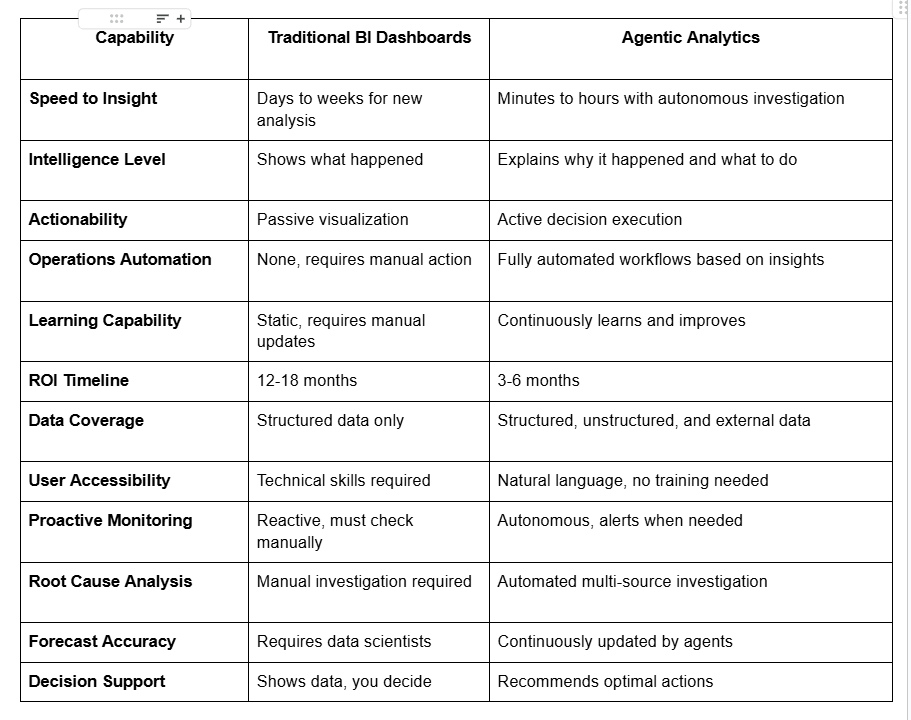
This comparison shows why traditional dashboards struggle to compete as BI dashboard alternatives. They simply operate at a different level of capability. What took dashboards days or weeks, agentic systems accomplish in minutes or hours.
How to Choose the Right BI Dashboard Alternative
Not every organization needs the same analytics solution. When evaluating BI dashboard alternatives, consider these factors:
Team Size and Structure: Smaller teams with limited analysts benefit enormously from autonomous systems that reduce manual workload. Larger enterprises with dedicated analytics teams gain strategic value by freeing analysts from routine questions to focus on complex problems.
Volume and Variety of Data: Organizations with massive data volumes or highly diverse data types need systems that can handle complexity. Agentic analytics excels when combining structured databases with unstructured documents and external sources.
Operational Complexity: Simple businesses with straightforward metrics might succeed with traditional dashboards. Complex operations with interdependent processes need intelligent systems that can understand relationships and coordinate responses.
Industry Requirements: Regulated industries need strong governance, audit trails, and compliance features. Agentic analytics platforms built for enterprise use provide these capabilities as core features.
Need for Automation: If your business requires fast automated responses to changing conditions, agentic analytics is essential. Traditional dashboards cannot execute actions autonomously.
Compliance and Security: Evaluate how potential BI dashboard alternatives handle data security, access control, and regulatory compliance. Enterprise grade agentic systems meet strict security standards.
Change Management Maturity: Implementing autonomous analytics requires some cultural adjustment. Organizations comfortable with AI driven automation will adopt faster than those preferring manual control.
Companies of all sizes are finding success with agentic analytics. According to data, 61% of organizations use four or more BI platforms, suggesting dissatisfaction with single platform approaches. Agentic analytics consolidates capabilities that previously required multiple tools.
Why Agentic Analytics Is Now Essential in 2026
The question is no longer whether to adopt better BI dashboard alternatives. The question is how quickly you can implement them before competitors gain an insurmountable advantage.
Competitive Pressure: Your competitors are moving to autonomous analytics. They are making decisions faster. They are catching opportunities earlier. They are preventing problems before they escalate. If you stay with traditional dashboards, the performance gap will compound over time until catching up becomes impossible.
Instant Decisions Required: Markets move too fast for manual analysis. By the time you investigate a trend, the window to act has closed. Customer preferences shift overnight. Competitors launch products without warning. Supply chains disrupt unexpectedly. You need systems that detect, analyze, and respond in real time.
AI Native Companies Pulling Ahead: A new generation of companies is being built with autonomous analytics from day one. They never experienced the dashboard era. They operate with the speed and intelligence that agentic systems provide. Traditional companies must adopt similar capabilities or accept competitive disadvantage.
Venture Capital Shift: Investment is flowing to automation first business models. Companies that demonstrate AI powered decision making attract higher valuations. Investors recognize that autonomous analytics creates sustainable competitive advantages that manual processes cannot match.
Enterprises Reallocating Budgets: Smart CFOs are cutting traditional BI budgets and redirecting funds to agentic analytics. Why pay for dashboards that underdeliver when superior BI dashboard alternatives exist? The budget shift is accelerating as early adopters prove value.
Data shows that organizations report average returns on investment of 171% from agentic AI deployments, with U.S. enterprises achieving around 192%. These returns make adoption not just advantageous but financially necessary.
The enterprises that will dominate in 2026 and beyond are not those with the prettiest dashboards. They are the organizations that turned analytics into autonomous intelligence. They are the companies that moved from looking at data to acting on insights automatically.
The Assistents.ai Platform: Your Complete Agentic Analytics Solution
If you are ready to move beyond traditional dashboards to true autonomous analytics, Assistents.ai provides the complete platform purpose-built for enterprise needs.
What Makes Assistents.ai Different?
Assistents.ai is not another BI tool with AI features bolted on. It is an agentic analytics platform built from the ground up to deliver autonomous intelligence at enterprise scale.
The platform uses multiple specialized AI agents that work together. Analytical agents continuously monitor your metrics and perform statistical analysis. Knowledge agents read through documents and extract relevant context. Workflow agents execute decisions based on findings. These agents coordinate seamlessly to provide comprehensive intelligence.
1. Complete Data Coverage
Unlike traditional BI dashboard alternatives that only handle structured data, Assistents.ai natively processes structured databases, unstructured documents, communications, and external market data. This means your analytics finally use 100% of available information instead of just 10%.
The analytical agents detect anomalies automatically and investigate root causes without being asked. They do not wait for you to notice a problem. They proactively monitor, analyze, and alert when human attention is needed.
The knowledge agents search through thousands of documents in seconds to find relevant context. They answer questions by pulling information that would take humans hours to locate manually.
2. Autonomous Decision Execution
The workflow engine executes governed actions based on your business rules. It triggers alerts, updates forecasts, initiates processes, and closes the loop from insight to action automatically.
The conversational interface lets you interact naturally with your data. Ask complex questions. Get detailed answers. Drill down into specifics. The system maintains context and handles multi turn conversations like talking to an expert analyst.
3. Enterprise Grade Capabilities
Assistents.ai includes comprehensive governance features. Role based access control ensures users only see data they are authorized to access. Detailed audit trails track every analysis and decision for compliance requirements. The semantic layer maintains consistent metric definitions across your organization.
The platform scales to handle massive data volumes and thousands of concurrent users. It integrates with your existing technology stack through pre built connectors for major enterprise systems and flexible APIs.
Security and compliance are built into every layer. The platform meets enterprise standards for data protection and regulatory compliance.
Get Started With Assistents.ai
Ready to move beyond static dashboards to autonomous analytics? Assistents.ai offers a personalized demo that shows exactly how agentic analytics works with your specific data and use cases.
Visit assistents.ai to schedule your demo and discover how you can implement the leading BI dashboard alternative that delivers 10 times faster insights and 171% average ROI.
The future of enterprise analytics is autonomous. The question is whether you will lead the transformation or struggle to keep up.
FAQs
1. Are BI dashboards still relevant in 2026?
Traditional BI dashboards remain useful for basic reporting and monitoring simple metrics. However, they are no longer sufficient as primary analytics tools for enterprises that need to compete in 2026. The limitations of static dashboards, including manual analysis requirements, inability to process unstructured data, and lack of autonomous action, make them inadequate for modern business demands.
2. What are the best BI dashboard alternatives for large enterprises?
For large enterprises, agentic analytics platforms represent the most comprehensive BI dashboard alternatives available in 2026. These systems provide autonomous monitoring, automated root cause analysis, predictive forecasting, and decision execution that traditional tools cannot match. When evaluating options, prioritize platforms that offer multi agent architectures for handling complexity, and enterprise-grade security. Assistents.ai leads this category by providing all these capabilities in a production ready platform designed specifically for enterprise deployment.
3. How does agentic analytics differ from traditional BI dashboards?
The fundamental difference is autonomy versus passivity. Traditional BI dashboards display information and wait for humans to interpret it, investigate issues, and take action. This manual process is slow and depends entirely on analyst availability and expertise. Agentic analytics operates autonomously with AI agents that continuously monitor data, detect patterns, investigate anomalies, and execute decisions without waiting for human direction.
4. Should enterprises replace dashboards completely or augment them?
The practical approach for most enterprises is gradual replacement rather than complete elimination overnight. Start by implementing agentic analytics for high value use cases where speed and automation deliver clear ROI, such as fraud detection, customer churn prevention, or supply chain optimization. Keep existing dashboards running for basic reporting while the agentic system proves value. As teams experience the superior capabilities of autonomous analytics, they naturally stop checking dashboards as frequently.
5. Is agentic analytics secure enough for large enterprises with sensitive data?
Enterprise grade agentic analytics platforms are designed specifically to meet strict security and compliance requirements. Platforms like Assistents.ai provide role based access control ensuring users only access data they are authorized to see, detailed audit trails tracking every analysis and decision for regulatory compliance, encryption for data in transit and at rest, compliance certifications for major standards including SOC 2, GDPR, and industry specific regulations, semantic layers that govern how data is interpreted.

Transform Your Business With Agentic Automation
Agentic automation is the rising star posied to overtake RPA and bring about a new wave of intelligent automation. Explore the core concepts of agentic automation, how it works, real-life examples and strategies for a successful implementation in this ebook.
Sarfraz Nawaz is the CEO and founder of Ampcome, which is at the forefront of Artificial Intelligence (AI) Development. Nawaz's passion for technology is matched by his commitment to creating solutions that drive real-world results. Under his leadership, Ampcome's team of talented engineers and developers craft innovative IT solutions that empower businesses to thrive in the ever-evolving technological landscape.Ampcome's success is a testament to Nawaz's dedication to excellence and his unwavering belief in the transformative power of technology.

More insights
Discover the latest trends, best practices, and expert opinions that can reshape your perspective







Contact us

