
AI Use Cases in Government: 25 Real Examples Across Agencies (2026)


AI use cases in government fall into six operating clusters: citizen services and case handling, documents and records, procurement and finance, infrastructure and utilities, revenue and compliance, and public health, education and workforce. The 25 examples below cover all six — but each one is described the way a public body actually has to buy it: what work it does, which systems it touches, what a person still decides, how much authority the software holds, and how you prove it worked.
That last part is where most government AI content stops and most government AI projects stall.
Key takeaways
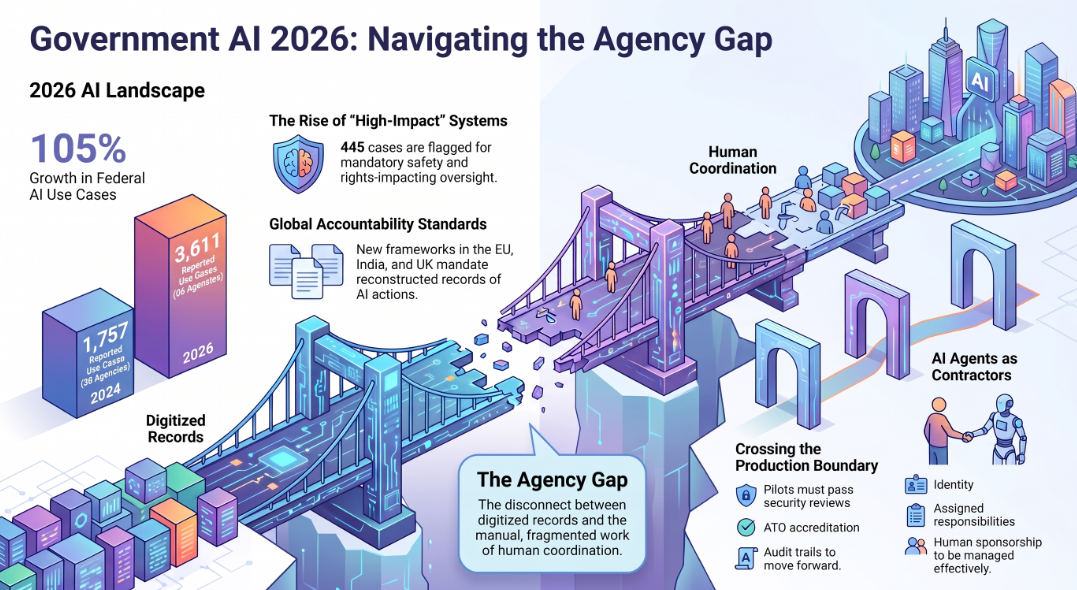
- The US federal government's 2025 AI Use Case Inventory documented 3,611 AI use cases across 56 submitting agencies — roughly double the 1,757 reported a year earlier. Adoption is no longer the question.
- Of those, 445 were classified as high-impact, triggering additional oversight requirements. The governance envelope is now part of the use case, not an afterthought.
- The highest-value government AI work in 2026 is not chat. It is durable, multi-step operational work — case handling, document adjudication, procurement coordination, infrastructure monitoring — that spans systems and takes days, not seconds.
- Every production use case needs four controls: a governed action path, compiled context rather than broad data access, bounded autonomy, and an outcome measure.
- Start with one contained, reversible, high-volume operation with a clear metric. Expand from proof, not from ambition.
The state of AI in government in 2026
Government AI adoption crossed from pilot to portfolio in the last eighteen months.
The Office of Management and Budget's 2025 Federal Agency AI Use Case Inventory, published in April 2026, consolidated 3,611 individual use cases across 56 submitting agencies — a 105% increase on the 1,757 reported for 2024. (Reporting counts vary slightly across secondary coverage; some outlets cite 41 agencies against the same repository. Treat the repository itself as authoritative.) Intelligence Community and Department of Defense use cases are exempt from reporting, so the real number is higher.
Within that inventory, 445 use cases were flagged as high-impact. That classification matters, because OMB Memorandum M-24-10 defines categories of safety-impacting and rights-impacting AI that must satisfy minimum practices before deployment, and M-25-21 (April 2025) directs agencies to accelerate lower-risk adoption while strengthening oversight of the rest and improving acquisition practices to avoid vendor lock-in.
The pattern repeats outside the US. The EU AI Act imposes logging and record-keeping obligations on high-risk systems. India's Digital Personal Data Protection framework creates an obligation to know exactly which personal data an automated system touched and why. The UK, Australia and the Gulf states each run their own accreditation pathway. Different acronyms, same requirement: if software acts on a citizen's behalf, you must be able to reconstruct what it did and why.
Why most government AI pilots stall before production
Public bodies are heavily digitised and still profoundly manual.
Records systems hold the state of the world — the permit, the invoice, the asset, the case file, the meter reading. Dashboards aggregate that state into metrics. What sits between a changing state and an improved outcome is work: someone has to notice, assemble the context, decide, coordinate across departments, chase an approval, act in three systems, and later verify that the intervention landed.
That work is what remains outside the systems. We call it the agency gap:
Government state is digitised. Government work is fragmented. Government accountability is human. Government improvement is coordinated by hand.
Traditional automation only covers the part of that work you can specify in advance. Workflow engines, rules and RPA are excellent when the path is known, inputs are structured and exceptions are rare. Government work is the opposite: it depends on documents, ambiguous language, evolving policy, cross-departmental reasoning and circumstances nobody anticipated.
Generative AI changed the economics because software can now interpret an objective, gather evidence, choose tools, revise a plan and explain itself. But that capability creates a new control problem. An agency running dozens of agents cannot manage them as a collection of prompts, chat sessions and shared API keys. Agents need identity, permitted data, assigned responsibilities, a human sponsor, escalation paths, limits and a performance record — the same things you would demand of a contractor.
Pilots stall at exactly that boundary. The demo works. The path to production runs through security review, ATO or equivalent accreditation, records management, procurement and audit — and the pilot has nothing to show any of them.
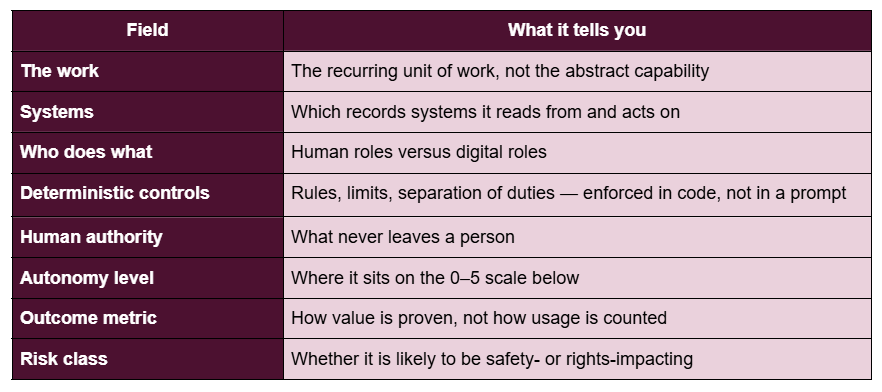
How to read this list: the operating-record format
Every use case below is described in the same eight fields. This is deliberate. A use case you cannot govern is not a use case; it is a slide.
Autonomy is an operating mode, not a switch
Nothing useful comes from agent.autonomous = true. Autonomy is a contract over work type, scope, action, value, time window and risk class. Agencies should adopt it as a progression:
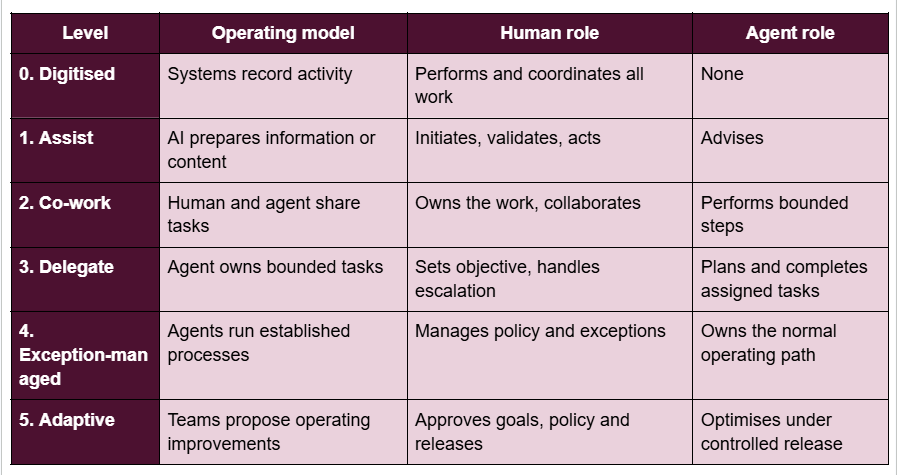
Almost all defensible government deployments in 2026 live at Levels 1 to 3. Level 4 is achievable for administrative and logistical operations with a clean audit trail. Level 5 is a design target, not a procurement requirement.
A practical autonomy contract looks like this:
agent: permit-intake-assistant
work_type: standard_completeness_check
scope:
permit_class: [residential_minor, signage]
value_band: below_statutory_threshold
permissions:
read_application: true
request_missing_document: true
create_followup_task: true
approve_permit: false
waive_requirement: false
limits:
contacts_per_applicant_per_week: 2
escalate_when:
- applicant_dispute
- policy_exception_detected
- confidence_below_0_85
valid_until: 2027-03-31
Note what that YAML makes impossible. The agent cannot approve. It cannot waive. It cannot widen its own authority. Those are not instructions in a prompt the model might reinterpret — they are enforced outside the model, before any action executes.
A note on the evidence below. Ampcome has delivered the deployments referenced across India, the Gulf, the UK, North America, Australia and East Africa. Clients are anonymised by sector and operation. Where a figure is an engineering target rather than a measured customer result, it is labelled as one. Four use cases at the end are drawn from public inventories and are clearly marked as market patterns rather than our deployments.
Cluster 1 — Citizen services and case handling
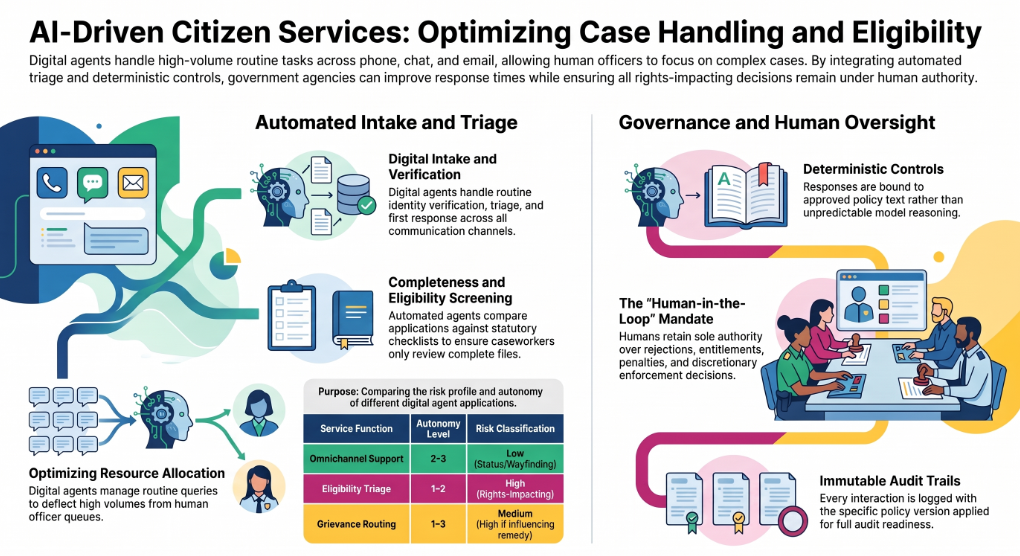
1. Omnichannel citizen service agent
The work. Intake, classification and resolution of routine citizen contact across phone, web chat, email and messaging — licence status, payment queries, appointment changes, "where is my application".
Systems. Case management, CRM or citizen relationship system, knowledge base, ticketing, telephony.
Who does what. A digital service agent handles intake, identity verification against existing records, triage and first response. Human officers take exceptions, vulnerable-citizen flags and anything contested.
Deterministic controls. Response templates bound to approved policy text. Identity verification as a gate, not a suggestion. Hard routing rules by query class. Every interaction logged with the policy version applied.
Human authority. Any decision affecting entitlement, penalty or enforcement.
Autonomy level. 2–3.
Outcome metric. First-contact resolution rate, average handling time, deflection from the officer queue, complaint rate.
Risk class. Rights-impacting if it touches eligibility. Not rights-impacting for pure status and wayfinding.
From delivery. We built an omnichannel support capability for a financial institution covering chat, email and phone with agent-assist summarisation, next-best-action prompts and full auditability — the outcome was faster case handling, more consistent responses and better audit readiness. Separately, we deployed a voice support agent operating in Hindi and English across a national retail network with several hundred sites, and a 24×7 service agent for a large property portfolio handling tenant queries, payment support and escalation to human teams. The architecture transfers directly to a citizen contact centre; the difference is the records system behind it and the statutory language in the knowledge base.
2. Application and eligibility triage
The work. Screening incoming applications — benefits, permits, licences, grants — for completeness, obvious ineligibility and document validity, so caseworkers spend their time on judgement rather than on chasing a missing pay slip.
Systems. Application portal, document store, identity and records systems, case management.
Who does what. A document agent extracts and validates. A completeness agent compares against the statutory checklist. A rules engine applies eligibility logic. A caseworker adjudicates.
Deterministic controls. Eligibility as versioned decision tables, never as model reasoning. Mandatory human review for every rejection. Extraction confidence thresholds that force human verification below a set score.
Human authority. Approval, rejection and any discretionary determination.
Autonomy level. 1–2. This is rights-impacting work; the agent prepares, a person decides.
Outcome metric. Backlog age, rework rate, proportion of applications complete on first submission, adjudication cycle time.
Risk class. Rights-impacting.
From delivery. For a healthcare staffing platform we built talent onboarding with credential capture, matching logic, and compliance workflows — structurally the same problem as benefits intake: verify a document, check it against a rule, route what does not fit. For a health testing provider we automated the booking → processing → reporting chain with status monitoring and automated notifications, which reduced missed handoffs and sped up citizen-facing communications.
3. Grievance and complaint routing with SLA enforcement
The work. Classifying incoming grievances, routing them to the accountable department, tracking the statutory response clock and escalating before a breach.
Systems. Grievance portal, departmental case systems, email, ticketing.
Who does what. A triage agent classifies and routes. A monitor agent watches the clock and escalates. Officers resolve.
Deterministic controls. SLA timers held in a durable workflow, not in model memory. Separation of duties — the department that caused the complaint cannot close it. Immutable escalation log.
Human authority. Resolution, remedy and any compensation.
Autonomy level. 3 for routing and escalation, 1 for resolution.
Outcome metric. SLA attainment, time-to-first-response, re-opened complaint rate, repeat-cause clusters.
Risk class. Generally not rights-impacting; becomes so if it influences remedy.
From delivery. In a multi-branch service operation we deployed ticketing integration with automated routing and tracking, producing measurably better SLA adherence and a consistent 24×7 response — the same mechanics an ombudsman function or a municipal grievance cell needs.
Cluster 2 — Documents, records and correspondence
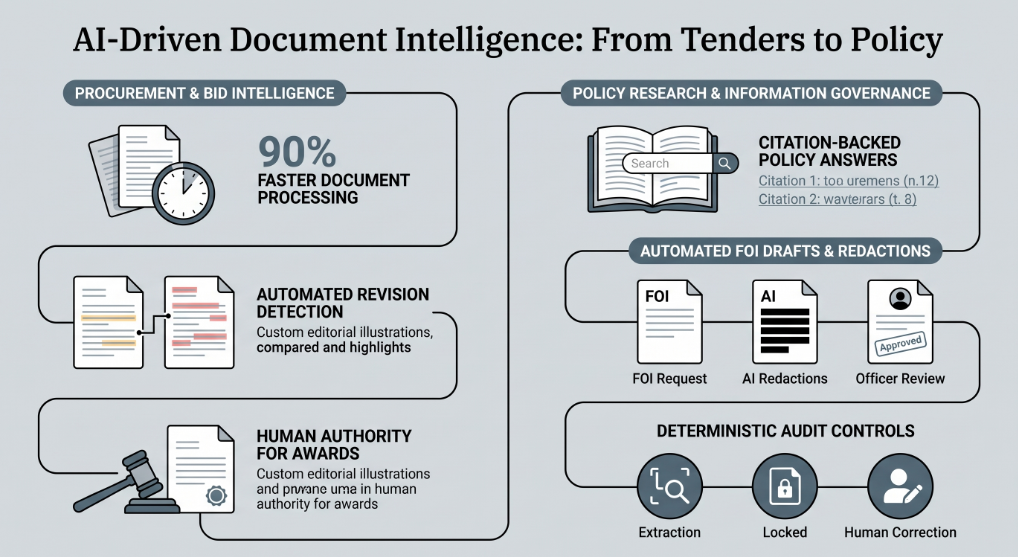
4. Tender and bid document intelligence
The work. Ingesting tender packs, addenda and bidder submissions; extracting requirements, deadlines, evaluation criteria and commercial terms; detecting what changed between revisions; assembling a compliance matrix.
Systems. e-procurement portal, document store, evaluation workbench, contract register.
Who does what. A retrieval agent monitors portals. An extraction agent reads complex PDFs including scanned drawings and tables. A revision agent diffs versions. Evaluators score.
Deterministic controls. Quote and version locking so an evaluated document cannot silently change. Full audit log of every extraction and every human correction. Mandatory dual review on disqualification.
Human authority. Scoring, qualification and award. Always.
Autonomy level. 2. Preparation and evidence assembly only.
Outcome metric. Tender turnaround time, extraction accuracy against human baseline, number of missed addenda, bid-risk incidents.
Risk class. Rights-impacting — procurement decisions are contestable.
From delivery. We built an intelligent document workbench for a construction and remediation specialist that ingests, analyses and synchronises complex tender documents into core operational systems using multi-agent orchestration and vision-LLM extraction, with deep two-way integration to the operational system, quote locking and audit logs. The system is engineered for up to ~90% faster tender document processing with a ~95% extraction accuracy target on standard formats — these are engineering targets, not audited customer results. The measured benefit the customer reported was reduced bid risk through revision detection and auditability.
This is, in our view, the single most transferable use case in this entire list for public procurement bodies. The document complexity, the revision problem and the audit requirement are identical.
5. Policy and regulation Q&A with citations
The work. Answering "what does the rule actually say" for officers, inspectors and the public — over statutes, circulars, standing orders, SOPs and precedent — with the source passage attached.
Systems. Document repositories, policy libraries, intranet, case precedent stores.
Who does what. A retrieval layer with permission-aware access. A drafting agent produces the answer and the citation. Officers apply judgement.
Deterministic controls. Permission-aware retrieval so the answer never spans documents the asker cannot see. Refusal when no supporting source exists — no answer without a citation. Version pinning so an answer references the policy in force on the relevant date.
Human authority. Any interpretation that becomes a determination.
Autonomy level. 1–2.
Outcome metric. Research time per query, citation accuracy on audit sample, consistency of answers across officers.
Risk class. Not usually rights-impacting in itself; becomes so if answers are treated as determinations.
From delivery. For a tax research automation product we built automated source collection, summarisation and draft memo generation with citations, plus workflow tracking and knowledge-base building. For a national retail operation we deployed a knowledge and training agent using retrieval over point-of-sale procedures and SOP documents, which cut onboarding time through on-demand guidance. Same pattern, different corpus.
6. Records classification and information-request drafting
The work. Classifying inbound correspondence and legacy records, applying retention and sensitivity labels, and drafting first-pass responses to freedom-of-information or right-to-information requests with redaction candidates flagged.
Systems. EDRMS, email archive, scanning pipeline, FOI/RTI case system.
Who does what. A classification agent labels. A redaction agent proposes. A records officer approves every release.
Deterministic controls. Retention rules as executable policy. Redaction as proposal-only, never applied automatically. Two-person rule on release. Complete decision record per document.
Human authority. Release, refusal and redaction. Without exception.
Autonomy level. 1. Preparation only. This is the use case where over-automation causes real harm.
Outcome metric. Statutory deadline compliance, officer hours per request, appeal and complaint rate.
Risk class. Rights-impacting.
Cluster 3 — Public procurement and finance operations
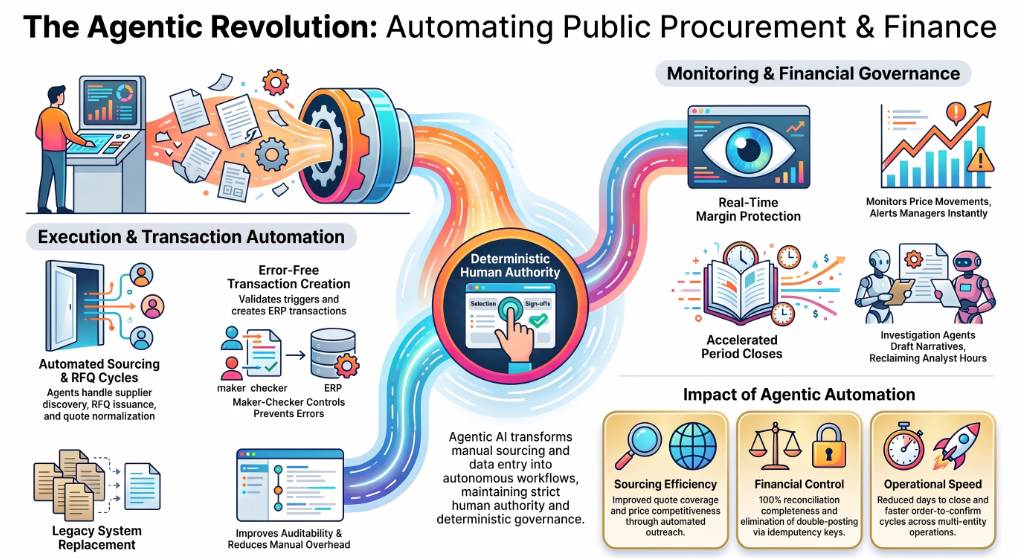
7. Supplier discovery and RFQ automation
The work. Turning a requirement into a sourcing event: finding qualified suppliers, generating and issuing RFQs, chasing non-responders, normalising quotations into a comparable grid.
Systems. Supplier master, e-procurement, email, ERP.
Who does what. A sourcing agent runs discovery and outreach. An extraction agent normalises quotes. Category managers evaluate.
Deterministic controls. Approved-supplier and category policy enforced by rules. Conflict-of-interest checks. Minimum-quotation thresholds. Communication logged and identical across bidders.
Human authority. Supplier selection and award.
Autonomy level. 3 for outreach and normalisation, 1 for selection.
Outcome metric. Sourcing cycle time, quote coverage per event, price and lead-time competitiveness, manual follow-up hours saved.
Risk class. Rights-impacting where public money is awarded.
From delivery. For a pharma sourcing and excipients platform managing thousands of SKUs we automated RFQs, supplier discovery and procurement decision support, plus quality and regulatory document handling and analytics on price, lead time and vendor performance. Reported outcomes: faster procurement cycles, less vendor coordination overhead and better price competitiveness through insight.
8. Procurement and finance KPI alerting across entities
The work. Continuous monitoring of purchase-price movement, margin impact, payment timing and vendor performance across departments or subsidiary entities — pushing exceptions to the accountable manager instead of waiting for a monthly review.
Systems. ERP, procurement, finance data warehouse.
Who does what. Watcher agents monitor defined thresholds and create work. An investigation agent assembles the explanation. Managers act.
Deterministic controls. Certified metric definitions in a semantic layer so "spend" and "vendor performance" mean one thing everywhere. Deduplicated alerts with validity windows. Role-scoped visibility.
Human authority. Any corrective commercial action.
Autonomy level. 3.
Outcome metric. Time from variance occurrence to detection, value of margin erosion caught early, alert precision.
Risk class. Not rights-impacting.
From delivery. For a large diversified group we built group-wide KPI standardisation with automated alerts covering purchase-price trend, gross-margin impact, early-payment analysis using notional finance cost, and vendor delivery and returns performance, delivered with scheduled insight packs for leadership. The reported outcomes were earlier detection of margin erosion and vendor slippage, and far fewer variance surprises. A department of finance running multiple agencies has the identical structural problem.
9. Transaction creation and reconciliation with audit evidence
The work. Interpreting an inbound trigger — an approved requisition, a signed agreement, a funded grant — validating it against policy and creating the corresponding ERP transaction, then reconciling what was created against what was intended.
Systems. ERP, document store, workflow engine, audit repository.
Who does what. A validation agent checks. A transaction agent creates through a governed capability. Finance staff approve and handle exceptions.
Deterministic controls. Maker-checker on every ERP write. Idempotency keys so a retry cannot double-post. Post-condition verification — the system confirms the record actually exists in the target state. Compensation path for failures.
Human authority. Approval above threshold; all exceptions.
Autonomy level. 3–4 for standard transactions inside value limits.
Outcome metric. Order-to-confirm cycle time, data-entry error rate, exception volume, reconciliation completeness.
Risk class. Not rights-impacting; high financial-control sensitivity.
From delivery. For a UAE engineering and technology group we automated SAP sales order creation using agentic AI — interpreting order triggers, validating them, creating the transaction, with rules and governance for exceptions and approvals, plus audit logs and reconciliation reporting. It replaced an end-of-life, high-licence-cost document capture system. Reported outcomes: sharply reduced manual order processing, a faster order-to-confirm cycle with fewer data-entry errors, and improved auditability.
10. Budget variance investigation and period close
The work. Explaining why a line moved, assembling the evidence, and coordinating the recurring close checklist across departments.
Systems. GL, budgeting system, warehouse, document store.
Who does what. Watcher agents detect variance. An investigation agent gathers drivers and drafts the narrative. Accountants review and sign.
Deterministic controls. Certified metric definitions. Point-in-time data snapshots so an explanation cannot be retroactively rewritten by later data. Sign-off gates per close stage.
Human authority. The financial statement. The sign-off.
Autonomy level. 2–3.
Outcome metric. Days to close, number of unexplained variances at cut-off, analyst hours reclaimed.
Risk class. Not rights-impacting.
From delivery. For a multinational logistics group we consolidated analytics across multi-entity global operations — standardising KPI definitions, building operational dashboards with variance explanations, and adding a data-quality and governance layer. The reported result was a single operational view across entities and materially faster leadership reporting.
Cluster 4 — Infrastructure, utilities and smart cities
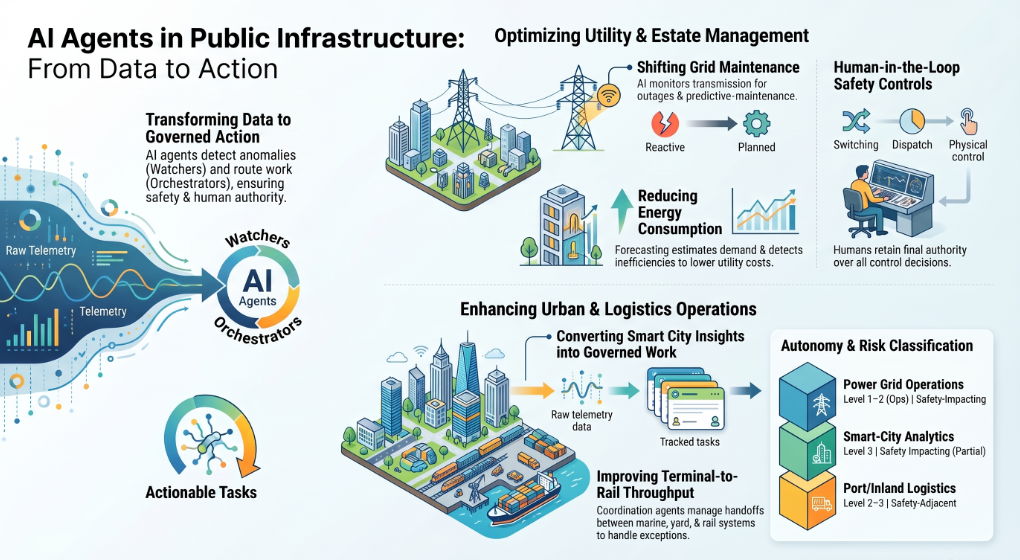
This cluster is where our public-sector evidence is deepest, and where government AI content is generally thinnest.
11. Transmission and grid operations monitoring
The work. Continuous monitoring of transmission performance, detection of anomalies, analysis of losses and outages, and generation of predictive-maintenance indicators for field crews.
Systems. SCADA and historian data, asset register, outage management, field workforce systems.
Who does what. Watcher agents monitor KPIs and detect anomalies. An analysis agent correlates and diagnoses. Control room engineers decide and dispatch.
Deterministic controls. Alert thresholds as versioned rules. Deduplication so one fault does not generate fifty work items. Read-only access to operational technology — no write path into control systems.
Human authority. Every switching, dispatch and safety-affecting decision. Non-negotiable.
Autonomy level. 1–2 in the operational domain, 3 for administrative coordination.
Outcome metric. Time-to-detect exceptions, outage duration, loss reduction, proportion of maintenance shifted from reactive to planned.
Risk class. Safety-impacting. Treat accordingly.
From delivery. We delivered transmission KPI monitoring with anomaly detection, loss and outage analytics, predictive-maintenance indicators, and dashboards with automated alerts for field operations to a state-owned electricity transmission utility. Reported outcomes: faster identification of grid exceptions and operational risk, improved reliability through proactive monitoring, and better operational transparency for leadership. This is a government-owned public utility, not a private analogue.
12. Smart-city operations: analytics that create work, not just charts
The work. Turning the telemetry flowing into a city operations centre into diagnosed situations with an owner, a deadline and a next action — rather than another wall of dashboards.
Systems. Sensor and IoT platforms, city command-centre systems, ticketing, departmental work systems.
Who does what. Watcher agents detect situations. An investigation agent establishes probable cause. An orchestration layer creates the work item and routes it. Department staff resolve.
Deterministic controls. Signals carry evidence, confidence, severity, affected assets and a deduplication key. Work creation is rate-limited so one cascading fault cannot flood the queue. Routing rules are explicit and versioned.
Human authority. Anything affecting public safety or service continuity.
Autonomy level. 3.
Outcome metric. Mean time to detect, mean time to assign, percentage of alerts that become closed work items, repeat-incident rate.
Risk class. Safety-impacting in parts.
From delivery. We built an agentic analytics and automated operational alerting layer on top of smart utility systems for a city-scale smart infrastructure operator running dozens of smart-city operation centres and connecting millions of assets and applications. Reported outcomes: higher operational visibility across operations, faster exception detection, and better response coordination. The important design point is that the value came from converting insight into governed, tracked work — not from adding another visualisation.
13. Public building and campus energy management
The work. Monitoring energy consumption across public estates, detecting inefficiency, forecasting demand and recommending optimisation.
Systems. BMS, meter data, sensor platforms, maintenance systems.
Who does what. Ingestion and anomaly detection run continuously. A forecasting service estimates demand. A recommendation agent proposes. Facilities teams implement.
Deterministic controls. Forecasting handled by a versioned, reproducible engine — never by free-text model reasoning. Recommendations are advisory; no automated control of building systems without explicit, separately governed authority.
Human authority. Any physical control action.
Autonomy level. 1–2.
Outcome metric. Consumption per square metre, cost per unit, number of inefficiencies detected and closed, forecast accuracy.
Risk class. Not rights-impacting.
From delivery. We delivered utility and sensor data ingestion with anomaly detection, forecasting and optimisation recommendations, dashboards and proactive alerting to a national astronomy research institute operating a campus-scale estate. Reported outcomes: improved energy visibility, faster detection of inefficiencies, reduced manual monitoring effort and more predictable operations through early alerts.
14. Port, terminal and inland logistics coordination
The work. Digitising terminal workflows and coordinating the handoff between marine, yard, rail and inland movement — with exception management when a link slips.
Systems. Terminal operating system, rail scheduling, customs and documentation systems, ERP.
Who does what. Coordination agents track state across systems and raise exceptions. Operations staff resolve and re-plan.
Deterministic controls. Every state change written through a governed capability with verification. Exception severity and escalation path defined in policy.
Human authority. Berth, yard and rail scheduling decisions.
Autonomy level. 2–3.
Outcome metric. Terminal-to-rail throughput predictability, dwell time, exception resolution time.
Risk class. Not rights-impacting; safety-adjacent.
From delivery. We built a terminal and rail management solution digitising port–inland logistics operations for a global ports and logistics operator, covering yard and rail operational dashboards, rail scheduling and visibility, exception management, and executive alerting. Reported outcomes: higher predictability of terminal-to-rail throughput and more efficient coordination across terminal and inland logistics. Port authorities, customs bodies and state logistics corporations run this operation directly.
Cluster 5 — Revenue, tax and regulatory compliance
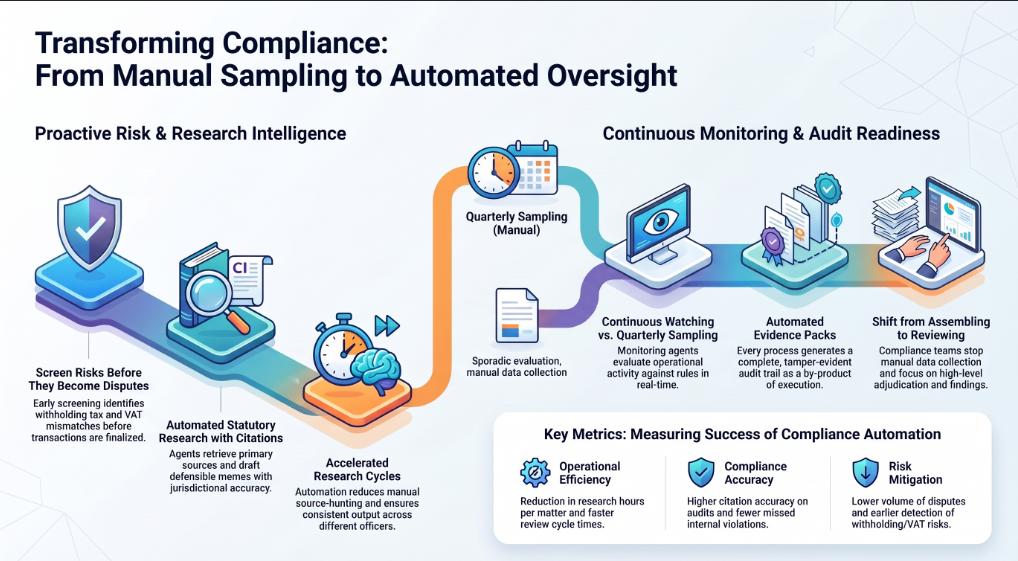
15. Transaction risk pre-screening
The work. Screening transactions early for risk indicators — withholding tax exposure, indirect-tax mismatches, permanent-establishment triggers — so problems surface before they become disputes.
Systems. ERP, transaction records, contract repository, tax rule sources.
Who does what. A screening agent classifies risk and collects supporting evidence with explainability notes. Specialists adjudicate.
Deterministic controls. Risk classification thresholds as rules. Mandatory escalation above a defined exposure. Evidence bundle attached to every classification.
Human authority. Any determination, assessment or demand.
Autonomy level. 1–2. Assessment authority never delegates.
Outcome metric. Risks identified pre-transaction versus post, dispute volume, review cycle time.
Risk class. Rights-impacting.
From delivery. For a cross-border tax technology product we built transaction screening workflows with risk classification, evidence collection with explainability notes, and an escalation workflow to tax experts. Reported outcomes: earlier detection of withholding and VAT risk, fewer last-minute disruptions and a faster, more consistent pre-compliance review.
16. Statutory research automation with citations
The work. Retrieving primary sources across jurisdictions, summarising the position and drafting a defensible memo with citations — for tax authorities, regulators and legal offices.
Systems. Statutory databases, internal precedent, document store.
Who does what. A research agent retrieves and summarises. A drafting agent produces the memo. A qualified officer signs.
Deterministic controls. No assertion without a retrievable source. Jurisdiction and effective-date pinning. Complete research trail preserved.
Human authority. The position taken.
Autonomy level. 1–2.
Outcome metric. Research hours per matter, citation accuracy on audit, consistency across officers.
Risk class. Rights-impacting where it informs determinations.
From delivery. For a sales-and-use-tax research automation product we built automated source retrieval, summarisation and drafting support with citations, plus workflow tracking. Reported outcomes: faster research cycles, less manual source-hunting and more consistent research output.
17. Continuous compliance monitoring and audit-trail generation
The work. Watching operational activity against policy continuously, rather than sampling it quarterly — and producing the evidence pack as a by-product of execution.
Systems. Case systems, ERP, access logs, policy repository, SIEM.
Who does what. Monitor agents evaluate activity against rules. An evidence agent compiles. Compliance officers judge.
Deterministic controls. Policy evaluated by a rules engine, not a model. Immutable, tamper-evident logs. Automatic escalation on violation. Export in the format the auditor actually wants.
Human authority. Every finding, sanction and disclosure.
Autonomy level. 3 for monitoring, 1 for findings.
Outcome metric. Time-to-detect violations, audit preparation hours, findings raised by external audit that internal monitoring missed.
Risk class. Rights-impacting where it affects individuals.
From delivery. Across regulated deployments we have consistently found that the durable value is not detection but evidence: every case processed generates a complete, automatically produced audit trail — policy version, inputs, rule applied, result, approver, timestamp. Compliance teams stop assembling evidence and start reviewing it.
Cluster 6 — Public health, education and workforce
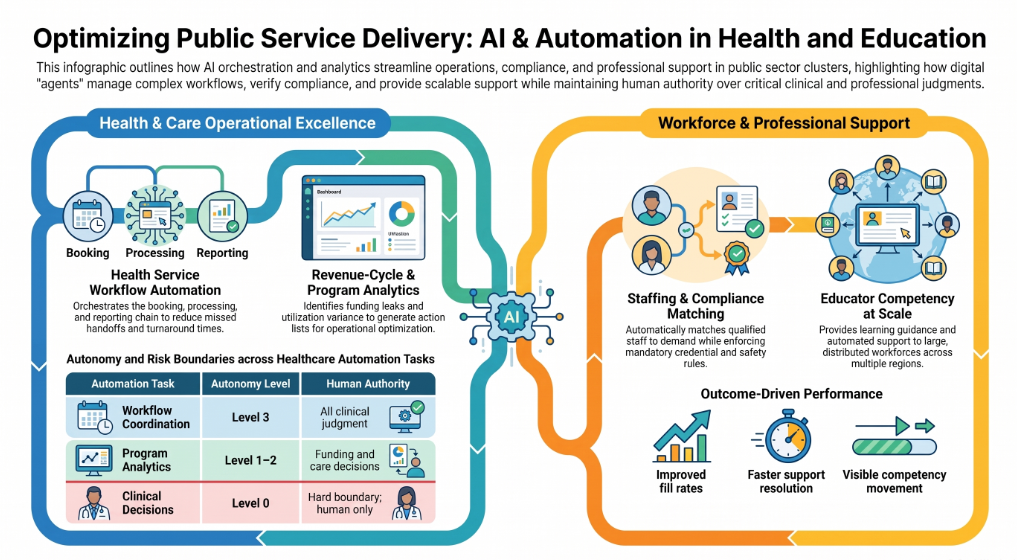
18. Health service workflow automation
The work. Orchestrating the booking → processing → reporting chain in public health delivery, with proactive status notifications.
Systems. Booking platform, laboratory or clinical systems, notification channels, reporting.
Who does what. Orchestration agents move the case through states and notify. Clinical staff perform the clinical work.
Deterministic controls. Durable workflow state that survives crashes and multi-day waits. Notification frequency limits. No clinical interpretation by agents.
Human authority. All clinical judgement.
Autonomy level. 3 for coordination, 0 for clinical decisions.
Outcome metric. Turnaround time, missed-handoff rate, citizen contact volume, no-show rate.
Risk class. Safety-impacting adjacency; keep the clinical boundary hard.
From delivery. For a private healthcare and testing provider with high-volume consumer workflows we automated the booking, processing and reporting chain with status monitoring, automated notifications and operational analytics. Reported outcomes: more scalable operations with less manual overhead, faster communications and fewer missed handoffs.
19. Care programme operations and revenue-cycle analytics
The work. Understanding where service performance and funding leak — utilisation, billing completeness, programme delivery variance — and generating action lists rather than reports.
Systems. Clinical or programme systems, billing, scheduling, finance.
Who does what. Analytics agents surface drivers with variance explanations. Programme managers act.
Deterministic controls. Certified metric definitions. Role-scoped access. No patient-level inference presented as clinical insight.
Human authority. Programme and funding decisions.
Autonomy level. 1–2.
Outcome metric. Revenue leakage identified and recovered, utilisation rate, time-to-decision.
Risk class. Rights-impacting where individual care is affected.
From delivery. For a physician-led clinical enterprise and an associated geriatric care provider we built revenue and utilisation analytics, performance dashboards with variance explanations, and action lists for billing and operational optimisation. Reported outcomes: better visibility into revenue-leakage drivers, faster operational decision-making and improved transparency into service performance.
20. Workforce staffing, credentialing and compliance matching
The work. Matching qualified staff to service demand while enforcing credential validity and compliance rules — the core problem of any public workforce that rosters against shifting demand.
Systems. HR and credentialing systems, rostering, compliance register, notifications.
Who does what. A matching agent proposes assignments. A compliance agent verifies credentials. Managers confirm.
Deterministic controls. Credential expiry as a hard block. Working-time and safety rules enforced by policy. Assignment audit trail.
Human authority. Final assignment where safety or entitlement is affected.
Autonomy level. 3 within credential and rule boundaries.
Outcome metric. Fill rate, time-to-fill, credential lapse incidents, utilisation.
Risk class. Rights-impacting for workers.
From delivery. For a healthcare staffing platform we built talent onboarding with credential capture, facility staffing request intake and matching logic, scheduling, notifications and compliance workflows, plus fill-rate and utilisation reporting. Reported outcomes: faster fill cycles, lower scheduling friction, better workforce utilisation and improved responsiveness for facilities.
21. Educator competency insight and support at population scale
The work. Giving a large distributed professional workforce — teachers, health workers, extension officers — competency insight, learning guidance and always-available support.
Systems. Learning platform, competency framework, support channels, programme analytics.
Who does what. A support agent answers programme and learning queries. An insight service maps competency. Programme operators design interventions.
Deterministic controls. Competency scoring through a versioned, explainable model. Individual-level results restricted by role. No automated professional consequence from a score.
Human authority. Any assessment with career consequence.
Autonomy level. 2.
Outcome metric. Support resolution rate, engagement, competency movement over cohorts, programme cost per participant.
Risk class. Rights-impacting if used in evaluation.
From delivery. For a global teacher community and learning platform serving well over a million educators across more than 130 countries we built competency insights, learning guidance and automated support workflows. Reported outcomes: scalable support for a very large educator community, faster access to guidance and better visibility into engagement and outcomes. A ministry of education running in-service training at state or national scale faces precisely this shape of problem.
Four more use cases agencies are deploying
These four appear in almost every government AI inventory and belong in any honest list. Ampcome has not delivered in these categories — we are describing the public record, not our work.
22. Public safety and law enforcement support. Digital evidence processing, case-file assembly, video and document triage. Jurisdictions have deployed evidence-management AI to reduce case delay. This category carries the heaviest civil-liberties risk in the entire list; predictive policing in particular has a documented record of encoding historical bias. If you deploy here, treat it as rights-impacting by default and build contestability in from day one.
23. Emergency management and disaster response. Resource pre-positioning, risk forecasting and response coordination. Federal agencies have deployed decision-support tools combining predictive analytics with generative summarisation to guide crew and equipment staging ahead of wildfire risk. Safety-impacting; human command authority must remain explicit.
24. Traffic and transport management. Signal optimisation, incident detection, demand forecasting. Local-government leaders consistently rank traffic and transportation as the area with the greatest AI potential in surveys of municipal priorities.
25. Benefit and tax fraud detection. Anomaly detection across claims and returns to prioritise investigation. High value, high risk — a false positive here is a citizen wrongly denied. Never automate the adverse decision; automate the prioritisation of human review, and measure false-positive rate as a first-class metric, not a footnote.
Why most of these fail — and the four controls that stop it
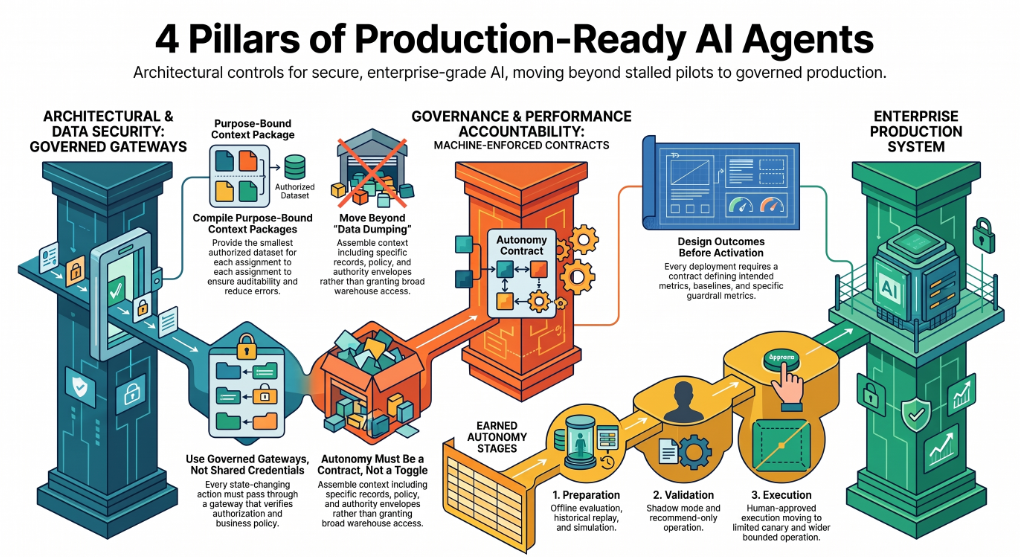
Across everything above, the same four design decisions separate a production system from a stalled pilot.
Actions must run through a governed gateway, not a shared credential
The most common failure in enterprise and government AI is an agent holding a service account with broad write permissions into a records system. It works in the demo and is indefensible in a security review.
The correct pattern: every state-changing action passes through a gateway that authenticates the actor, verifies the work purpose, evaluates technical authorisation, evaluates business policy, checks required approval and separation of duties, enforces limits, executes with an idempotency key, verifies the external state actually changed, records a receipt, and triggers compensation or escalation on failure.
A model may propose an action. Only the gateway may authorise and execute it. No agent should hold shared ERP credentials or an ungoverned write path.
Context must be compiled, not dumped
Giving an agent broad access to a data warehouse and letting it decide what it needs increases cost, leakage risk and reasoning error simultaneously.
Instead, assemble a purpose-bound context package for each assignment: the objective, the affected records, the process stage and deadline, the certified metrics, the relevant policy and documents, similar historical cases, the permitted capabilities and the authority envelope — filtered by tenant isolation, role permissions, row and field restrictions, purpose limitation, temporal consistency and retention rules. The model receives the smallest authorised set, with provenance attached.
This is also what makes an answer reproducible six months later during an audit. You can show exactly what the system knew at the moment it acted, rather than what the database says today.
Autonomy must be a contract, not a toggle
Covered above, but worth restating as a procurement requirement: ask any vendor to show you how autonomy is expressed. If the answer is a configuration checkbox or a paragraph in a system prompt, the control does not exist. If the answer is a versioned, machine-enforced envelope with scope, value limits, escalation triggers and an expiry date, it does.
Autonomy should also be earned through a sequence: offline evaluation, historical replay, simulation, shadow mode, recommend-only, human-approved execution, limited canary, wider bounded operation, continuous monitoring with rollback.
Outcomes must be designed in, not reported after
Human acceptance of a recommendation is a behavioural signal, not proof of value. Every deployment should carry an outcome contract before it activates: the intended outcome and metric, the baseline, the observation window, the guardrail metrics that must not degrade, the attribution method, and the accountable owner.
For a citizen service agent, the guardrail is complaint rate. For fraud detection, it is false-positive rate. For a permit assistant, it is appeal volume. If a deployment improves its primary metric and degrades its guardrail, it has not worked.
Relevant standards to anchor this against: the NIST AI Risk Management Framework and its Generative AI Profile, OWASP's agentic AI security risks (goal hijacking, tool misuse, privilege abuse, memory poisoning, cascading failures, rogue agents), and EU AI Act record-keeping obligations for high-risk systems.
Why assistents.ai: what the platform actually does today
assistents.ai is Ampcome's enterprise agentic intelligence platform — a governed context, decisioning and action layer that sits above the systems an agency already runs, rather than replacing any of them.
Because public-sector buyers are entitled to know what ships versus what is planned, here is the honest capability map. Items marked Roadmap are strategic platform additions from our internal architecture programme and are not currently shipped functionality.
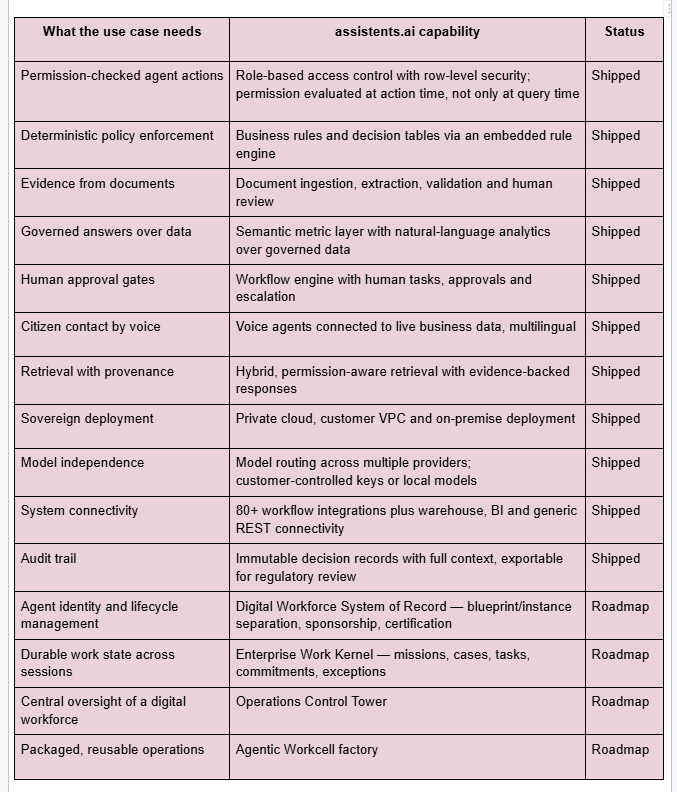
On assurance posture: the platform is presented as SOC 2 Type II certified, GDPR compliant, HIPAA capable and ISO 27001 aligned. Those distinctions are deliberate and we keep them — ask us for the current report references during procurement rather than relying on a badge.
You can review the control model in detail on the agent governance page.
Why assistents.ai is the right platform for public sector deployment
Seven reasons that matter specifically to a government buyer.
1. It deploys where public data has to stay. Private cloud, customer VPC or fully on-premise, with customer-managed keys and restricted-network modes. Many agencies cannot move citizen, operational or infrastructure data into a public SaaS tenancy, and no amount of capability compensates for a deployment model that fails the security review.
2. Governance is the architecture, not a module. Permission checks happen on every operation at action time. Policy violations are blocked and flagged before execution. This is not a compliance feature bolted on after the agent was built; it is the path every action takes.
3. It is model-neutral. Route across providers, bring your own keys, or run local models. OMB guidance explicitly directs agencies to improve acquisition practices to avoid vendor lock-in. A platform that is a thin wrapper over one model vendor is a lock-in risk wearing a different label.
4. Deterministic where it must be, adaptive where it helps. Eligibility, limits, authority and routing run through a versioned rule engine. Agents handle interpretation, evidence assembly and coordination — the parts that genuinely cannot be pre-specified. This split is what makes an agency deployment defensible.
5. Audit evidence is a by-product of execution. Every action produces a record: who asked, under what authority, with what context, which policy applied, what changed, who approved. Compliance stops being a documentation project run alongside the system and becomes an output of the system.
6. Proven in regulated, infrastructure-heavy operating environments. State-owned utility operations, city-scale infrastructure monitoring, national research estate management, port and inland logistics, public-health service delivery, multi-entity finance and procurement control, and tender document adjudication — delivered across India, the Gulf, the UK, North America, Australia and East Africa.
7. It lands as one measurable operation, not a multi-year programme. Start with a contained use case using capabilities that ship today — governed analytics, document processing, a voice or email agent, a case application, workflow automation, operational monitoring. Prove quality, time saved, rework and business impact. Then add adjacent work, roles, context and controlled action around the same operation. Expand from evidence.
Request a demo or review the security and trust documentation.
How to choose your first government AI use case
Score candidate use cases against six criteria. Take the highest total, not the most exciting.
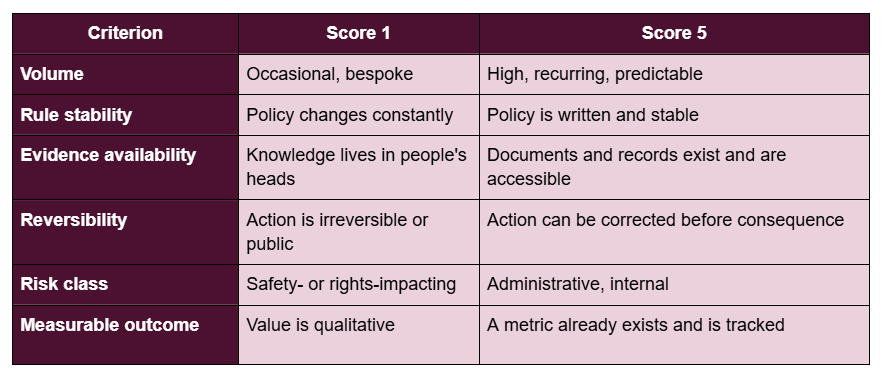
A first deployment scoring 24 or above will almost always reach production. Below 18, expect an eighteen-month pilot with no owner.
Two practical rules. First, prefer operations where the agent prepares and a person decides — you get most of the time saving with a fraction of the risk. Second, never make your first deployment the one your minister will be asked about in the legislature.
Where this goes next
The 25 use cases above are individually valuable and collectively fragmented. That is where most agencies are: a chatbot here, a document tool there, a monitoring dashboard somewhere else, each with its own credentials, its own context and its own audit gap.
The direction of travel is to run them as a governed operating layer instead. One identity model. One context layer. One action gateway. One place where a manager can see which agents exist, who owns them, what work they are doing, what they were denied, what they cost and what value they produced. That is the difference between a portfolio of AI tools and an accountable operation.
The operating philosophy we recommend to every public-sector client is short enough to put on a slide and strict enough to survive an audit:
Human-led strategy. Human-owned accountability. Agent-operated processes. Exception-managed control. Outcome-driven improvement.
Start with one operation. Prove it. Then expand the controls, not just the capability.
Ampcome is the technology company behind assistents.ai, its proprietary enterprise agentic intelligence platform. Client deployments referenced in this article are anonymised by sector and geography. Outcomes are as reported by the customer; where a figure is an engineering target rather than a measured result, it is labelled as such.
Talk to us about a government AI deployment →
FAQs
What are the main AI use cases in government?
The main AI use cases in government are citizen service and case handling, document and records processing, procurement and finance operations, infrastructure and utility monitoring, revenue and compliance screening, and public health, education and workforce operations. Document-heavy and monitoring-heavy work produces the fastest measurable return.
How is AI used in local and state government?
State and local agencies use AI for citizen contact centres, permit and licence processing, grievance routing, utility and grid monitoring, smart-city operations, energy management across public estates, procurement, and fraud prioritisation. Local government leaders consistently rank traffic and transportation, infrastructure and public safety as the highest-potential areas.
What is a high-impact or rights-impacting AI use case?
Under US OMB guidance, safety-impacting AI affects human safety or critical infrastructure, and rights-impacting AI affects civil rights, civil liberties, access to benefits or equal opportunity. Both categories require minimum practices before deployment, including pre-deployment testing, impact assessment, ongoing monitoring and a human appeal route. In the 2025 federal inventory, 445 use cases were flagged as high-impact.
What is agentic AI in government, and how is it different from a chatbot?
A chatbot answers a question and stops. An agentic system is assigned a piece of work, gathers evidence across systems, uses tools, coordinates with other agents and people, waits for events, and carries responsibility for an outcome over hours or days. The practical difference is that agentic systems take actions, which is why they require identity, permissions, limits and audit that a chatbot does not.
Can government agencies run AI on-premise or in a sovereign environment?
Yes. Platforms including assistents.ai support private cloud, customer VPC and fully on-premise deployment with customer-controlled model keys or local models, tenant isolation, customer-managed encryption keys and audit export to the agency's own security tooling. For classified, air-gapped or data-residency-constrained environments, this is usually a precondition rather than a preference.
What are the biggest risks of AI in government?
The main risks are bias encoded from historical data, inability to explain or contest a decision, ungoverned action paths where software writes to records systems without authorisation, data leakage through over-broad context access, and claiming benefit without measuring it. Each maps to a specific control: representative evaluation, decision records with contestability, an action gateway, a context compiler, and an outcome contract.
How do agencies prove an AI system is actually working?
Define the outcome contract before activation: the primary metric, a baseline or counterfactual, an observation window, guardrail metrics that must not degrade, an attribution method and an accountable owner. Usage, adoption and user satisfaction are secondary. If the guardrail degrades, the deployment has not worked regardless of the headline number.
Which AI use case should a government agency start with?
Start with high-volume, document-heavy, reversible internal work with an existing metric — tender or application document processing, policy research, or operational monitoring and alerting. Avoid making a rights-impacting adjudication your first deployment. Prove the control model on something administrative, then extend the same controls to consequential work.

Transform Your Business With Agentic Automation
Agentic automation is the rising star posied to overtake RPA and bring about a new wave of intelligent automation. Explore the core concepts of agentic automation, how it works, real-life examples and strategies for a successful implementation in this ebook.
Sarfraz Nawaz is the CEO and founder of Ampcome, which is at the forefront of Artificial Intelligence (AI) Development. Nawaz's passion for technology is matched by his commitment to creating solutions that drive real-world results. Under his leadership, Ampcome's team of talented engineers and developers craft innovative IT solutions that empower businesses to thrive in the ever-evolving technological landscape.Ampcome's success is a testament to Nawaz's dedication to excellence and his unwavering belief in the transformative power of technology.

More insights
Discover the latest trends, best practices, and expert opinions that can reshape your perspective


.jpg)




Contact us

